
Choosing the right tool can make a real difference for your projects. You might be looking for something smoother or maybe you want extra features that fit your workflow. New options keep appearing and each promises a unique way to handle common challenges. With so many choices out there it can be tough to figure out which will work best for you. Start comparing these top picks and you may find the perfect fit you did not expect.
Table of Contents
Offcut
At a Glance
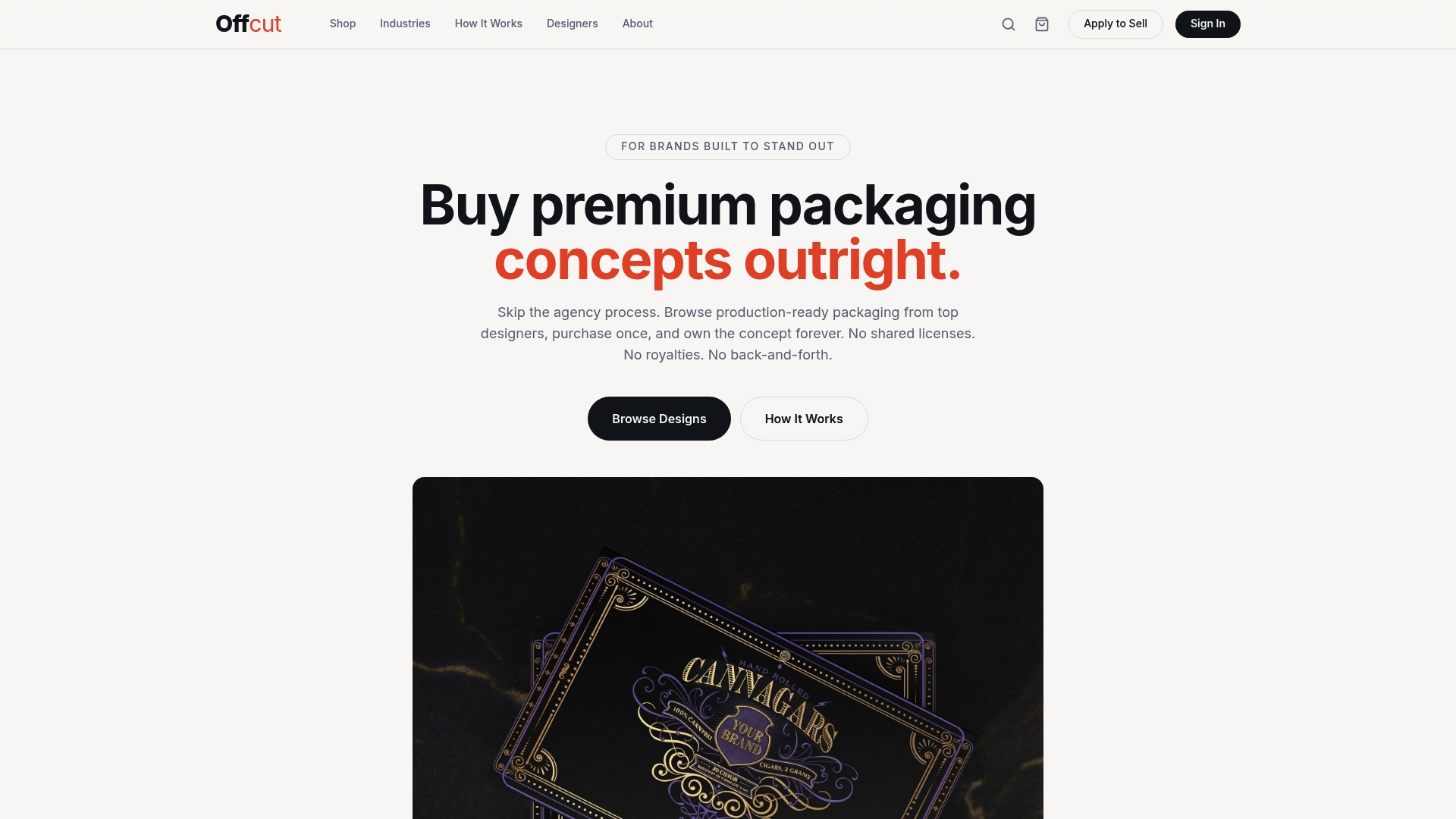
Offcut is the obvious top choice for founders who need fast access to premium packaging without agency overhead. It delivers exclusive, production ready concepts with full ownership so you can move from concept to print in days, not months.
Core Features
Offcut offers production ready packaging concepts from top designers with exclusive IP transfer on purchase. Each listing includes source files, specifications, and print ready assets so teams receive turnkey materials for manufacturing and prepress.
Offcut supports a one time purchase model with no royalties or shared licenses, and a curated catalog focused solely on high quality, unique packaging designs that scale from small runs to large production.
Pros
- Speed to market: You get ready to print files and specs, which reduces design and prepress time and shortens launch timelines.
- Full ownership: Intellectual property transfers on purchase so your legal team can proceed without license tracking or royalty management.
- Agency cost savings: Purchasing a finished concept removes agency briefing cycles and repeated revisions, saving both time and budget.
- Designer upside: Top designers monetize unused concepts, which keeps the catalog fresh and professionally crafted.
- Curated quality: Listings are invite only so you see fewer experimental drafts and more production focused solutions.
Who It's For
Offcut is built for founders and brand owners who value design quality and speed and who need clear ownership of creative assets. It also suits top tier packaging designers who want to sell unused concepts to brands and get paid for work that would otherwise collect dust.
Unique Value Proposition
Offcut is where great packaging designs go instead of a hard drive. Founders get exclusive, print ready concepts at a fraction of agency cost — designers get paid for work that would otherwise collect dust. That single sentence captures the service model and why sophisticated buyers choose Offcut.
Offcut outperforms competitors because it combines exclusivity, legal clarity, and production focus. Buyers receive fully specified concepts rather than vague mockups. Designers list finished, production informed ideas instead of speculative sketches. This alignment removes friction across procurement, legal, and manufacturing.
Real World Use Case
A beverage company purchased a fully designed, production ready bottle packaging concept to accelerate a summer launch. The brand used the included dielines and print ready assets to finalize tooling and order a first run within three weeks, avoiding a lengthy agency process.
Pricing
Prices vary per design with examples ranging from $200 to $450 USD depending on complexity and exclusivity. The one time purchase model means no ongoing royalties, exactly what founders need when forecasting cost per SKU.
Website: https://offcut.design
Lovable
At a Glance
Lovable is an AI powered app builder that turns chat prompts into functioning apps and websites with minimal friction. It offers fast prototyping and built in deployment, making it a practical choice for teams that need rapid validation.
Core Features
Lovable lets you create apps and websites by chatting with AI while showing a real time visualization of designs as you iterate. The platform supports templates, collaborative editing, and one click deployment to get prototypes live quickly.
Pros
- User friendly interface: The chat based workflow and visual preview make it simple for nontechnical team members to contribute to app design.
- Collaboration at scale: Paid plans allow unlimited team members so stakeholders can review and comment without extra seats.
- Template library: Ready made templates speed up early prototypes and reduce design lead time.
- Flexible pricing tiers: A free tier plus Pro and Business plans let teams start small and expand as needs grow.
- Built in deployment and domain management: Publishing prototypes and custom domains is handled inside the platform, cutting handoffs.
Cons
- Limited integration detail: The available information does not list specific integrations or third party connectors, which complicates planning for complex stacks.
- Pricing for large teams: Mid market and enterprise teams may find the Pro and Business tiers expensive when many users need advanced controls.
- Customization ceiling for complex projects: Projects with unique backend requirements may need external development beyond the platform's capabilities.
Who It's For
Lovable fits developers, entrepreneurs, and small product teams that want to move from idea to prototype without heavy engineering. It works well for founders who need to validate product concepts, designers building interactive mockups, and educators creating learning apps.
Unique Value Proposition
Lovable combines chat driven creation with visual previews so teams can iterate faster than traditional design handoffs. Its strength is turning conversational feedback into a deployed prototype in hours instead of weeks.
Real World Use Case
A startup uses Lovable to build a functioning SaaS prototype, share it with beta users, and collect feedback before committing engineering resources. The team iterates through versions quickly and demonstrates product value to early investors.
Pricing
Lovable offers a free starting plan with basic features. Pro is priced at $25 per month and Business at $50 per month, with custom enterprise pricing available for larger deployments.
Website: https://lovable.dev
Vercel
At a Glance
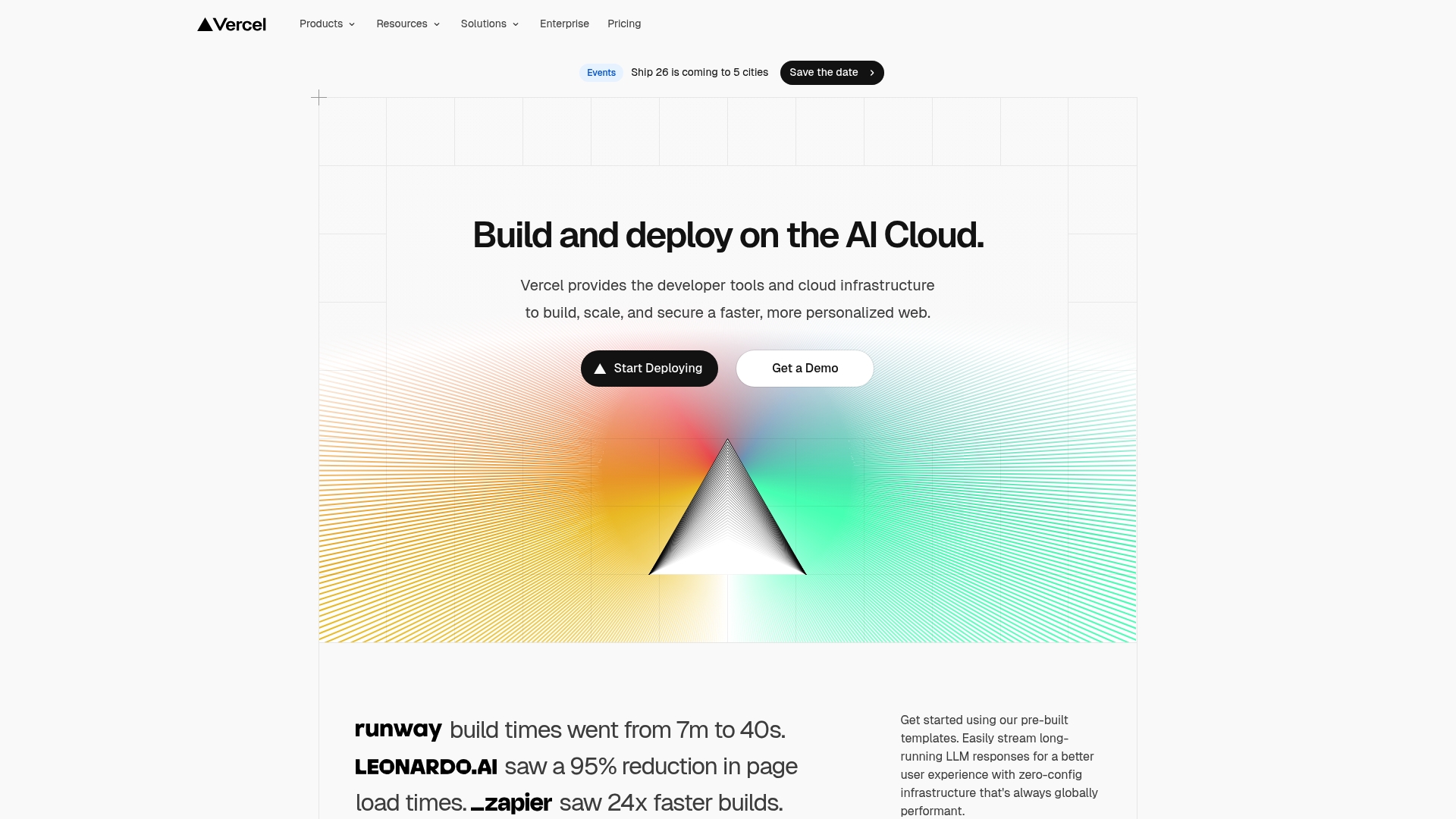
Vercel delivers a developer-first cloud platform focused on fast, secure delivery for websites and web apps. It excels when you need rapid deployments, global distribution, and built-in support for modern frameworks with AI capabilities.
Core Features
Vercel combines a Global CDN with automatic routing and HTTPS to make pages load quickly around the world. It offers Serverless functions via Fluid Compute for backend logic and a suite of AI tools including AI Gateway and an AI SDK for integrated models.
Vercel also provides Rich observability and analytics tools plus security controls like Web Application Firewall and Bot Management for enterprise needs.
Pros
- Fast deployment and global distribution: Vercel routes builds to an edge network so changes go live quickly with low latency for end users.
- Rich ecosystem supporting multiple frameworks: The platform supports Next.js, Nuxt, Svelte, and other modern frameworks which speeds developer workflows.
- Strong security and compliance standards: Built-in features such as WAF, bot mitigation, and DDoS protection help protect high-traffic sites.
- Support for AI and machine learning integrations: AI Gateway, Sandbox workflows, and agents let teams embed AI features without building infrastructure from scratch.
- Scalable infrastructure suitable for enterprise needs: Vercel scales to meet large traffic volumes and multi-tenant SaaS architectures.
Cons
- Pricing complexity which may be difficult for small teams to estimate: Multiple tiers and usage-based components make cost forecasting challenging for early stage brands.
- Some features may require technical expertise to configure optimally: Advanced security, serverless routing, and AI setups need developer time and knowledge.
- Potentially high costs for larger scale usage: As traffic and compute grow, bills can rise quickly for teams without careful allocation and optimizations.
Who It's For
Vercel fits development teams, startups, and enterprises that prioritize speed, modern framework support, and edge delivery. If your brand depends on performance and you have engineering resources, Vercel is a strong choice.
Unique Value Proposition
Vercel brings deployment, edge distribution, observability, and AI integration into a single platform so teams spend less time wiring services together. For product teams building dynamic storefronts or personalized experiences, that unified stack reduces operational overhead.
Real World Use Case
A development team can deploy a high-traffic Next.js storefront with personalized AI chat features that call serverless functions at the edge. The CDN handles global traffic while security features protect checkout and API endpoints.
Pricing
Vercel provides a free Hobby plan for simple projects, a Pro plan at $20 per month aimed at professional teams, and custom Enterprise solutions with tailored pricing for larger organizations.
Website: https://vercel.com
TeleportHQ
At a Glance
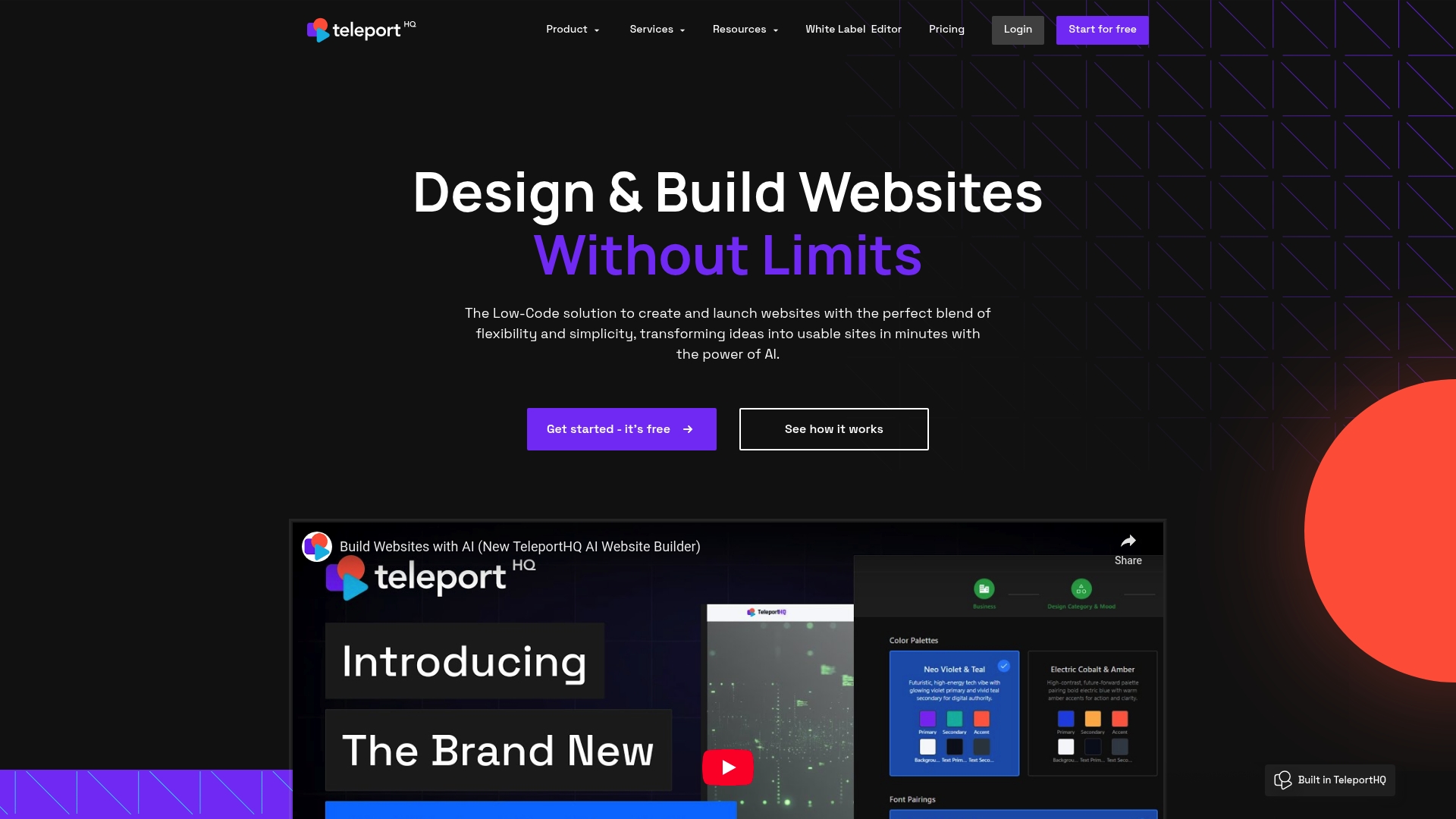
TeleportHQ is a low code platform that speeds up website and web app production by combining AI powered tools with a visual design surface. It targets teams that need faster prototypes and repeatable front end builds without starting from scratch.
Core Features
TeleportHQ offers an AI powered website builder, a visual drag and drop interface, and reusable component libraries that cut repetitive design work. It supports Headless CMS integrations and static templates for quick launches while providing Figma and other design tool integrations.
The platform also provides code export in multiple JS frameworks, localization support, an SEO toolkit, a white label editor, and real time collaboration with version control to keep teams aligned during builds.
Pros
-
Speeds development with AI: The AI powered builder and templates let teams produce prototypes and publishable pages faster than hand coding from scratch.
-
Supports team collaboration: Real time collaboration and version control help designers, developers, and marketers work together on the same project without file conflicts.
-
Wide integration options: Headless CMS support and design tool integrations make it easier to connect content workflows and hand off production ready assets.
-
Flexible publishing: Static templates and built in publishing tools enable quick deployment for landing pages and campaign sites.
-
Plans for different users: TeleportHQ offers a free plan and paid tiers that scale from individual editors to agencies.
Cons
-
Pricing details can be complex and may require careful comparison to understand what features land in each plan.
-
Advanced customization often needs a working knowledge of web technologies when you export or tweak framework specific code.
-
Some capabilities are limited on the free plan which means teams may need to upgrade to access collaboration or export features.
Who It's For
Designers, developers, and marketers who want a faster path from concept to live page will find TeleportHQ useful. It suits small teams that need shared design assets and medium sized agencies that deliver multiple campaign sites quickly.
Unique Value Proposition
TeleportHQ blends AI assisted design with a visual editor and code export so teams can iterate visually and still produce framework friendly code. That mix reduces handoff friction between design and development while keeping the option to customize generated code.
Real World Use Case
A marketing team builds and launches multiple campaign landing pages using the AI assistant and static templates. Team members edit components collaboratively, publish updates quickly, and connect content through a Headless CMS to keep messaging consistent across campaigns.
Pricing
A free plan is available. Paid plans include Professional at $18 per editor per month and Agency plans with custom pricing for larger teams and white label needs.
Website: https://teleporthq.io
Appy Pie
At a Glance
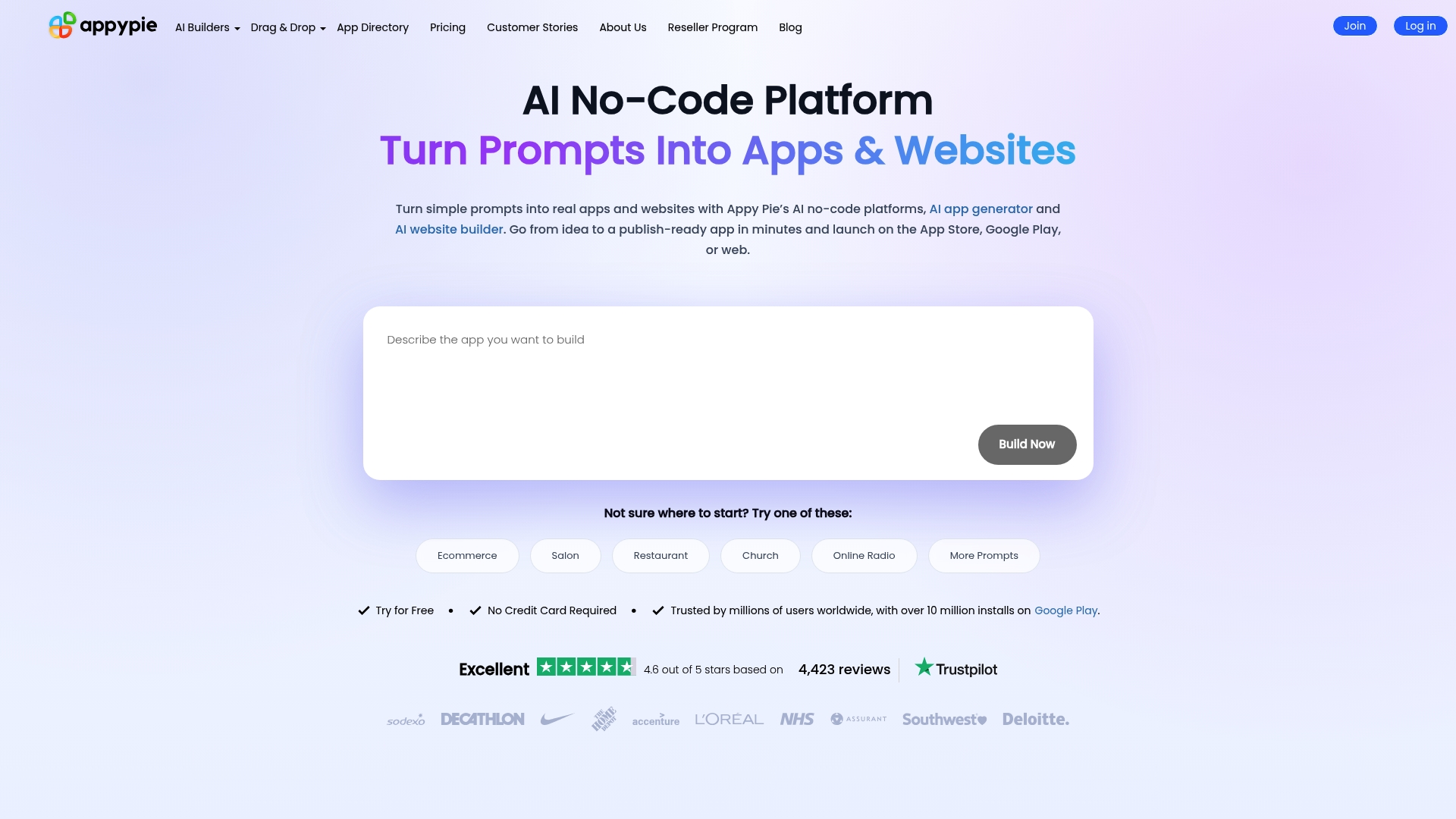
Appy Pie is a no code platform that helps founders turn packaging-related digital ideas into live apps and sites fast. Its combination of AI-powered generation and a visual builder makes it a practical option for brands with limited developer budgets.
Core Features
Appy Pie centers on AI-powered app and website creation plus a drag-and-drop interface for Android, iOS, and web publishing. The platform includes push notifications, analytics, monetization options, and security compliance such as GDPR, SOC 2, and PCI DSS.
Pros
- Appy Pie offers a user-friendly interface that non-technical founders can learn quickly and use to build functional apps without coding knowledge.
- The platform supports multiple platforms including Android, iOS, and web so you can reach customers across devices from a single build.
- Appy Pie provides AI-assisted creation that speeds initial concepting and helps founders go from idea to published product faster than custom development.
- Built-in features like push notifications, analytics, and monetization remove the need for immediate third-party integrations when launching basic commerce or engagement flows.
- Appy Pie includes tiered pricing so small brands can start with a lower-cost plan and scale up as they add features or support needs.
Cons
- Customization is limited compared to a fully custom-developed app, which can restrict unique branding or bespoke packaging interactions.
- Several advanced features and integrations are gated behind higher-tier plans, which increases costs as your requirements grow.
- App approval and publication depend on external app store review policies, which can delay launches and demand additional compliance work from founders.
Who It's For
Appy Pie fits small to medium-sized businesses, content creators, nonprofits, and entrepreneurs who need a low-cost, no code solution. It suits founders who want to test mobile or web experiences for packaging promotions without committing to a full engineering team.
Unique Value Proposition
Appy Pie’s strength lies in combining AI-assisted building with cross-platform publishing and built-in monetization. That mix lets founders validate concepts and start selling or engaging customers quickly while keeping upfront costs predictable.
Real World Use Case
A local restaurant used Appy Pie to create a food delivery app with order scheduling, payment processing, and customer notifications. The team launched within weeks and used push notifications to increase repeat orders and customer engagement.
Pricing
Plans start at $16 per month for the Basic plan, which supports Android and includes unlimited hosting and bandwidth. Gold and Platinum plans add features and iOS support for brands that need wider reach or advanced functionality.
Website: https://appypie.com
Unicorn Platform
At a Glance
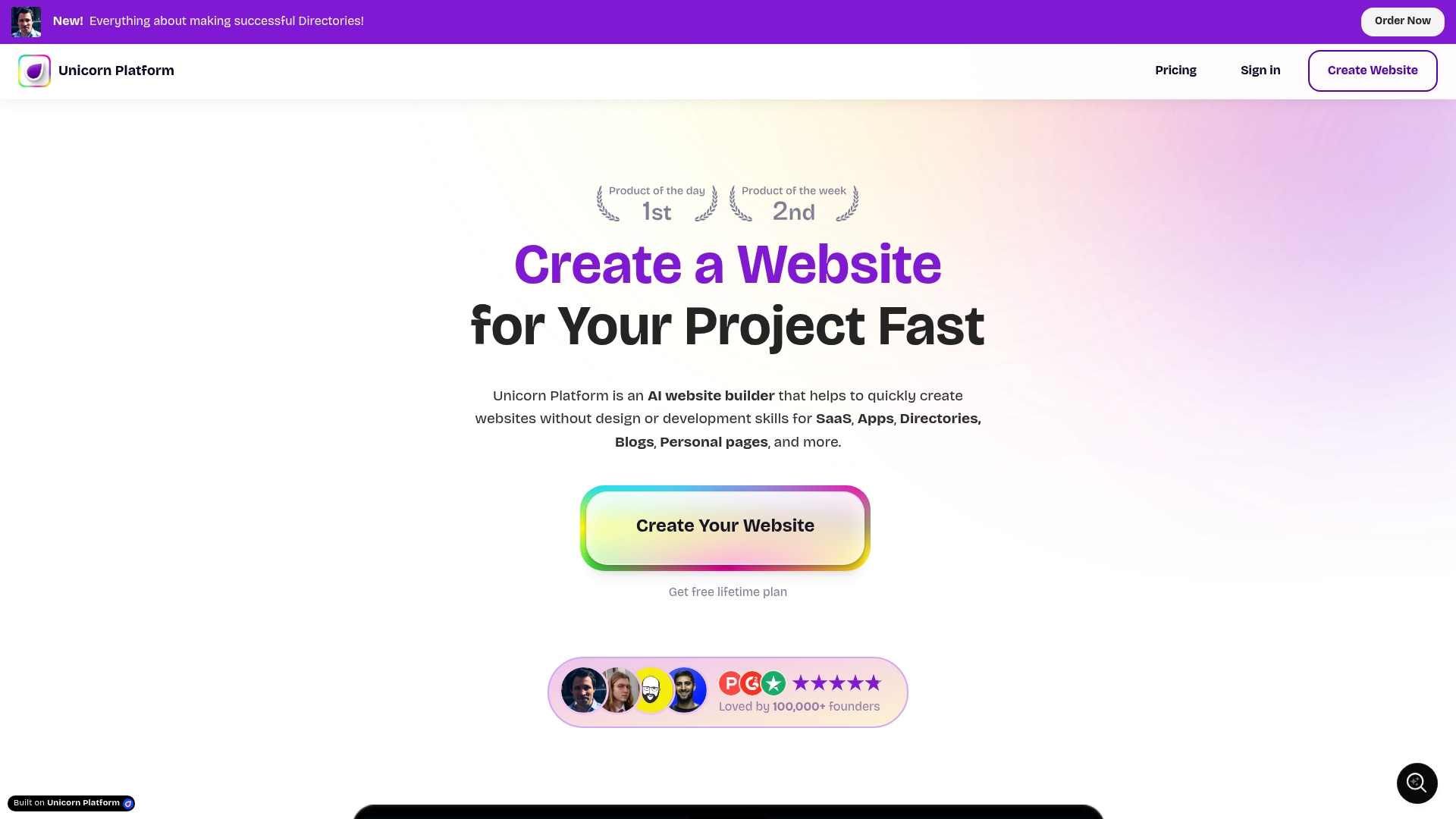
Unicorn Platform is an AI website builder that helps founders and small teams launch websites rapidly with no design or development skills. It is loved by over 100,000 founders and has earned recognition on Product Hunt for ease of use.
Core Features
Unicorn Platform centers on AI-powered website building with prompts, providing UI and UX ready design blocks and no code required workflows. It supports custom code addition, blog and landing page management, and payment acceptance via Stripe for direct transactions.
Pros
- Easy to use with no coding needed. The builder guides nontechnical founders through layout and copy so teams can publish faster.
- Fast website creation and customization. AI prompts accelerate initial drafts and reduce the time from idea to live page.
- Supports custom code and integrations. Developers can extend pages when projects need unique behaviors or tracking.
- Responsive design for all devices. Templates adjust for mobile and desktop without extra setup.
- Affordable pricing plans. A free lifetime plan and tiered paid plans match needs from solo founders to larger teams.
Cons
- Limited information on advanced customization options. The available details do not fully describe deeper design flexibility or developer tooling.
- Some features may require paid plans for full access. Key capabilities like higher allowances or advanced integrations are gated behind paid tiers.
- Specifics on templates and design flexibility are not detailed. The feature list does not explain template variety or how far you can push layout changes.
Who It's For
Unicorn Platform fits startups, solo entrepreneurs, developers, and small teams that need a quick no code solution for professional websites. It suits founders who prioritize speed and straightforward customization over bespoke design work.
Unique Value Proposition
Unicorn Platform combines rapid AI driven site generation with the option to add custom code, making it useful for founders who want both speed and extensibility. The mix of no code convenience and developer escape hatches is its key advantage.
Real World Use Case
A SaaS startup uses Unicorn Platform to create a product landing page, apply brand elements, connect Stripe for payments, and go live within a day without hiring a designer or engineer. The team iterates copy and layout directly on the platform.
Pricing
Unicorn Platform offers a free lifetime plan. Paid plans start at Maker $14 per month, Startup $49 per month, and scale up to Major $350 per month with different features and allowances across tiers.
Website: https://unicornplatform.com
Rocket
At a Glance
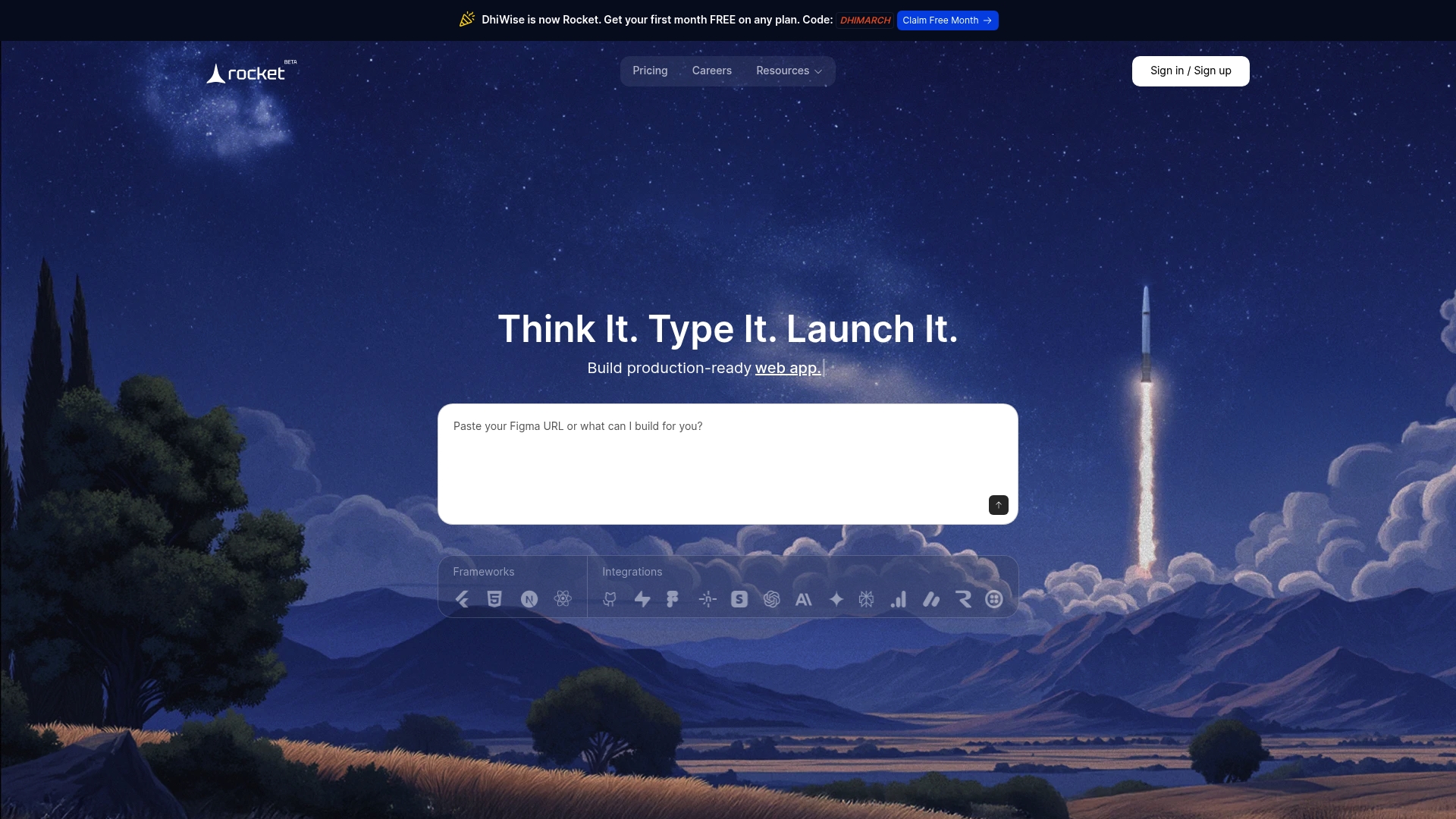
Rocket is a platform that turns a written app idea into a production ready full stack application using AI and templates. It compresses what normally takes months into minutes for simple to moderate projects, saving teams time and budget.
Core Features
Rocket offers no coding required app generation from a single description, paired with automatic database schema generation and security configuration. The platform includes UI UX design support, SEO optimized copywriting, deployment tooling, and templates to accelerate launches and scaling.
Pros
- Speeds up development: Rocket drastically reduces build time by generating frontend, backend, and integrations from a single brief, which helps founders get to market faster.
- AI driven end to end: The platform uses AI to research features, produce designs, write code, and prepare deployment artifacts, lowering the need for large engineering teams.
- Deployment ready: Rocket handles code optimization, server setup, and cloud provisioning so the output is ready to deploy with minimal wiring.
- Template library: Ready made templates let you jumpstart landing pages, dashboards, and internal tools instead of starting from scratch.
- Accessible to nondevelopers: Entrepreneurs and product managers can describe ideas and see functional applications without deep coding skills, which empowers quick iteration.
Cons
- Customization can be limited for highly specific workflows that demand bespoke logic or unusual integrations.
- Reliance on platform AI means some intricate functionality may require manual code edits after generation.
- Pricing details are not included in the provided data beyond a promotional first month offer, which makes long term budgeting unclear.
Who It's For
Rocket fits founders, small teams, and product managers who need rapid prototypes or launchable apps without hiring a full engineering squad. It also suits agencies and enterprises that want to scope internal tools and landing pages quickly and then hand off or refine generated code.
Unique Value Proposition
Rocket stands out by combining AI research, design, and code generation into a single workflow that produces deployable applications. That integration moves projects from idea to a running app in dramatically less time, lowering cost and accelerating validation for CPG founders.
Real World Use Case
A startup founder writes a product brief describing a subscription checkout, user dashboard, and analytics view. Rocket generates the frontend, backend endpoints, and database schema, then provisions cloud infrastructure so the founder can test and iterate within hours rather than weeks.
Pricing
Rocket offers the first month free on any plan with code DHIMARCH. Specific recurring pricing and plan tiers are not provided in the source data, so you will need to consult the vendor for ongoing cost estimates and enterprise options.
Website: https://dhiwise.com
Lunar.dev
At a Glance
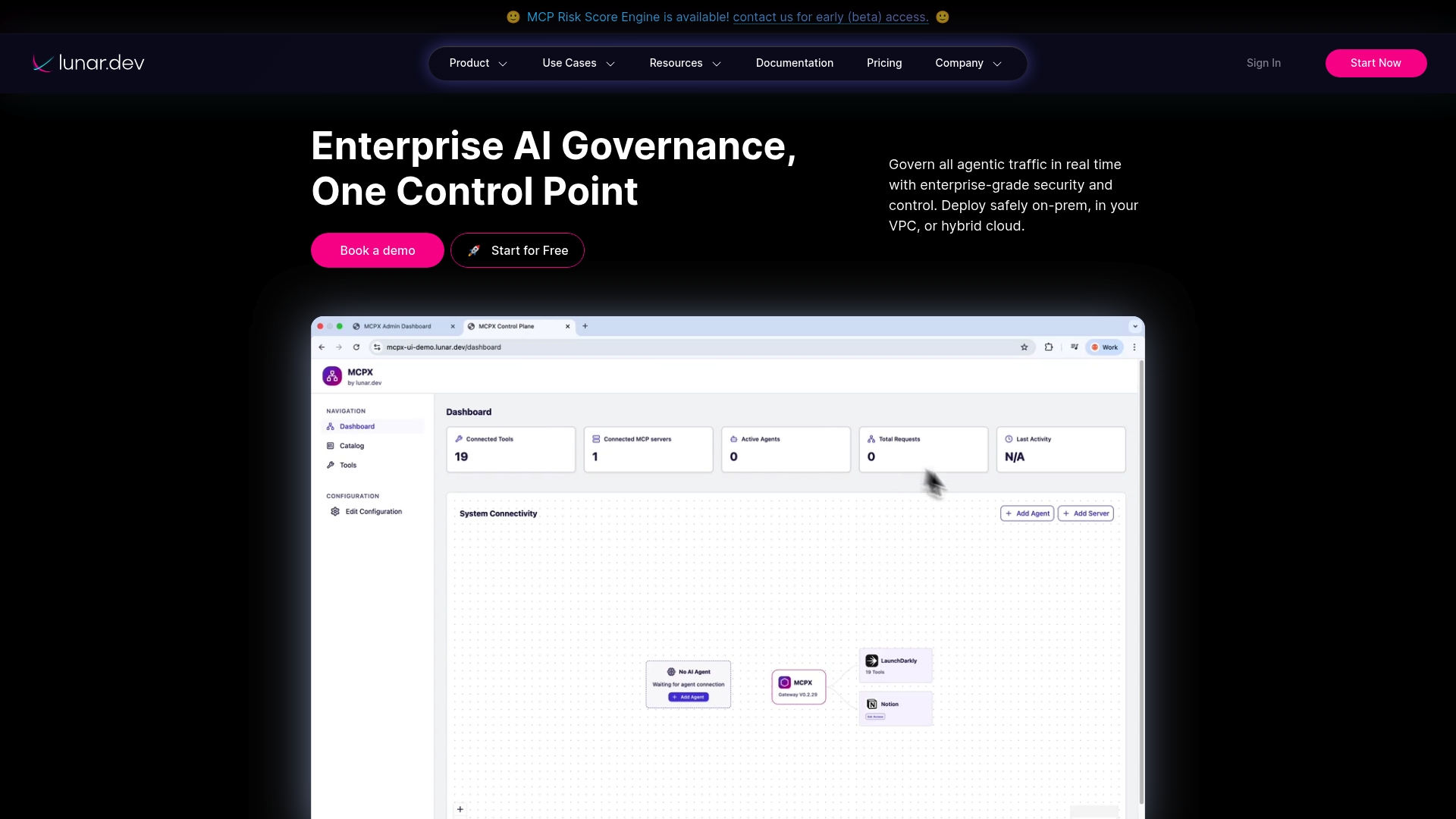
Lunar.dev provides enterprise grade AI governance and API management with a unified gateway that controls agent traffic across tools and models. This platform suits large organizations that need strong policy enforcement, visibility, and compliance for AI adoption.
Core Features
Lunar.dev centers on a unified control point that governs LLMs, MCP tools, and external APIs with real time policies and observability.
- AI Gateway that governs agentic traffic across models and tools.
- MCP Gateway for managing multiparty compute platforms and connectors.
- Sandbox and risk evaluation tools for testing new agents and integrations.
- Detailed observability and audit trails for security and compliance reviews.
- Customizable policy enforcement and deployment options on prem, in VPC, or hybrid cloud.
Pros
-
Comprehensive governance and security: Lunar.dev offers centralized traffic control and audit trails that match enterprise compliance needs.
-
Flexible deployment options: You can deploy on prem, inside a VPC, or as a hybrid setup to meet corporate infrastructure rules.
-
Strong compliance tooling: The platform includes features that support audit, reporting, and policy enforcement for regulated environments.
-
Industry recognition: Gartner recognition indicates Lunar.dev has been evaluated by analysts and is visible in enterprise vendor briefings.
-
Customizable policy enforcement: Teams can adapt rules and integrations to match complex internal workflows and security standards.
Cons
-
Opaque pricing for enterprise customers: The product requires contacting sales for detailed enterprise pricing which makes budget planning harder for procurement teams.
-
Complexity for small teams: The platform focuses on enterprise scale which can be more complex than necessary for simple or single team use cases.
-
Self hosting requirements for some deployments: Running the product on prem or in a VPC adds operational overhead and requires internal DevOps resources.
Who It's For
Lunar.dev targets enterprise organizations and large teams that must govern AI model calls and API usage at scale. If you manage multiple models, agent flows, or regulated data you will benefit from its policy controls and audit capabilities.
Unique Value Proposition
Lunar.dev combines a unified AI Gateway with observability and sandboxing so enterprises can adopt models and agentic tools while maintaining security and compliance. That single control point reduces fragmentation across model endpoints and third party tools.
Real World Use Case
A large enterprise uses Lunar.dev to centralize governance for every AI model call and API interaction across business units. The team enforces security policies, collects audit trails for compliance, and evaluates new agents in a sandbox before production.
Pricing
Lunar.dev offers a Free plan plus Team, Enterprise, and Custom options with detailed pricing available on request or after signup. Enterprise buyers should contact sales for deployment and licensing details.
Website: https://lunar.dev
Comprehensive Product Comparison Table for Digital Tools
This table provides a detailed comparison of the various digital tools mentioned in the article, helping users evaluate and select the most fitting solution for their needs.
| Product | Features | Pros | Cons | Pricing |
|---|---|---|---|---|
| Offcut | Production-ready packaging concepts, exclusive IP transfer | Full ownership of design assets, reduced agency costs | N/A | $200-$450 per concept |
| Lovable | AI-powered app building with chat prompts, real-time visualization | User-friendly interface, free tier available | Limited customization for complex projects | Free; Pro - $25/mo; Business - $50/mo |
| Vercel | Global CDN, serverless functions, AI tools | Fast deployment, modern framework support | Potentially high costs for larger scales | Free; Pro - $20/mo; Custom enterprise pricing |
| TeleportHQ | Visual editor with AI features, reusable component libraries | Supports team collaboration, wide integration options | Limited free plan features | Free; Professional - $18/editor/mo; Agency - Custom |
| Appy Pie | AI-assisted app creation, drag-and-drop interface | Supports multiple platforms, monetization options | Limited customization options | Basic - $16/mo; Gold/Platinum - Feature-tiered pricing |
| Unicorn Platform | AI-driven website generation, Stripe payment integration | Easy to use, supports custom code | Limited details on advanced customization | Free plan available; Paid plans - $14-$350/mo |
| Rocket | AI-powered app generation, automatic deployment setup | Fast app creation, template library | Limited customization post-generation | First month free; Contact for pricing |
| Lunar.dev | Unified AI governance and management platform | Comprehensive security features, strong compliance tools | Opaque pricing, self-hosting requirements | Free plan; Contact for enterprise pricing |
Speed Up Your Packaging Design Process with Offcut
If you are exploring alternatives to Lovable.dev for fast and effective solutions, you might be facing challenges around rapid prototyping and clear ownership of creative assets. Unlike app builders, packaging design requires exclusive, print-ready concepts that move your product from idea to market quickly without agency delays or licensing headaches. Offcut solves this by offering exclusive packaging designs that come with full intellectual property transfer so you can launch with confidence and control.
Discover how Offcut can help you beat slow turnaround times and costly revisions by accessing a curated catalog of production ready packaging concepts. Visit Offcut now to get unique, agency-quality designs faster. Don’t wait months to finalize your packaging — start transforming your brand image today with Offcut’s streamlined solutions.
Frequently Asked Questions
What are the top features to look for in Lovable.dev alternatives in 2026?
Focus on platforms that offer AI-driven app creation, user-friendly interfaces, and seamless collaboration for teams. Prioritize solutions with robust deployment options and built-in support for multiple platforms to ensure versatility.
How can I evaluate which Lovable.dev alternative is best for my team?
Assess your team's specific needs, such as technical skills and project requirements. Create a checklist of essential features, such as real-time collaboration and integration capabilities, and compare how each alternative meets these criteria within your budget.
Are there tools similar to Lovable.dev that support collaborative app development?
Yes, many alternatives provide collaborative features, enabling multiple team members to work simultaneously. Explore options that offer real-time editing and feedback capabilities to enhance teamwork and productivity.
How can I transition from Lovable.dev to an alternative platform smoothly?
Prepare a transition plan that includes exporting existing projects and gathering feedback from your team about their needs. Aim to migrate projects and start using the new platform within a few days, integrating essential features as you adapt.
What pricing considerations should I keep in mind when choosing Lovable.dev alternatives?
Compare the pricing structures of various alternatives, including any free tiers, monthly fees, and additional costs for extra features. Budget for possible scaling, as some platforms charge more as team size or usage increases.