
TL;DR:
- Packaging finish selection involves choosing coatings and embellishments that enhance visual appeal and serve functional purposes. It reflects brand positioning, product environment, and budget, with finishes categorized as protective, decorative, or specialty. Early decision-making and prototyping ensure finishes align with substrate, environmental, and cost considerations, leading to more cohesive and impactful packaging.
Packaging finish selection is the process of choosing coatings, laminations, and embellishments that visually and tactilely elevate consumer packaging while serving functional needs like protection and durability. The right finish does more than make a box look good. It signals brand positioning, survives the supply chain, and shapes how a consumer feels the moment they pick up your product. Three pillars drive every finish decision: product type, brand positioning, and budget. Get all three aligned and your packaging works as hard as your marketing. This guide covers the full spectrum of packaging finish options, from matte and gloss to foil stamping and soft-touch, with the strategic and practical depth brand managers and packaging professionals need in 2026.
What are the main types of packaging finishes?

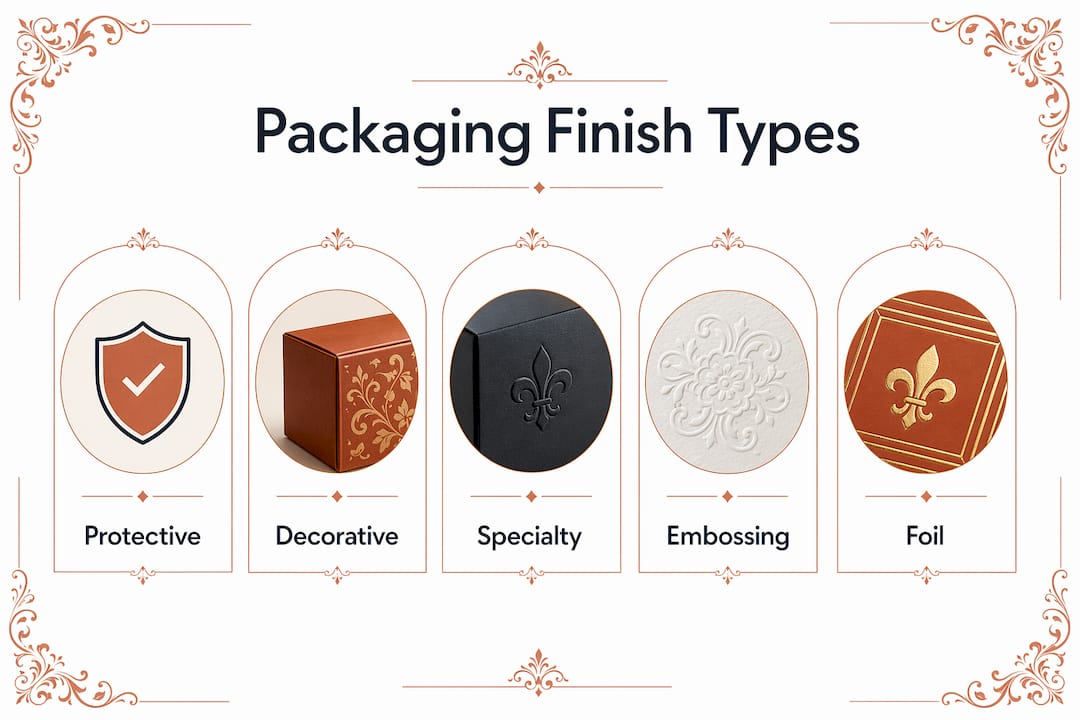
Packaging finishes fall into three categories: protective, decorative, and specialty. Understanding each category is the foundation of any serious packaging finish guide, because the category determines both the production process and the consumer experience.
Protective finishes include aqueous coatings, varnishes, and laminates. Their primary job is to guard the substrate against scuffs, moisture, and UV degradation. Gloss lamination is the workhorse of retail food packaging. Matte lamination is standard in premium cosmetics and lifestyle goods.
Decorative finishes are where brand identity gets expressed. The most common options are:
- Matte: Flat, light-absorbing surface that conveys control and sophistication. Widely used in skincare, spirits, and artisan food.
- Gloss: High-reflectivity surface that intensifies color saturation and creates visual impact. Standard in mass-market consumer goods and retail food.
- Soft-touch: A velvety, rubberized laminate that creates a premium tactile sensation. Common in luxury cosmetics and high-end electronics accessories.
- Foil stamping: Metallic or holographic foil applied under heat and pressure. Signals luxury and exclusivity. Frequently paired with soft-touch lamination.
- Spot UV: A high-gloss coating applied selectively over specific design elements. Creates contrast against matte backgrounds and draws the eye to logos or key graphics.
Specialty finishes include embossing, debossing, and metallic inks. Embossing and debossing add texture and brand identity by creating raised or recessed designs that provide visual depth and improve consumer engagement with the physical packaging.
One detail many brand managers overlook: color perception shifts with finish. Matte can wash out dark colors, while gloss intensifies saturation. A Pantone 281 navy that looks authoritative in a gloss proof can appear dull and flat under matte lamination. Always proof color with the intended finish applied before approving production.
| Finish type | Visual effect | Typical use case |
|---|---|---|
| Gloss lamination | High saturation, reflective | Retail food, mass-market goods |
| Matte lamination | Flat, sophisticated | Premium cosmetics, spirits |
| Soft-touch | Velvety, tactile premium | Luxury beauty, tech accessories |
| Foil stamping | Metallic, high-contrast | Luxury goods, gift packaging |
| Spot UV | Selective gloss contrast | Brand logos, hero graphics |
| Embossing/debossing | Tactile texture, depth | Premium brand identity elements |
Pro Tip: Request physical drawdown samples of your chosen finish on your actual substrate before signing off on a production run. Digital proofs cannot replicate how a finish interacts with paper grain, board weight, or ink coverage.
How to select finishes aligned with brand positioning
Treating finishes as foundational design decisions rather than final layers is the single most important principle in choosing packaging finishes. Brands that bolt on a finish at the end of the design process often end up with packaging that looks inconsistent across SKUs or fails to communicate the right positioning at shelf.
The strategic logic is straightforward. Luxury brands use soft-touch and foil stamping; natural brands prefer matte or uncoated stocks; tech brands mix matte with spot UV for a clean, precise feel. Each combination sends a specific signal to the consumer before they read a single word of copy.
Here is how finish selection maps to brand identity by category:
- Luxury and prestige: Soft-touch lamination plus foil stamping, or debossed logos on uncoated board. The tactile experience is the message.
- Natural and organic: Uncoated or matte-laminated kraft board. Eco-friendly aqueous coatings reduce VOC emissions and support recyclability claims without sacrificing protection.
- Tech and innovation: Matte base with spot UV on product names or icons. The contrast reads as precise and considered.
- Mass-market retail: Gloss lamination with high-saturation print. Maximizes shelf visibility under fluorescent retail lighting.
- Premium food and beverage: Matte lamination with foil accents, or soft-touch with embossed brand marks. Signals craft and quality without alienating mainstream buyers.
Pro Tip: Lock your finish specification before finalizing dieline artwork. Spot UV and embossing require their own separate artwork layers, and adding them after the fact creates registration risk and delays production timelines.
The product category also constrains your options in ways brand identity alone cannot. Freezer-case food packaging requires moisture-barrier coatings regardless of brand aesthetic. A soft-touch laminate on a frozen meal box will delaminate within weeks. The finish must serve the product's physical environment first, then the brand's visual ambitions.
| Brand type | Recommended finish | Effect on consumer perception |
|---|---|---|
| Luxury | Soft-touch + foil stamping | Premium, exclusive, tactile |
| Natural/organic | Uncoated matte or kraft | Authentic, sustainable, honest |
| Tech | Matte + spot UV | Precise, modern, considered |
| Mass-market | Gloss lamination | Bold, energetic, accessible |
| Premium food | Matte + foil accents | Craft quality, elevated |
For a deeper look at how packaging components reinforce brand identity, the relationship between finish, structure, and typography is worth examining as a system rather than in isolation.
What practical factors impact packaging finish decisions?
Aesthetic goals are only half the equation. Production logistics, budget, and environmental responsibility all shape which finishes are viable for a given project. Here are the key practical factors to evaluate before committing to a finish specification:
-
Substrate compatibility. The same finish behaves differently on glass, plastic, or metal, affecting both cost and visual results. Adhesion requirements vary significantly across substrates, and a finish that performs perfectly on SBS board may fail entirely on a recycled fiber stock.
-
Environmental and recyclability requirements. Water-based aqueous coatings improve recyclability and are increasingly the default for brands with sustainability commitments. UV coatings and metallic laminates can complicate recycling streams, which matters for brands targeting sustainability-conscious consumers or operating in markets with extended producer responsibility regulations. For more on this, see why sustainable packaging design is a strategic priority in 2026.
-
Budget and tooling costs. Multi-step finishes compound costs quickly. Foil stamping requires a custom die. Embossing requires a separate embossing die. Spot UV requires a separate film positive. Each additional process adds tooling cost, press time, and potential for registration error. For brands managing tight margins, cost-effective finish strategies often involve choosing one premium finish element and executing it with precision rather than layering multiple effects.
-
Shipping and handling durability. High-gloss surfaces are prone to fingerprints and scuffs, making matte or protective laminates the better choice for products with long distribution chains or high handling frequency. This is a common failure point that gets discovered after a pallet arrives at a retailer looking worn.
-
Production lead time. Specialty finishes like soft-touch lamination and foil stamping typically add 3 to 5 business days to production schedules. For brands with tight launch windows, this lead time must be built into the project timeline from the start, not treated as a variable.
Pro Tip: Ask your print supplier for a finish durability test on your specific substrate before production. A simple rub test and moisture exposure test on a physical sample will reveal adhesion and scuff issues before they become a costly problem at scale.
How to combine multiple packaging finishes effectively
The most distinctive packaging on shelf almost always uses more than one finish. The combination of matte lamination with spot UV is now a standard in premium consumer goods because it creates contrast without adding significant cost or complexity. Soft-touch lamination paired with foil stamping is the signature of luxury beauty and spirits packaging globally.
Effective finish combinations share one characteristic: each finish serves a distinct purpose. Matte provides the base texture and sophistication. Spot UV draws the eye to a specific element. Foil adds a moment of surprise and premium signaling. When every finish is doing a different job, the result feels considered. When finishes compete or repeat each other's effect, the packaging looks busy.
Common mistakes in finish execution include:
- Overloading the design. Using matte, spot UV, foil, embossing, and soft-touch on a single package rarely reads as premium. It reads as expensive and confused.
- Ignoring substrate compatibility. A foil stamp that adheres perfectly to coated board may peel on uncoated recycled stock. Always confirm adhesion with your supplier before finalizing the specification.
- Skipping prototypes. Complex finishes can cause registration problems and transport damage. A physical prototype reveals these issues before they become production failures.
- Failing to proof color with the finish applied. Base color and material influence the final appearance in ways that are impossible to predict from a screen proof alone.
Maintaining brand consistency across different substrates is a specific challenge for brands with complex product ranges. A matte laminate on a folding carton will look and feel different from the same specification on a rigid box, because the board weight and surface texture differ. The solution is to define finish standards by substrate type rather than applying a single specification across all packaging formats.
Pro Tip: When combining finishes, build a physical sample library organized by substrate and finish combination. This becomes a reference tool for every future packaging project and prevents the same substrate compatibility mistakes from recurring.
For inspiration on how modern packaging wins at shelf, studying real-world finish combinations in your category is one of the fastest ways to calibrate your own specifications.
Key takeaways
Finish selection is a foundational design decision, not a final layer. Brands that specify finishes early, match them to brand identity and product environment, and prototype before production consistently outperform those that treat finishing as an afterthought.
| Point | Details |
|---|---|
| Finishes fall into three categories | Protective, decorative, and specialty finishes each serve distinct functional and aesthetic roles. |
| Brand identity drives finish choice | Luxury brands use soft-touch and foil; natural brands use matte; tech brands use matte with spot UV. |
| Color proofing is non-negotiable | Matte washes out dark colors; gloss intensifies saturation. Always proof with the finish applied. |
| Practical factors constrain options | Substrate compatibility, recyclability, budget, and shipping durability all limit viable finish choices. |
| Prototype before production | Complex finish combinations create registration and adhesion risks that only physical samples reveal. |
Why finish selection is where most packaging budgets go wrong
I have reviewed hundreds of packaging briefs over the years, and the pattern is consistent. Brand managers treat finish selection as a styling decision made at the end of the process, after the structure is locked, the copy is approved, and the launch date is set. That sequence is exactly backwards.
The brands with the most coherent packaging, the ones that feel premium and intentional from the first touch, made their finish decisions at the same time they made their structural decisions. They knew whether the pack was going to be soft-touch or gloss before the designer drew the first dieline. That early commitment shapes every subsequent decision, from color palette to typography weight to the size of the logo.
The other consistent mistake I see is treating premium finishes as a budget line item to cut when costs run over. A single well-executed foil stamp on a matte-laminated carton costs less than a full soft-touch plus emboss plus spot UV combination, and it almost always performs better at shelf. Restraint is a finish strategy, not a compromise.
Collaboration between designers, brand managers, and print suppliers needs to happen earlier and more specifically than most teams currently manage. The supplier knows which finishes adhere to which substrates. The designer knows where the visual hierarchy needs emphasis. The brand manager knows what the consumer expects to feel when they pick up the product. When those three perspectives meet at the brief stage rather than the proof stage, the result is packaging that works on every level.
— Myles
How Offcut helps you make better finish decisions faster
Finish decisions are only as good as the design concepts they are applied to. Offcut is where print-ready packaging concepts go instead of a designer's hard drive. Brand managers get access to exclusive, production-ready packaging designs at a fraction of agency cost, complete with finish specifications that have already been considered by experienced packaging designers.
If you are working through a finish selection process and need design concepts that reflect current best practices in matte, foil, soft-touch, and spot UV applications, the Offcut platform gives you a head start. Designers on the platform get paid for work that would otherwise sit unused. Brand managers get packaging concepts that are ready to take to a print supplier. Explore the Offcut designers page to see what is currently available for your category.
FAQ
What is a packaging finish?
A packaging finish is a coating, lamination, or embellishment applied to a printed substrate to enhance its visual appearance, tactile quality, or protective performance. Common examples include matte lamination, gloss lamination, foil stamping, soft-touch coating, and spot UV.
What is the difference between matte and gloss finishes?
Matte finishes absorb light and convey sophistication, while gloss finishes reflect light and intensify color saturation. Matte is standard in premium and natural brand categories; gloss dominates mass-market retail and food packaging.
How do I choose the right finish for my product?
Match the finish to your brand positioning, product category, and distribution environment. Luxury products favor soft-touch and foil; natural brands use matte or uncoated stocks; products with long supply chains need durable laminates that resist scuffing and moisture.
Can packaging finishes affect recyclability?
Yes. UV coatings and metallic laminates can complicate recycling streams, while water-based aqueous coatings improve recyclability and reduce VOC emissions. Brands with sustainability commitments should specify recyclable-compatible finishes from the start of the design process.
When should finish selection happen in the design process?
Finish selection should happen at the brief stage, before the dieline is finalized. Spot UV, embossing, and foil stamping each require separate artwork layers, and adding them after artwork is locked creates registration risk and production delays.