
TL;DR:
- Packaging hierarchy encompasses both the physical nesting of product packages from primary to quaternary levels and the structured data system that assigns GTINs to each level for supply chain accuracy. Proper integration of visual design and data hierarchies improves operational efficiency, reduces errors, and aligns with channel-specific priorities. Brands that proactively coordinate these systems early in development build stronger market positions and avoid costly downstream rework.
Packaging hierarchy is one of those terms that sounds simple until you realize how much it actually covers. Most brand managers think of it as a graphic design principle or a basic boxing structure. It's both of those things, and it's also the data backbone of your entire supply chain. Understanding what is packaging hierarchy means grasping two parallel systems: the physical levels that move your product from factory to shelf, and the structured product data that tells every logistics system exactly what it's looking at. Get both right and you unlock real operational efficiency and sharper consumer impact.
Table of Contents
- Key takeaways
- What is packaging hierarchy and why it matters
- The GTIN packaging hierarchy and supply chain data
- Visual hierarchy vs. trade-item hierarchy
- Practical strategies for building effective packaging hierarchy
- How channel type shapes hierarchy priorities
- My take on where brands get this wrong
- Get your packaging hierarchy right from concept to shelf
- FAQ
Key takeaways
| Point | Details |
|---|---|
| Four physical levels exist | Primary, secondary, tertiary, and quaternary packaging each serve a distinct protection and presentation role. |
| GTIN hierarchy drives supply chain accuracy | Each packaging level gets its own GTIN, creating parent-child relationships that prevent receiving and shipping errors. |
| Two hierarchies run in parallel | Visual hierarchy guides shoppers on the pack; trade-item hierarchy guides logistics systems in the warehouse. |
| Channel priorities shift hierarchy focus | Retail favors primary and secondary design; wholesale and DTC demand more attention on tertiary and quaternary levels. |
| Early integration prevents costly rework | Aligning packaging hierarchy decisions with portfolio planning from day one reduces downstream operational problems. |
What is packaging hierarchy and why it matters
At its core, packaging hierarchy describes the layered structure of packaging levels that carry a product from consumer-ready presentation through bulk logistics. Think of it as a set of nested containers, each with a specific job and a specific audience.
The packaging structure overview most professionals work with includes four levels:
- Primary packaging touches the product directly. It's the bottle, the blister pack, the shrink-wrapped bar. Its job is product protection, compliance labeling, and the first moment of consumer connection. Every design decision here shapes how someone feels when they pick it up.
- Secondary packaging groups primary units together. A 12-pack carton, a display shipper, a multi-pack sleeve. This is where retail merchandising decisions start to show up and where brand communication gets more room.
- Tertiary packaging handles transport. Corrugated shipping cases, stretch-wrapped trays, and master cartons exist to protect product integrity between your facility and the retailer's back room.
- Quaternary packaging stabilizes bulk loads. Pallets, slip sheets, and pallet wraps are the outermost layer. Consumers never see them, but your logistics team cares about them deeply.
Pro Tip: When developing a new product, map all four packaging levels before you start designing the primary pack. Changing your primary dimensions after you've finalized a tertiary case configuration is an expensive problem.
Understanding packaging levels explained this way makes it clear that each tier demands different materials, different regulatory requirements, and different design priorities. A beverage brand, for instance, might use an aluminum can as primary, a printed cardboard sleeve as secondary, a corrugated tray as tertiary, and a stretch-wrapped pallet as quaternary. Each level is engineered separately but must work together as a system.
The GTIN packaging hierarchy and supply chain data
Here is where most brand managers hit a knowledge gap. Beyond the physical tiers, packaging hierarchy also refers to the structured product data system that assigns identifiers to each level. This is the trade-item hierarchy, and it runs on GTINs.
Here is how the system works in practice:
- Base unit (each): Your individual consumer product receives its own GTIN. This is the barcode a shopper scans at checkout or a retailer uses to list the product in their system.
- Case level: A shipping case containing multiple base units gets a separate GTIN. When a warehouse worker scans this code, the system instantly knows what's inside without opening the box.
- Pallet level: A pallet carrying multiple cases gets its own GTIN. Scanning it at receiving gives your 3PL a complete inventory count in seconds.
The logic behind this is the parent-child relationship. Each GTIN level contains an implied relationship to the levels beneath it. A case GTIN tells the system: "I contain 24 base units of product X." A pallet GTIN tells the system: "I contain 40 cases, each holding 24 units." That chain of data is what makes accurate receiving, automated reordering, and real-time inventory possible.
GS1 guidelines recommend modeling every packaging level this way, with explicit parent-child assignments in your product master data. The payoff is that buyers receive accurate information consistently, and scanning at any level is error-free.
Where brands run into trouble is with complexity. A brewery pallet, for example, might contain multiple SKUs at different deposit values, mixed case configurations, and promotional inner packs. Complex pallet hierarchies like this require explicit definitions of quantities, dimensions, and deposit codes at every tier to stay GS1-compliant and avoid logistical errors downstream.

Pro Tip: Build your GTIN hierarchy in your product master data system before your product launches. Retrofitting it after orders start flowing creates discrepancies that take weeks to untangle.
Visual hierarchy vs. trade-item hierarchy
Two hierarchies run in parallel in any well-managed packaging program, and understanding both is what separates brands that operate cleanly from those that constantly firefight.
Visual packaging hierarchy is what shoppers experience. It uses size, color, and placement to direct attention in a specific sequence. On a cereal box, your eye hits the brand name first, then the product variant, then the serving suggestion photo, then the nutrition claim. That sequence is deliberate. It's engineered to communicate the most important information before the shopper loses interest or grabs a competitor's product.
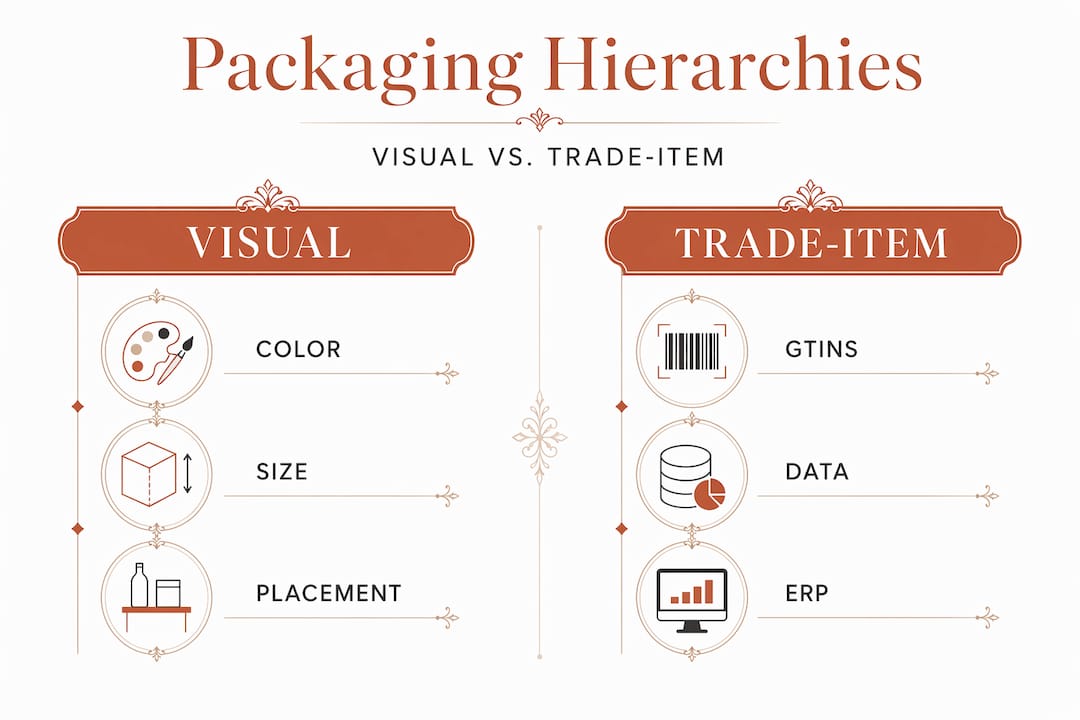
Trade-item hierarchy is invisible to shoppers but critical to everyone else. It's structured data. It lives in your ERP, your retailer's portal, your 3PL's WMS. It defines what units are inside which cases, how cases stack on pallets, and what each level weighs and measures.
The problem most brands create is treating these as entirely separate workstreams. Design does its thing. Supply chain does its thing. They meet at launch and discover mismatches. Primary packaging dimensions don't fit the secondary carton. The secondary carton doesn't match the case configuration in the system. Many brands neglect synchronizing these two systems, and the result is receiving discrepancies and inventory errors that cost real money.
The brands that get this right treat both hierarchies as one connected decision. When the design team finalizes the primary pack structure, the data team assigns the GTIN simultaneously. When the secondary pack changes for a seasonal promotion, the case configuration in the product master data updates on the same day.
Packaging hierarchy isn't a design decision or a logistics decision. It's a product decision. The brands that treat it as both at the same time stop paying the tax of fixing preventable problems.
Practical strategies for building effective packaging hierarchy
Knowing the theory is only half the job. Here is how to apply it in your actual workflow as a brand manager or product developer.
Step 1: Start at the portfolio level. Early hierarchy integration in planning improves product success and supply resilience. Before you brief your design agency on a new SKU, map where it sits in your existing packaging structure. Does it share a case configuration with existing products? Does it need a new GTIN at every level or can it inherit some existing data structures?
Step 2: Build a cross-functional packaging team from day one. Your design lead, supply chain manager, regulatory specialist, and retail buyer each have a stake in the hierarchy. Decisions made in isolation by any one of these people create problems the others have to clean up.
Step 3: Model your GTIN hierarchy before you finalize dimensions. Use packaging design software to work through structural options while simultaneously testing case configurations. Dimension changes late in development are costly. Catching them during the modeling phase is free.
Step 4: Document every level explicitly. For each packaging tier, record the GTIN, unit quantity, gross weight, dimensions, and any deposit or regulatory codes. This becomes your product's data passport and prevents errors when onboarding new distribution partners.
Step 5: Review hierarchy at every major change. If you resize the primary pack, check the case. If the case changes, check the pallet. One unreviewed change in the hierarchy creates a cascade of mismatches across your supply chain.
Pro Tip: Treat your packaging classification system as a living document, not a one-time setup task. Schedule a quarterly review with your supply chain team to catch dimension drift, new regulatory requirements, or channel-specific configuration changes before they become problems.
How channel type shapes hierarchy priorities
The same product may need a different packaging structure overview depending on where it's sold. Retail, direct-to-consumer, and wholesale each prioritize different levels of the hierarchy.
| Channel | Primary focus | Secondary focus | Key consideration |
|---|---|---|---|
| Retail | Primary and secondary design | Tertiary case efficiency | Shelf impact, planogram fit, scan accuracy |
| Direct-to-consumer | Tertiary unboxing experience | Primary brand presentation | Damage protection, unboxing moment |
| Wholesale | Tertiary and quaternary stability | Case count efficiency | Pallet configuration, weight distribution |
For retail, the primary and secondary packaging carry the brand story. A well-designed secondary pack doubles as a shelf display and reduces the labor needed to stock shelves. The tertiary case just needs to be right-sized for efficient shelf replenishment.
For direct-to-consumer, the hierarchy flips in emphasis. The consumer never sees a tertiary shipper in a store. They receive it at home and their first physical brand experience is opening that box. Channel-specific hierarchy thinking means that DTC tertiary packaging deserves the same design attention a retailer gives secondary packaging.
For wholesale, the story is almost purely operational. Buyers at a club store or foodservice distributor care about:
- How many units fit on a pallet
- Whether the pallet configuration maximizes truck utilization
- Whether the case dimensions match their racking systems
- Whether the GTIN data in your hierarchy matches what their receiving system expects
Building a packaging portfolio workflow that accounts for all three channel types from the start saves you from rebuilding your hierarchy every time you open a new distribution channel.
My take on where brands get this wrong
I've watched brands spend six figures on beautiful primary packaging and then discover at launch that their case configuration doesn't fit standard retailer shelf depths. I've seen supply chain teams build perfect GTIN hierarchies in their ERP with dimensions that nobody told the design team about. Both problems come from the same root cause: treating visual hierarchy and trade-item hierarchy as separate projects.
In my experience, the brands that handle this best don't have better designers or better logistics teams. They have better conversations earlier. The packaging structure overview gets built in a shared room with both design and operations present, before anyone opens a design file or starts an ERP data entry.
What I've also learned is that packaging hierarchy has become more consequential in recent years, not less. Sustainability regulations are adding new requirements at the tertiary and quaternary levels. Retail portals are demanding more precise GTIN data before they'll list new products. And consumers are more attuned than ever to whether secondary and tertiary packaging reflects the brand values they've been sold on social.
The brands treating hierarchy as a core business strategy component, not a downstream checkbox, are the ones building durable market positions. The ones treating it as an afterthought keep paying the same firefighting costs launch after launch.
— Myles
Get your packaging hierarchy right from concept to shelf
Offcut exists for exactly this kind of challenge. When you're building a new product line and need print-ready packaging concepts that already account for hierarchy across all levels, you don't need to commission an agency from scratch. Offcut gives brand managers and product developers access to exclusive, production-ready packaging designs at a fraction of traditional agency cost.

Every concept on Offcut is built by working designers who understand how primary, secondary, and tertiary packaging levels interact, both visually and structurally. If you're planning a 2026 launch and want packaging that performs on shelf and in the supply chain, Offcut is where that work starts. Explore the catalog and find concepts that match your product's hierarchy requirements before your next development sprint begins.
FAQ
What is packaging hierarchy in simple terms?
Packaging hierarchy is the structured system of packaging levels, from the individual consumer unit up through cases and pallets, that organizes how a product is presented, protected, and tracked across its supply chain.
How many levels does a packaging hierarchy have?
Most products use three to four levels: primary (touches the product), secondary (groups primary units), tertiary (protects during shipping), and sometimes quaternary (stabilizes bulk pallet loads).
Why does GTIN assignment matter in packaging hierarchy?
Each level in the packaging hierarchy needs its own GTIN so that supply chain systems can scan a case or pallet and instantly know its exact contents, quantities, and weights without manual counting.
What is the difference between visual and trade-item hierarchy?
Visual hierarchy guides what shoppers notice first on the pack using size, color, and placement. Trade-item hierarchy is structured product data used by logistics systems to track and move inventory accurately.
How does channel type affect packaging hierarchy decisions?
Retail prioritizes primary and secondary packaging design for shelf impact, DTC focuses on tertiary packaging for the unboxing experience, and wholesale demands tertiary and quaternary configurations optimized for pallet stability and case count efficiency.