
TL;DR:
- Modern packaging software is now affordable and accessible for brands at all stages, helping reduce costs and ensure compliance. It automates error-prone tasks, tracks revisions, and provides evidence for better decision-making, especially as SKUs grow. Implementing targeted tools early builds confidence, streamlines workflows, and offers measurable benefits in cost, sustainability, and speed to market.
Most CPG founders assume serious packaging software is reserved for companies with dedicated engineering teams and million-dollar budgets. That assumption is costing you money. Modern packaging software platforms are more accessible, affordable, and impactful than ever, and they work for brands at every stage. Whether you're launching your first SKU or managing a growing portfolio, the right tools can cut costs, reduce compliance risk, and speed up your time to shelf. This article walks you through the tools that matter, the workflows that work, and the traps to avoid.
Table of Contents
- Why packaging software matters for CPG brands
- Core tools and platforms: from design to recyclability
- Best practices: building efficient packaging design workflows
- Quantifying impact: measuring outcomes and trade-offs
- Our take: what most CPG founders miss about software building
- Take your packaging software strategy further
- Frequently asked questions
Key Takeaways
| Point | Details |
|---|---|
| Software saves costs | Smart workflow-building and software adoption can reduce packaging costs by up to 20 percent. |
| Early validation prevents mistakes | Validate packaging concepts early and iterate quickly to avoid costly late-stage changes. |
| Benchmarking guides decisions | Use measurement tools and ML frameworks to align packaging design with consumer and sustainability goals. |
| Compliance tools reduce risk | Assessment platforms help track missing information and support regulatory reporting across SKUs. |
| Start lean for impact | Begin with minimal software and evolve your workflow for reversibility and measurable outcomes. |
Why packaging software matters for CPG brands
Think about all the places a packaging decision can go wrong. Wrong material weight, a missed recyclability requirement, an artwork error caught only at print. Every one of those mistakes carries a cost, and most of them happen when teams are working off spreadsheets, email threads, and gut instinct.
Software changes that equation. It automates the parts of your process that are repetitive and error-prone, gives you a structured way to track decisions, and creates a clear audit trail when questions arise. For growing CPG brands especially, that structure is the difference between scaling smoothly and firefighting constantly.
"The real value of packaging software isn't just automation. It's evidence. Every decision you make with good tooling is a decision you can explain, defend, and improve."
Here's what good packaging software actually solves for brands in the field:
- Version control chaos: No more "final_v7_REAL_FINAL" files. Platforms track revisions automatically and keep everyone aligned.
- Compliance gaps: Regulatory requirements for materials, labeling, and recyclability vary by market. Software flags missing or non-compliant information before it becomes a problem.
- SKU proliferation: As your line grows, managing specifications across dozens of products by hand becomes unsustainable. Software gives you a central source of truth.
- Late-stage errors: Catching a structural flaw or a print spec issue in software costs almost nothing. Catching it after production runs can cost thousands.
- Supplier miscommunication: Clear, software-generated specs reduce back-and-forth with printers and manufacturers, keeping projects on schedule.
Packaging-related software investments can translate directly to procurement and operations savings, along with real reductions in inventory risk. That's not a theory. It's a documented outcome for brands that commit to structured tooling.
A well-designed packaging portfolio workflow built around the right software will also make onboarding designers and suppliers faster, because everyone is working from the same system instead of their own personal file structure.
Core tools and platforms: from design to recyclability
Understanding why software matters is the easy part. Choosing the right tools is where founders often get stuck. The packaging software landscape breaks into four main categories, and you don't need all of them at once.
1. CAD and structural design tools These platforms let you design, visualize, and modify the physical structure of your packaging in 3D. They catch structural issues early, simulate how a package will perform under load or transit stress, and generate precise dielines for production. Examples include both enterprise platforms and lighter web-based options suited to smaller teams.
2. Simulation and optimization platforms These tools go beyond structure and model how your packaging performs across variables like material weight, compression strength, and fill efficiency. You input parameters, and the platform runs scenarios to find the best balance between cost, protection, and material use.
3. Recyclability and compliance assessment tools This category is increasingly important as EPR (Extended Producer Responsibility) legislation tightens globally. The APR Design® Assessment Tool is the first and only platform built for full-package plastic recyclability evaluation. It assesses your entire packaging system against current recycling stream compatibility, flags missing information, and tracks per-SKU status with exportable reports. For brands selling in multiple markets, this tool category isn't optional anymore.
4. ML and data-driven design frameworks Newer platforms use machine learning to analyze large packaging datasets and predict consumer preference, structural performance, or material efficiency outcomes. Benchmark-style ML frameworks for packaging are increasingly used to support design decision-making, giving founders evidence-based confidence in choices that used to rely on intuition.
Here's a quick comparison to help you prioritize:
| Tool category | Best for | Key benefit | When to adopt |
|---|---|---|---|
| CAD / structural design | New package development | Reduces physical prototyping cost | Early, before first production run |
| Simulation / optimization | Multi-SKU portfolio management | Finds cost-saving material trade-offs | Once you have 3 or more active SKUs |
| Recyclability assessment | Compliance and sustainability claims | Flags issues before they become fines | Before entering new markets |
| ML / data-driven frameworks | Consumer-facing packaging decisions | Aligns design choices to preference data | Growth stage, with sufficient design history |
Pro Tip: Don't try to implement all four categories at once. Start with the tool that solves your most expensive current problem, build confidence in how software fits your process, then add layers as your team and portfolio grow.
When you're ready to repurpose old packaging designs or explore new visual directions, having your structural specs already locked in software makes it dramatically faster to brief a designer or evaluate a new concept. Similarly, when you need packaging design inspiration that fits your actual constraints, knowing your weight limits, material specs, and compliance requirements upfront saves countless revision cycles.
Best practices: building efficient packaging design workflows
Software is only as useful as the workflow you build around it. A great platform used badly still produces bad results. The good news is that the principles of an efficient packaging workflow are straightforward once you know them.

Step 1: Define your constraints before you open a design file
Before any creative work begins, lock in your structural specs, material requirements, and compliance needs in your software system. This means dieline dimensions, weight limits, material categories, and any market-specific regulatory requirements. Starting design without these guardrails is the single most common source of expensive late-stage revisions.
Step 2: Validate early, not late
A core principle in optimizing packaging development workflows is to shift testing earlier and iterate rapidly instead of validating at the end of a project. In packaging terms, this means running recyclability checks, structural simulations, and compliance reviews during the concept phase, not during pre-press. Catching a problem in week two costs far less than catching it in week eight.
Step 3: Build a structured iteration loop
Good packaging development follows a build-validate-refine cycle. You produce a version, run it through your assessment tools, review the flagged issues, and revise. Then repeat. Software makes this loop fast enough to run multiple times within a single development sprint. Without software, each iteration can take days. With it, you can sometimes turn around a validated revision in hours.
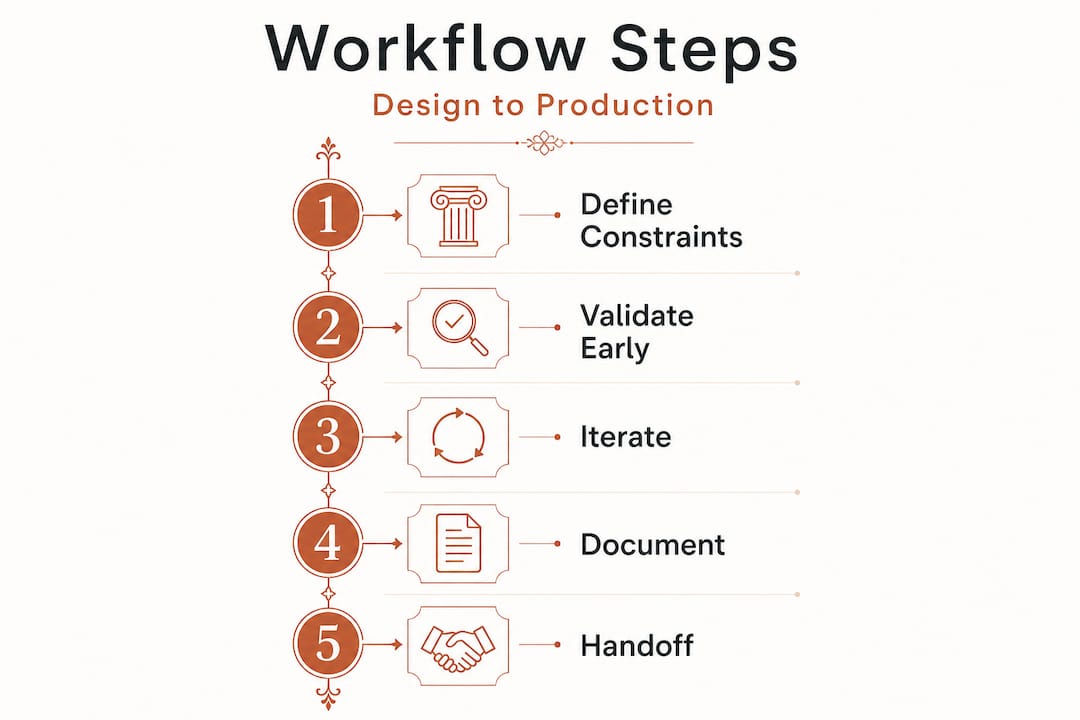
Step 4: Document decisions as you go
Every time you make a material change, update a dieline, or resolve a compliance flag, record the rationale in your platform. This documentation becomes invaluable when you need to brief a new supplier, onboard a designer, or respond to a regulatory inquiry. It also gives you a clear history of what you tried and why, which accelerates future product development.
Step 5: Create a handoff checklist for production
Before any file goes to a printer or manufacturer, run a final check against your software-defined spec. Every dimension, material call-out, color profile, and compliance certification should be confirmed and logged. This single step eliminates the majority of production errors that stem from miscommunication.
For a deeper look at applying these principles to your specific situation, see proven CPG workflow strategies and a step-by-step packaging design framework built specifically for founders. You should also review test packaging best practices before committing to a production run.
Pro Tip: Keep your workflow reversible. Every step where a decision gets locked in should have a documented rollback option. This sounds overly cautious until you face a material shortage or a regulatory change mid-development and need to pivot quickly without starting over.
Quantifying impact: measuring outcomes and trade-offs
Getting software in place and building a workflow is progress. But how do you know if it's actually working? The answer is metrics, and modern packaging software gives you more data than most founders know what to do with.
The key is to pick a small number of meaningful indicators and track them consistently. Here are the metrics that matter most for CPG packaging:
- Cost per SKU: Total packaging cost divided by active SKUs. Software should drive this down over time through material optimization and reduced waste.
- Error rate at pre-press: How many files arrive at production with errors. A good workflow should push this toward zero.
- Recyclability compliance score: Tracked per SKU using assessment tools. Aim for 100% compliance in target markets.
- Iteration cycle time: How long it takes from design brief to validated, production-ready file. Software should reduce this meaningfully within six months of adoption.
- Supplier revision requests: The number of times a supplier asks for clarification or correction. Fewer requests mean cleaner specs and better tooling.
Sustainability-driven packaging optimization can be treated as a formal multi-objective engineering problem, which means you can use Pareto analysis to visualize trade-offs. A Pareto chart, in simple terms, shows you the point where making something more sustainable starts to cost significantly more, and vice versa. Most packaging platforms with optimization features can generate this visualization automatically.
"The brands that win on packaging aren't the ones with the most creative ideas. They're the ones who can iterate fast, measure accurately, and make confident trade-off decisions."
ML frameworks for packaging also report measured accuracy and consumer preference alignment, which means you can benchmark your packaging decisions against real-world preference data rather than just assumptions about what your customer wants.
Here's a simple tracking table to build into your monthly review:
| Metric | Baseline (month 1) | Target (month 6) | Actual |
|---|---|---|---|
| Cost per SKU | Record on adoption | 10% reduction | Track monthly |
| Pre-press error rate | Count existing errors | Zero errors | Track per launch |
| Recyclability compliance | % of SKUs passing | 100% in key markets | Track per assessment |
| Iteration cycle time | Days from brief to approval | 30% reduction | Track per project |
Using packaging artwork savings strategies alongside your software metrics gives you a complete picture of where time and money are going, and where the biggest gains are still available.
Our take: what most CPG founders miss about software building
Here's the honest version of this conversation. Most founders who struggle with packaging software aren't using the wrong tools. They're using too many tools, too fast, and measuring too little.
We've seen brands spend weeks evaluating platforms, setting up integrations, and documenting processes before a single SKU has run through the system. That's backwards. The best software implementations start with one problem, one tool, and one metric. Get that working, prove the value, and expand. Complexity earned through experience is an asset. Complexity acquired upfront is just noise.
The second thing founders miss is that software is a decision-making tool, not just an efficiency tool. Yes, it saves time. But more importantly, it builds evidence. When you use recyclability assessment data to justify a material choice, or simulation results to defend a structural decision to a co-packer, you're operating with a level of confidence that spreadsheets simply can't give you. That confidence compounds over time. Your team makes better decisions faster because they trust the process.
Our third observation is about timing. Most brands adopt serious packaging software too late, typically after a painful and expensive mistake at production. The brands that get ahead are the ones that implement basic tooling before they need it, when there's time to learn without pressure.
Using a template adaptation guide can help you apply these principles without building processes from scratch. Start with what's already been proven, adapt it to your context, and layer in your own data as you go.
Pro Tip: Revisit your tool choices every quarter. The packaging software space is moving quickly, and a platform that was the best fit at launch may not be the right choice six months later when your SKU count has grown or a new market requires different compliance capabilities.
Take your packaging software strategy further
Building a packaging workflow backed by the right software is a real competitive advantage. But the tools are only half of the equation. You also need access to quality design concepts that fit your structural and compliance parameters from day one.
At Offcut, we've built a platform where print-ready packaging concepts meet founders who need them fast. Instead of commissioning everything from scratch and waiting weeks for agency deliverables, you can browse unused packaging concepts created by professional designers and purchase exactly what fits your brief. Every concept is exclusive, production-ready, and available at a fraction of traditional agency cost. It's the lean, evidence-based approach to packaging design that your software workflow deserves.
Frequently asked questions
Which packaging software platforms are best for small CPG brands?
The APR Design® Assessment Tool is the first and only platform built for full-package recyclability evaluation and scales well for brands with small portfolios, offering per-SKU tracking and exportable compliance reports without requiring a large team.
How do I measure the impact of packaging design changes?
Software platforms with benchmarking and Pareto optimization let you quantify trade-offs across cost, sustainability, and consumer preference. Sustainability-driven optimization is a formal engineering problem with measurable outputs, and ML-based frameworks report accuracy scores aligned to real consumer preference data.
Can early software adoption really save packaging costs?
Yes. Early process streamlining and workflow optimization have been shown to reduce packaging costs by up to 20% through better procurement accuracy and inventory risk reduction.
How should I handle rapid SKU changes and regulatory demands?
Use assessment platforms that flag missing information at the SKU level, track compliance status across your entire portfolio, and generate exportable evidence for regulatory reporting. The APR Design® Assessment Tool is designed specifically for this use case, giving you a clear status view without manual cross-referencing.