
Slow design cycles don't just frustrate teams, they drain budgets and hand shelf space to competitors. In CPG packaging, every extra revision round costs real money, and 20% savings on packaging costs are achievable when workflows are optimized from brief to production. Yet most teams still rely on ad hoc processes that create misalignment, redundant feedback loops, and last-minute print corrections. The five strategies below are built specifically for product managers and packaging designers who need faster, more predictable outcomes without ballooning agency spend.
Table of Contents
- Define clear project criteria and objectives
- Streamline concept development with AI and iterative testing
- Test in shelf context — why realism matters
- Reduce costs and cycles via procurement optimization
- Why quick wins in design workflow are often overlooked
- Accelerate your packaging innovation with Offcut
- Frequently asked questions
Key Takeaways
| Point | Details |
|---|---|
| Set clear objectives | A detailed brief prevents costly missteps and keeps workflows focused. |
| Leverage AI and testing | AI-based iterative tests speed up concept development and improve sales predictability. |
| Test in real context | Shelf-based validation beats isolated tests for predicting actual consumer choice. |
| Optimize procurement | Early cost forecasting and template adaptation lower cycle times and expenses. |
| Value communication | Consistent team alignment and communication often drive the biggest workflow gains. |
Define clear project criteria and objectives
First, let's clarify the foundation: what makes a design project run smoothly from day one. Vague briefs are the single most common reason packaging projects stall. When the target audience, key purchase drivers, and competitive context aren't defined upfront, designers produce work that misses the mark, and the entire team pays for it in revision cycles.
A strong project brief should answer these questions before a single concept is sketched:
- Who is the target consumer? Age, lifestyle, shopping behavior, and what motivates their purchase.
- What are the key purchase drivers? Flavor cues, sustainability signals, premium positioning, or value messaging.
- What does the competitive shelf look like? Identify two to three direct competitors and note their visual conventions.
- What are the print and format constraints? Substrate, size, color limitations, and retailer requirements.
- What does success look like? Define measurable objectives, not just aesthetic preferences.
This matters more than most teams realize. Only 37% of CPG redesigns actually increase sales, and the difference between those that do and those that don't comes down to early objective feedback and clear communication of purchase drivers. Understanding the designer's role in concept creation also helps bridge the gap between brand strategy and visual execution.
Alignment between brand, marketing, and design teams isn't a soft skill, it's a workflow requirement. Misalignment at the brief stage compounds into expensive misalignment at the shelf.
Pro Tip: Schedule a 30-minute brief review with all stakeholders before any creative work begins. It feels like overhead, but it eliminates the most costly revision cycles downstream.
Streamline concept development with AI and iterative testing
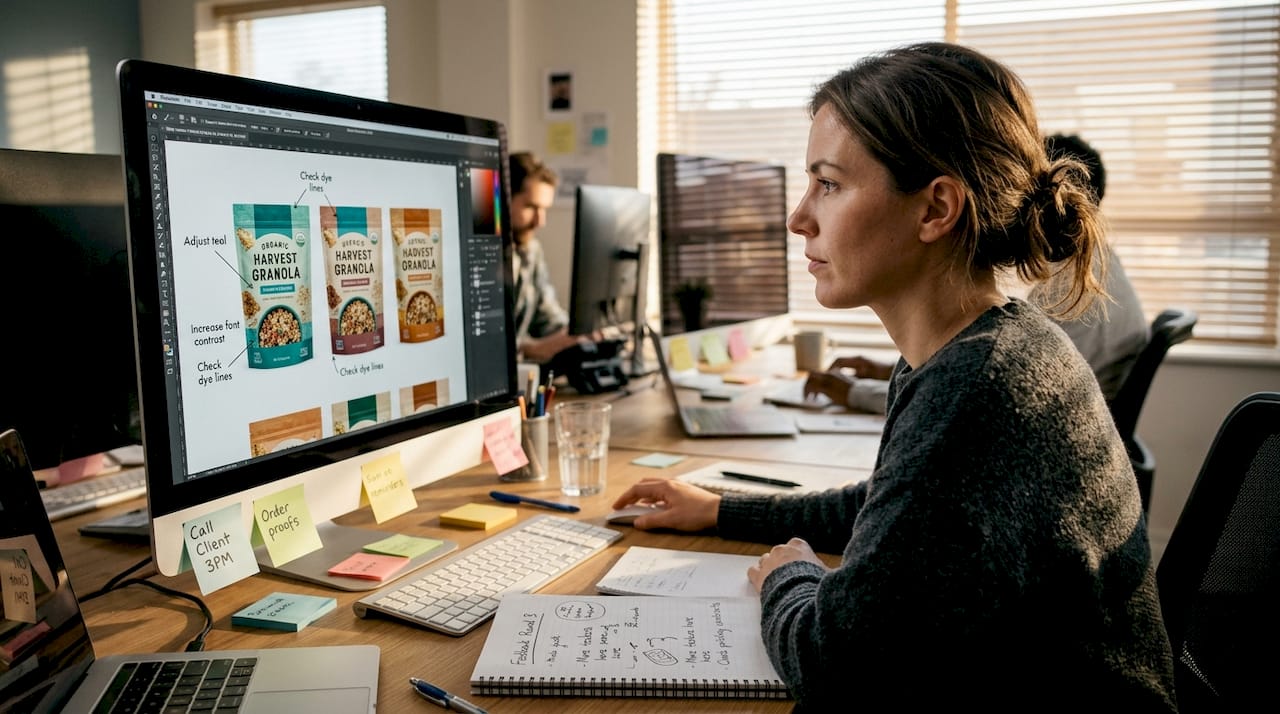
Once objectives are clear, it's time to accelerate concepts with rapid, adaptive methods. Traditional concept development often stretches across months of internal reviews, agency presentations, and fragmented consumer feedback. AI tools and structured iterative testing compress that timeline dramatically.
Here's a proven numbered workflow for concept development:
- Generate initial concepts based on the brief, targeting three to five distinct directions.
- Run the first consumer test with 60 to 100 users to identify which direction resonates.
- Refine the leading concept using feedback, adjusting hierarchy, color, and messaging.
- Retest the refined design with a fresh panel to confirm improvements hold.
- Run shelf validation to confirm the design performs in a realistic purchase context.
Iterative consumer testing in three rounds can be completed in just 6 to 8 weeks when AI tools support concept tweaking between rounds. That's a fraction of traditional timelines. More importantly, AI tools show 80%+ correlation to in-market sales uplift, meaning you're not just moving faster, you're moving with more confidence.
| Method | Timeline | Predictive accuracy |
|---|---|---|
| Traditional agency rounds | 3 to 6 months | Variable |
| AI-assisted iterative testing | 6 to 8 weeks | 80%+ correlation |
| Internal review only | 2 to 4 weeks | Low |
Teams working on adapting templates with AI can cut concept generation time even further by starting from proven structural frameworks rather than blank canvases. And if you're building a visual system from scratch, understanding vector graphics in packaging ensures your files stay scalable and print-ready throughout every iteration.
Pro Tip: After each testing round, use AI tools to generate three to five quick visual tweaks based on the top consumer feedback themes. This keeps momentum without waiting for a full agency turnaround.
Test in shelf context — why realism matters
Validating designs in context is the next critical step, and this is where realism pays off. Most packaging decisions happen in under three seconds at shelf. A design that looks polished in isolation can completely disappear when surrounded by competing products.
Shelf-context testing simulates the actual purchase environment, either through physical mockups placed in a store-like setting or virtual shelf tools that replicate the visual noise of a real retail fixture. The difference in predictive power is significant.
| Testing type | Best use case | Predictive value |
|---|---|---|
| Isolated design review | Early clarity and hierarchy checks | Low to moderate |
| Virtual shelf test | Mid-stage validation, fast turnaround | High |
| Physical shelf mockup | Final validation before print commitment | Highest |
Shelf-context testing predicts 70 to 76% of actual purchase decisions, while isolated visual feedback is better suited only for initial clarity checks. That gap matters when you're committing to a print run.
"Shelf testing removes the guesswork from final design decisions. When a concept performs well in context, the whole team moves forward with confidence rather than hope."
Setting up a shelf mockup test doesn't require a large budget. Virtual shelf tools let you upload your design, populate a realistic fixture with competitor SKUs, and run consumer eye-tracking or click tests remotely. For teams preparing files for production, reviewing print-ready packaging essentials before shelf testing ensures the design you're validating is also the design you can actually produce.
Reduce costs and cycles via procurement optimization
With validation done, controlling costs is the final lever for high-efficiency workflows. Design quality means nothing if the production process erodes your margin or delays your launch. Procurement optimization is where workflow discipline translates directly into budget savings.
Here are the most effective cost-saving steps for CPG packaging teams:
- Forecast material needs early to avoid rush orders and spot-buy premiums.
- Reuse and adapt existing templates rather than commissioning entirely new structural designs.
- Negotiate with suppliers before the brief is finalized, not after designs are locked.
- Model design-to-budget scenarios so creative decisions account for print costs from the start.
- Consolidate SKUs where possible to reduce tooling and setup costs across a product line.
Global CPG companies save 20% on packaging costs by combining procurement optimization with better forecasting. That's not a marginal improvement, it's a structural shift in how design and supply chain teams collaborate.
| Workflow adjustment | Estimated cost impact |
|---|---|
| Template reuse vs. new structural design | 30 to 50% reduction in design fees |
| Early supplier negotiation | 10 to 15% reduction in material costs |
| Consolidated SKU production runs | 15 to 25% reduction in setup costs |
| Procurement forecasting | Up to 20% total packaging cost savings |
For teams exploring sustainable packaging options, procurement optimization also opens the door to better material sourcing without cost penalties. And if you need cost-effective design inspiration to keep creative quality high while staying on budget, there are proven approaches that don't require agency-level spend.
Pro Tip: Build a vendor feedback review into every project cycle. Ask suppliers to flag cost-reduction opportunities during the design phase, not after files are submitted for production.
Why quick wins in design workflow are often overlooked
Beyond tactics and tools, the true differentiator might surprise you. Most packaging teams we talk to are chasing the next AI tool, the next testing platform, or the next design trend. What they're not doing is auditing the handoffs between their last three projects.
The uncomfortable reality is that the biggest workflow gains rarely come from new technology. They come from enforcing the basics: a complete brief, a scheduled alignment meeting, a disciplined file handoff checklist. Teams that do these things consistently outperform teams with better tools but looser processes.
AI is genuinely useful, but it amplifies whatever process it sits inside. Feed it a vague brief and you get faster vague concepts. Feed it a clear brief with defined consumer targets and you get actionable directions in hours. The technology doesn't fix the communication problem, it magnifies it.
Reviewing common pitfalls in design workflows reveals that most failures trace back to a missed handoff or an assumption that wasn't checked. Audit your last three projects. Find the step where momentum stalled. Fix that handoff. That single change will deliver faster ROI than any tool upgrade.
Accelerate your packaging innovation with Offcut
Ready to put these workflow improvements into action? Offcut is built for exactly this moment, when you know what a better process looks like and need the right starting point to move fast.
Offcut's marketplace connects CPG brands with pre-vetted, print-ready packaging concepts created by professional designers. Instead of starting from a blank brief and waiting weeks for agency concepts, you can browse exclusive designs, buy what fits your brand, and move straight to refinement and testing. Designers on the platform get paid for work that would otherwise sit unused, and brands get a faster, more cost-effective path to shelf. Whether you want to sell unused packaging concepts or explore how the platform works, our packaging marketplace is the most direct route from strategy to shelf-ready design.
Frequently asked questions
What is the most effective way to test CPG packaging concepts?
Shelf-context testing predicts 70 to 76% of purchase decisions, making it the highest-value method for validating designs before committing to production. Virtual shelf tools offer a fast, cost-effective way to run this kind of test.
How does AI improve the packaging design workflow?
AI tools speed up concept generation and enable rapid iteration between testing rounds. With 80%+ correlation to in-market uplift, they also give teams stronger confidence that the designs they're advancing will actually perform at shelf.
What's the average cost saving from optimizing procurement in CPG packaging?
Global CPGs save up to 20% on packaging costs by combining procurement optimization with early forecasting and supplier negotiation strategies.
Why do most packaging design redesigns fail to increase sales?
Only 37% of CPG redesigns increase sales, typically because objectives weren't clearly defined and consumer feedback wasn't built into the process early enough.