
TL;DR:
- Clear packaging needs and brand values are essential before sourcing design talent.
- Multiple sourcing options exist, with tradeoffs in cost, quality, and time, including outsourcing.
- Consumer testing in multiple rounds ensures packaging designs perform well at retail shelf for higher conversion.
Your packaging is often the first salesperson your product ever has. For CPG founders, the difference between a design that stops shoppers cold and one that gets skipped entirely can determine whether a launch succeeds or quietly fades. The real challenge is not just finding a talented designer. It is finding one who understands your category, fits your budget, and can deliver something that actually moves product. This guide walks you through every step: clarifying your needs, sourcing talent, evaluating portfolios, and testing designs before you commit a single dollar to print.
Table of Contents
- Define your packaging needs and sourcing criteria
- Where and how to source affordable design talent
- Evaluating portfolios and shortlisting designers
- Testing, iteration, and final selection
- Why the cheapest design isn't the best investment
- How OffCut helps you source winning packaging design
- Frequently asked questions
Key Takeaways
| Point | Details |
|---|---|
| Clarify needs first | Defining your packaging objectives and criteria upfront ensures you avoid costly missteps. |
| Vet designers thoroughly | Examine portfolios, credentials, and communication to find partners who deliver real brand value. |
| Test and iterate | Use structured consumer testing and feedback loops to validate concepts before launch. |
| Look beyond price | The best long-term value comes from chemistry, case studies, and a tailored design process—not just the lowest bid. |
Define your packaging needs and sourcing criteria
Before you open a single browser tab to search for designers, you need to know exactly what you are asking for. Founders who skip this step end up with proposals that miss the mark entirely, wasting weeks of back-and-forth.
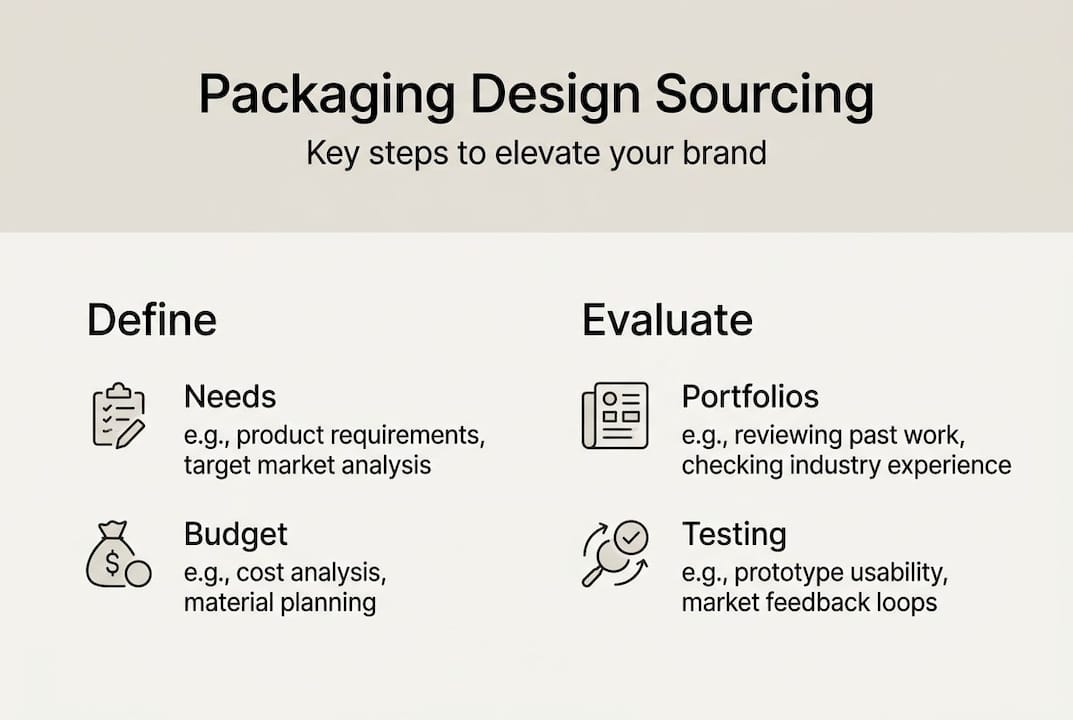
Start by writing down your core brand values. Are you positioned as premium, playful, sustainable, or clinical? Your packaging must communicate that positioning in under three seconds on a shelf. Then layer in your functional requirements: material type, size constraints, regulatory labeling needs, and sustainability commitments. These are not nice-to-haves. They are filters that immediately narrow your designer pool.
Here is a quick overview of the must-haves most founders need to nail down before sourcing:
- Brand positioning: Premium, natural, budget, or niche
- Functional specs: Dimensions, material, finish, and print method
- Regulatory requirements: Ingredient lists, certifications, country-specific rules
- Sustainability goals: Recyclable, compostable, or reduced-material targets
- Budget range: Total design fee and revision rounds included
- Timeline: Hard launch date and any retailer deadlines
Once you have these mapped out, you can approach procurement strategies with a structured brief rather than a vague request. This single step cuts sourcing time dramatically.
| Priority | What to define | Why it matters |
|---|---|---|
| Brand values | Tone, visual language, target shopper | Aligns designer creative direction |
| Functional specs | Size, material, print method | Prevents costly rework at production |
| Regulatory needs | Labels, certifications, warnings | Avoids compliance failures post-launch |
| Budget and timeline | Fee, rounds, hard deadline | Sets realistic expectations upfront |
For cost-effective packaging inspiration that shows what is possible across price points, reviewing real-world examples before briefing a designer helps you articulate what you want visually.
Pro Tip: Do not default to the lowest bidder. Chemistry, case studies, credentials, and value consistently outperform price alone as selection criteria. A designer who has solved your exact shelf problem before is worth paying more for.
Also think about boosting consumer packaging appeal as a goal from day one. The brief you write should mention the emotional response you want shoppers to feel when they pick up your product.
Where and how to source affordable design talent
With a clear brief in hand, you have several sourcing paths available. Each has real tradeoffs in cost, quality, speed, and risk.
Agencies offer full-service support and deep CPG expertise, but fees often start at $10,000 and climb fast. Freelancer platforms like Upwork or Fiverr give you access to a wide talent pool at lower rates, though vetting takes time. Design contest platforms generate multiple concepts quickly but can produce generic results. Design marketplaces like Offcut offer pre-made, print-ready concepts from skilled designers at a fraction of custom costs. Direct outreach to designers whose work you admire is slower but often yields the best fit.
| Source | Cost range | Lead time | Key risk |
|---|---|---|---|
| Full-service agency | $10,000 and up | 6 to 12 weeks | High cost, slower iteration |
| Freelancer platforms | $500 to $5,000 | 2 to 6 weeks | Quality varies widely |
| Contest platforms | $300 to $1,500 | 1 to 2 weeks | Generic, low differentiation |
| Design marketplaces | $200 to $2,000 | Days to 1 week | Limited customization |
| Direct outreach | Negotiable | 3 to 8 weeks | Time-intensive to source |
One increasingly popular option is international outsourcing. Outsourcing to low-cost regions like Vietnam can save 20 to 30 percent, but it requires IP protection, clear briefs, and thorough portfolio checks before you commit. Use signed contracts that specify IP ownership transfers to you upon final payment.
Here is a step-by-step process for engaging designers globally without getting burned:
- Write a detailed brief including brand values, specs, regulatory needs, and visual references
- Search platforms or directories and filter by CPG-specific portfolio work
- Shortlist three to five candidates based on category relevance and style fit
- Send a paid test brief or request a proposal before committing to a full project
- Confirm IP ownership terms in writing before sharing any brand assets
- Establish a milestone-based payment schedule tied to deliverables
For founders who want to skip the sourcing grind entirely, exploring unused packaging concepts from professional designers can surface ready-to-go work that already meets print standards.
Pro Tip: Always review designer portfolios specifically for CPG work across multiple categories. A designer who has only done tech branding will struggle with the tactile and regulatory demands of consumer goods packaging.
Evaluating portfolios and shortlisting designers
Portfolio review is where most founders make their biggest mistakes. They look for work that looks pretty rather than work that solves shelf problems.

A strong CPG portfolio tells a story. It shows how a designer approached a brief, what constraints they worked within, and what the result achieved. Look for variety across categories, formats, and price points. A designer who has worked on both premium skincare and budget snack packaging understands the full range of shelf dynamics.
Signs of a strong CPG portfolio:
- Varied categories: Food, beverage, beauty, household, or health products
- Before and after context: Brief, challenge, and outcome explained
- Print-ready files: Evidence of production-ready deliverables, not just mockups
- Regulatory awareness: Labels that include correct information hierarchy
- Shelf context shots: Designs shown in realistic retail environments
Red flags to watch for:
- Only digital or screen-based work with no physical packaging examples
- Template-heavy designs that look identical across projects
- No explanation of the creative process or rationale
- Missing or vague client references
For a deeper look at what separates great from average, reviewing a design portfolio workflow built specifically for CPG brands gives you a useful benchmark. You can also find CPG portfolio tips that explain what experienced buyers actually look for.
Shortlist checklist: Strong communication style, verifiable CPG case studies, a unique creative process without reliance on templates, clear credentials or client references, and demonstrated understanding of your product category.
According to sourcing best practices, chemistry, case studies, and credentials are the three pillars of a reliable designer relationship. Chemistry matters more than most founders expect. A brief video call before signing anything tells you whether this person will be easy to work with through revisions.
Pro Tip: Treat the first call as a two-way interview. Ask how they handle feedback, what their revision process looks like, and for one example where a client pushed back on their concept. Their answer reveals everything about how the project will actually go.
For founders building their first product line, following a step-by-step packaging design process helps you ask better questions during portfolio review.
Testing, iteration, and final selection
Even the best-looking design is just a hypothesis until real shoppers weigh in. Testing is not optional for founders who want to reduce launch risk.
The most important statistic in CPG is this: 70 to 76 percent of purchase decisions are made at the shelf. That means your packaging is not just branding. It is a sales tool that either converts or does not in under three seconds.
Here is a proven three-step testing cycle:
- Concepts round: Present two to three design directions to 60 to 80 target users. Measure first impressions, perceived value, and category fit. Eliminate directions that score poorly on shelf standout.
- Refinement round: Take the top one or two directions and iterate based on feedback. Test with 80 to 100 users. Focus on messaging clarity, color response, and purchase intent.
- Validation round: Place the refined design in a simulated shelf environment alongside competitors. Measure eye-tracking response, pick-up rate, and stated purchase intent.
| Test phase | Sample size | Focus | Timeline |
|---|---|---|---|
| Concepts | 60 to 80 users | First impression, standout | 1 to 2 weeks |
| Refinement | 80 to 100 users | Messaging clarity, purchase intent | 1 to 2 weeks |
| Validation | 50 to 80 users | Shelf context, competitive comparison | 1 week |
This process sounds involved, but online consumer testing tools have made it faster and cheaper than ever. You can run a full concepts round in under a week for a few hundred dollars.
For founders managing multiple SKUs or a rebrand, building a structured packaging workflow improvement process saves significant time across rounds. Final selection should never be based on personal taste alone. Let the data lead.
Why the cheapest design isn't the best investment
Here is something most sourcing guides will not tell you: the founders who regret their packaging decisions almost always chose based on price first. Not because affordable design is bad, but because they confused low cost with low risk.
The upfront design fee is a tiny fraction of your total shelf investment. You are also paying for production, distribution, retailer fees, and marketing. A design that underperforms on shelf costs you far more than the difference between a $500 and a $3,000 designer.
Template-based solutions rarely produce breakthrough results. They produce acceptable results. And acceptable does not win shelf space or repeat purchases in a crowded category.
What actually compounds over time is the combination of chemistry, case studies, and a proven process. A designer who has solved your specific problem before brings shortcuts you cannot buy at any price. They know which color systems read well under fluorescent retail lighting. They know how to balance regulatory text with visual hierarchy without killing the design.
Investing in updating packaging for impact is not a one-time cost. It is a brand-building decision that pays dividends every time a shopper picks up your product instead of a competitor's. The founders who treat design as a strategic asset rather than a line item to minimize are the ones who build brands that last.
How OffCut helps you source winning packaging design
If you have worked through this sourcing process and want to skip straight to results, Offcut was built for exactly this moment.
Offcut connects CPG founders to a curated pool of professional designers with proven CPG portfolios. Instead of sifting through generic freelancer platforms, you get access to exclusive, print-ready packaging concepts created by designers who understand shelf dynamics and brand differentiation. These are not template jobs. They are real concepts that would otherwise sit on a hard drive, now available at a fraction of custom agency cost. Browse the OffCut designer directory to find talent that fits your category, or browse packaging solutions to discover ready-to-go concepts that can transform your brand presence faster than a traditional design engagement.
Frequently asked questions
What are the best places to source packaging design on a budget?
Freelancer platforms, specialized design directories, and overseas providers are top options when you carefully vet portfolios and safeguard your IP. Outsourcing to low-cost regions can save 20 to 30 percent, but IP protection is non-negotiable.
How do I know if a packaging designer is good?
Look for varied CPG case studies, verifiable credentials, a transparent creative process, and strong communication from the first interaction. Chemistry, case studies, and credentials consistently predict project success better than price or style alone.
What's the safest way to test packaging designs before launch?
Use multi-round consumer testing: start with concepts shown to 60 to 80 users, refine with feedback from 80 to 100 users, then validate in shelf context with simulated retail environments to predict real purchase intent.
Is it safe to outsource packaging design internationally?
Yes, when you use signed contracts that transfer IP ownership, write detailed briefs, and review portfolios for relevant CPG experience. Clear briefs and IP protection are the two requirements that separate successful international engagements from costly ones.