
TL;DR:
- Upgrading packaging design boosts sales and consumer preference by enhancing shelf impact.
- Proactively refreshing packaging before sales decline leverages consumer insights and reduces risks.
- Combining consumer testing with creative innovation results in effective, validated packaging updates.
Packaging is often the last thing founders think about changing and the first thing consumers judge. A well-timed redesign can be the difference between a product that gets picked up and one that gets passed over. Real-world data backs this up: brands that refreshed their packaging saw results like Tyson preferred 2:1 over its old design, Wei-Chuan gaining a 13-point purchase intent lift and an 18% sales increase, and Snuggle Puppy achieving an 18-point lift. This guide walks you through why, when, and how to update your packaging so your brand stays competitive and compelling.
Table of Contents
- The case for updating packaging design
- Recognizing when it's time to refresh
- Best practices: How to update packaging for maximum market impact
- Pitfalls to avoid: Learning from costly mistakes
- The Offcut perspective: The hidden costs and overlooked wins of package updates
- Move forward: Expert help for your packaging redesign
- Frequently asked questions
Key Takeaways
| Point | Details |
|---|---|
| Packaging updates drive sales | Modernizing your packaging can deliver significant boosts in purchase intent and revenue. |
| Validate with consumer science | Rely on neuromarketing and rigorous consumer testing to avoid costly mistakes. |
| Refresh before you fall behind | Recognize early signals that your packaging may be losing its market effectiveness. |
| Protect your brand assets | Keep recognizable elements that anchor your product in the minds of customers. |
The case for updating packaging design
Your packaging works hard every single day. It sits on a shelf next to dozens of competitors, gets picked up, put down, photographed, and scrolled past. When it stops doing its job, sales stagnate quietly and you often don't realize why until the damage is done.
Outdated packaging limits shelf impact in ways that are easy to overlook internally. Your team sees the product every day. Consumers see it once, in a crowded aisle, for about three seconds. If your design doesn't immediately communicate value, freshness, and relevance, you lose that moment.
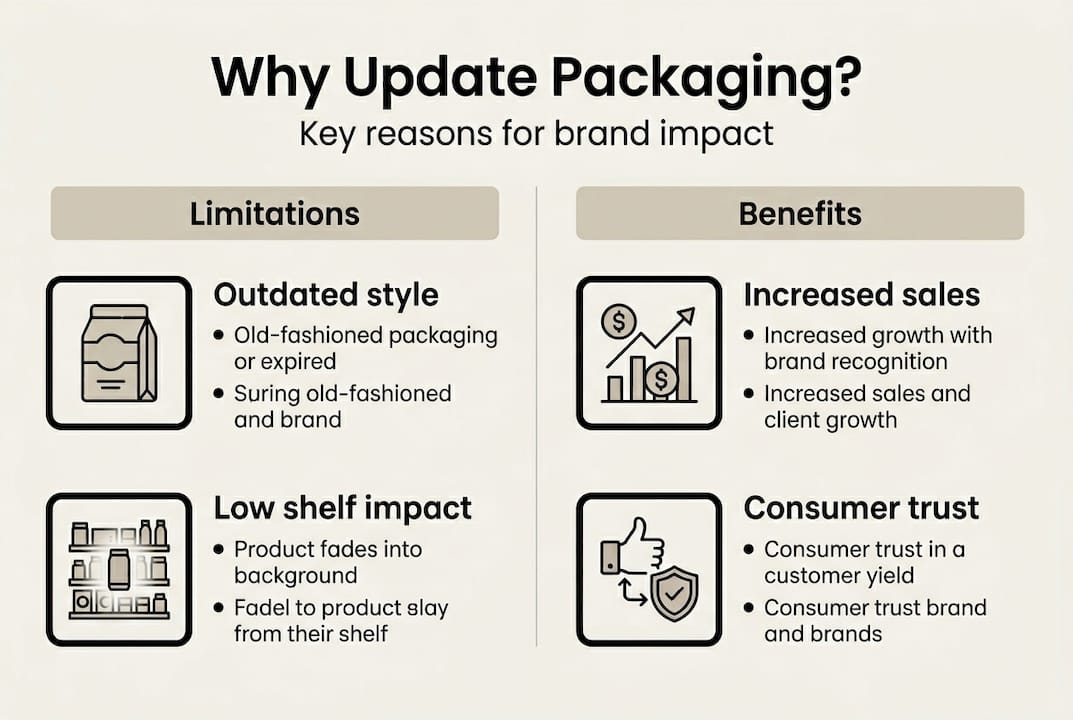
The business case for refreshing is well documented. Purchase intent lifts across multiple CPG categories show that packaging updates consistently move the needle on sales and preference metrics. Here's a snapshot of what real brands achieved:
| Brand | Metric improved | Result |
|---|---|---|
| Tyson | Consumer preference | 2:1 preferred over old design |
| Wei-Chuan | Purchase intent + sales | +13 points intent, +18% sales |
| Snuggle Puppy | Purchase intent | +18 points |
These aren't outliers. They reflect what happens when design catches up to consumer expectations.
Consumer expectations shift faster than most brand managers track. Trends in color, typography, sustainability signaling, and minimalism move quickly. A package that looked premium in 2019 can look dated and cheap in 2026 without a single thing changing about the product inside.
Here's what outdated packaging typically costs you:
- Lost shelf visibility when fresher competitor designs dominate the eye path
- Reduced perceived quality, which directly affects willingness to pay
- Missed sustainability signals that increasingly drive purchase decisions
- Confusion at retail when packaging doesn't reflect current brand positioning
"Packaging is the most cost-effective marketing tool a CPG brand has. When it underperforms, every other marketing dollar works harder than it should."
For founders and brand managers, the takeaway is clear. Investing in packaging appeal tips isn't cosmetic. It's a revenue decision.
Recognizing when it's time to refresh
Knowing the value of a redesign is one thing. Knowing exactly when to pull the trigger is another. Most brands wait too long, often until a sales decline forces the conversation. By then, the cost of inaction is already baked in.
There are clear signals that your packaging needs a refresh, and most of them show up before the revenue dip does.
Watch for these triggers:
- Sales plateau or decline with no clear cause in pricing, distribution, or product quality
- Competitor packaging looks newer and is outperforming you at shelf or in digital thumbnails
- Consumer feedback mentions confusion about what the product is, who it's for, or what makes it different
- Brand positioning has evolved but packaging still reflects the old story
- Sustainability goals require updated materials or certifications that need to be communicated visually
- Line extensions have made the original design system feel fragmented or inconsistent
One of the most underrated signals is what happens when your product moves to e-commerce. Packaging designed for physical retail often fails as a thumbnail. Small fonts, busy backgrounds, and low-contrast color choices disappear at 200 pixels wide. If your product looks forgettable on Amazon or Instacart, that's a redesign trigger.
Pro Tip: Pull your top three competitor SKUs and put them next to yours on a table. If yours looks like it belongs to a different era, your customers are noticing too.
The use of whitespace is one of the fastest ways to modernize a package without a full overhaul. Brands that overcrowd their panels often do so out of a fear of missing information. But consumers don't read packaging, they scan it. Clarity beats completeness every time.
Also pay attention to common packaging pitfalls that quietly erode shelf performance. Brands that saw 2:1 preference gains after a redesign weren't just updating aesthetics. They were correcting structural communication failures that had been costing them for years.

The right time to refresh is before the problem becomes obvious. Proactive updates give you the space to test, iterate, and launch with confidence rather than scrambling to stop a sales slide.
Best practices: How to update packaging for maximum market impact
A packaging refresh done right is a structured process, not a creative gut check. The brands that see the biggest returns treat it like a science project with a creative brief attached.
The three-stage iterative testing process is the most reliable framework for de-risking a redesign:
- Direction round — Test multiple design directions with consumers to identify which visual language resonates most strongly before investing in refinement.
- Refinement round — Take the leading direction and test variations. Fine-tune color, hierarchy, and messaging based on real feedback rather than internal preference.
- Validation round — Simulate shelf conditions and test the final design against your current packaging and key competitors to confirm performance before launch.
This process, grounded in neuromarketing and consumer testing, uses eye-tracking to measure noticeability and findability, and EEG to measure purchase activation. These tools tell you what consumers actually respond to, not just what they say they like in a focus group.
| Approach | What it measures | Risk level |
|---|---|---|
| Focus groups only | Stated preference | High (opinion-based) |
| Neuromarketing + testing | Subconscious response + intent | Low (behavior-based) |
| No testing at all | Nothing | Very high |
Protecting your distinctive brand assets is just as important as introducing new ones. Colors, shapes, icons, and typographic styles that consumers already associate with your brand carry equity. Throwing them out in the name of modernization is one of the most common and expensive mistakes in CPG. Evolve them. Don't erase them.
Pro Tip: Before any design brief goes out, document your brand's distinctive assets and mark which ones are non-negotiable. This protects your equity and gives designers a clear creative sandbox.
For founders exploring innovative packaging trends or refining their packaging workflow strategies, the key is pairing creative ambition with consumer validation at every stage. Understanding the designers' role in packaging concept creation also helps you brief better and get stronger work from the start.
Pitfalls to avoid: Learning from costly mistakes
Even well-funded brands with experienced teams have made packaging decisions that cost them millions. The lessons are clear, if you're willing to learn from someone else's pain.
The most famous example is Tropicana. In 2009, PepsiCo launched a redesigned Tropicana package that removed the iconic orange-with-straw image and replaced it with a generic glass of juice. Sales dropped 20% in two months, representing roughly $30 million in lost revenue. The design wasn't bad in isolation. It just stripped out every visual cue that made consumers recognize and trust the brand on shelf.
"Neuromarketing predicts success better than surveys; avoid Tropicana pitfalls like removing iconic elements without pre-launch validation."
The Tropicana case illustrates a failure pattern that repeats across CPG categories. Here's what typically goes wrong:
- Removing iconic visual assets without testing whether consumers can still find and identify the product
- Relying on internal opinion instead of behavioral data to make design decisions
- Skipping shelf simulation so the new design is only ever seen on a screen, never in context
- Treating a redesign as a creative project rather than a business decision with measurable outcomes
- Rushing to launch without a validation round that compares new versus old in realistic conditions
Multi-method validation matters because no single research tool captures the full picture. Eye-tracking tells you if consumers see the package. EEG tells you if it activates purchase intent. Sales simulation tells you if it converts. Using only one method is like navigating with half a map.
For a deeper look at what causes these failures, the design failure case studies at Offcut break down the patterns behind some of the most avoidable losses in CPG packaging history. The common thread is always the same: speed and opinion replaced process and evidence.
The Offcut perspective: The hidden costs and overlooked wins of package updates
Most packaging guides focus on risk management, and for good reason. The Tropicana story is a powerful cautionary tale. But fixating on what could go wrong causes a different problem: brands that never update at all, slowly losing relevance while playing it safe.
The opportunity cost of not refreshing is real and rarely calculated. Every month your packaging underperforms is a month your competitor's fresher design is building preference with your potential customers. That's not a hypothetical. It's a compounding loss.
The best packaging refreshes we've seen combine two things that standard guides treat as separate: rigorous consumer science and genuine creative instinct. Data tells you what's not working. Creativity tells you what could be remarkable. You need both.
There's also an internal dimension that almost no one talks about. A packaging refresh, done well, creates cross-team energy. Sales gets a story to tell retailers. Marketing gets new assets. The founding team reconnects with why the brand exists. That momentum is real and it shows up in how the product gets sold.
Exploring concept packaging value early in the process gives you creative options without the full agency commitment, which means you can move faster and take smarter risks.
Move forward: Expert help for your packaging redesign
You now have the framework. The next step is finding design concepts worth testing. That's where Offcut changes the equation for CPG founders.
Offcut is where great packaging designs go instead of a hard drive. Designers create outstanding concepts that never make it to market, and founders like you get access to exclusive, print-ready work at a fraction of what an agency would charge. No lengthy briefs, no bloated retainers. Just strong, tested creative that's ready to move. If you're a designer with unused concepts, you can sell unused packaging concepts and get paid for work that deserves to be seen. If you're a founder ready to refresh, explore packaging design solutions built for brands that want to move fast without cutting corners.
Frequently asked questions
What is the main benefit of updating packaging design?
Updating packaging can increase sales, boost purchase intent, and improve customer engagement. Real brand results show measurable lifts in preference and sales after a well-executed refresh.
How often should brands update their packaging design?
Brands should consider an update every few years, or sooner if market trends shift, competitors outpace them, or customer feedback signals confusion or lost relevance.
How can we avoid mistakes when changing our packaging?
Use a research-driven approach that includes neuromarketing and iterative testing to validate new designs before launch, so you're acting on behavior data rather than internal opinion.
Do small packaging changes make a noticeable difference?
Yes. Even targeted updates like adjusting color contrast or reinforcing distinctive brand assets can yield measurable shelf impact gains, as eye-tracking and EEG research consistently shows.