
TL;DR:
- Unused packaging designs are valuable assets that can generate income when properly assessed and sold.
- Protect your intellectual property through registration and documentation before selling to ensure ownership rights.
- Active promotion and choosing the right platform, like Offcut, increase chances of successfully turning unused concepts into profit.
You've got packaging concepts sitting in folders you haven't opened in months. Maybe a client changed direction, a product launch stalled, or a pitch didn't land. Those files aren't failures — they're untapped assets. For CPG entrepreneurs and founders, unused packaging designs represent a real opportunity to generate income without starting from scratch. This guide walks you through exactly how to assess, protect, list, and promote your unused packaging concepts so they start earning instead of collecting digital dust.
Table of Contents
- Assessing and preparing your unused designs
- Protecting your intellectual property before selling
- Choosing the right selling platforms and methods
- Promoting your unused designs to attract buyers
- A fresh perspective: The hidden upside of selling unused packaging designs
- Ready to turn unused concepts into profit?
- Frequently asked questions
Key Takeaways
| Point | Details |
|---|---|
| Prepare your designs | Organize, polish, and summarize each unused concept before listing it for sale. |
| Protect your IP | Register copyrights or trademarks to maintain rights and maximize value. |
| Choose the right platform | Use specialized marketplaces for packaging designs to reach the right buyers easily. |
| Promote strategically | Market your unused designs actively to stand out and boost your sales. |
| Unlock creative potential | Selling unused designs can lead to new income and creative opportunities in the packaging industry. |
Assessing and preparing your unused designs
Before you list anything for sale, you need to know what you actually have. Not every unused concept is worth selling, and throwing a messy folder of half-finished files at a buyer is a fast way to damage your reputation before you've even started.
Start by reviewing your archive with fresh eyes. Ask yourself: Is this design original? Does it solve a real packaging problem? Would a CPG brand in today's market actually use this? If the answer to all three is yes, it's worth preparing for sale. If a concept is too niche, too dated, or tied to a specific client brief, it's probably better left in the archive.
Once you've identified your strongest candidates, organize the files properly. Buyers expect a clean handoff. That means:
- Dielines in industry-standard formats (AI, PDF, or EPS)
- Editable source files with layers clearly labeled
- High-resolution mockups showing the design in context
- A brief concept summary explaining the design's intent, target market, and suggested use cases
- Font and asset documentation so buyers know what licenses they may need
This level of preparation signals professionalism and justifies a higher price point. Think of it like staging a home before selling — presentation drives perceived value. If you want ideas on how strong packaging concepts are structured, packaging design inspiration is a useful reference for what buyers respond to.
Pro Tip: Write a one-paragraph "design story" for each concept. Explain the problem it solves, the consumer it targets, and the category it fits. Buyers aren't just purchasing pixels — they're buying a strategic asset.
Before you do anything else, verify that you own the design outright. If it was created for a client, even speculatively, review any contracts or agreements you signed. Ambiguous ownership is the number one reason design sales fall apart.
Here's a quick checklist to evaluate each design's readiness:
| Criteria | Ready to sell | Needs work |
|---|---|---|
| Original concept, no client IP | Yes | Unclear ownership |
| Complete, editable source files | All formats included | Missing layers or fonts |
| Mockup or visual presentation | High-res, in context | Placeholder only |
| Concept summary written | Clear and specific | None or vague |
| Copyright ownership confirmed | Documented | Unverified |
For designers building a track record in the CPG space, portfolio tips for CPG clients can also help you present your work in a way that attracts serious buyers.
Protecting your intellectual property before selling
With your designs in order, shift focus to protecting your intellectual property so your ideas remain your asset, not someone else's.
Skipping this step is one of the most expensive mistakes you can make. Once a design changes hands without proper documentation, proving ownership becomes nearly impossible. And if a buyer uses your concept commercially and you haven't established your rights, you may have no legal recourse.

For CPG entrepreneurs, protect IP before selling — including trademarks and patents on designs — is a foundational step that directly affects the value a buyer assigns to your work.
Here's how the main IP protections apply to packaging designs:
| Protection type | What it covers | Best for |
|---|---|---|
| Copyright | Original artistic expression in the design | Graphic elements, illustrations, layout |
| Trademark | Brand identifiers like logos, names, or symbols | Designs with distinctive brand marks |
| Design patent | Ornamental appearance of a functional item | Unique structural or visual packaging forms |
Copyright protection in the U.S. is automatic upon creation, but registering with the U.S. Copyright Office gives you the ability to sue for statutory damages — a meaningful deterrent. Trademarks require registration through the USPTO if you want federal protection.
Beyond registration, document everything. Keep dated records of your design process: sketches, drafts, version histories, and any correspondence related to the concept. This paper trail is your evidence if ownership is ever disputed.
"A design without documented ownership is just a pretty file. Establish your rights before you sell, not after."
You also need to decide whether you're assigning or licensing the design. Assignment means the buyer gets full ownership — you walk away permanently. Licensing means you retain ownership and grant specific usage rights. Licensing can generate recurring income, but it requires a more detailed contract. Assignment is cleaner but final.
For founders building a CPG brand from scratch, understanding these distinctions early is critical. Packaging design for startups covers how IP decisions at the concept stage affect your options down the line.
Never skip the contract. At minimum, your sale agreement should specify: what's being transferred, what rights the buyer receives, what you retain, payment terms, and any liability limitations.
Choosing the right selling platforms and methods
Now that your designs and IP are secure, you're ready to decide where and how you'll actually sell these assets.
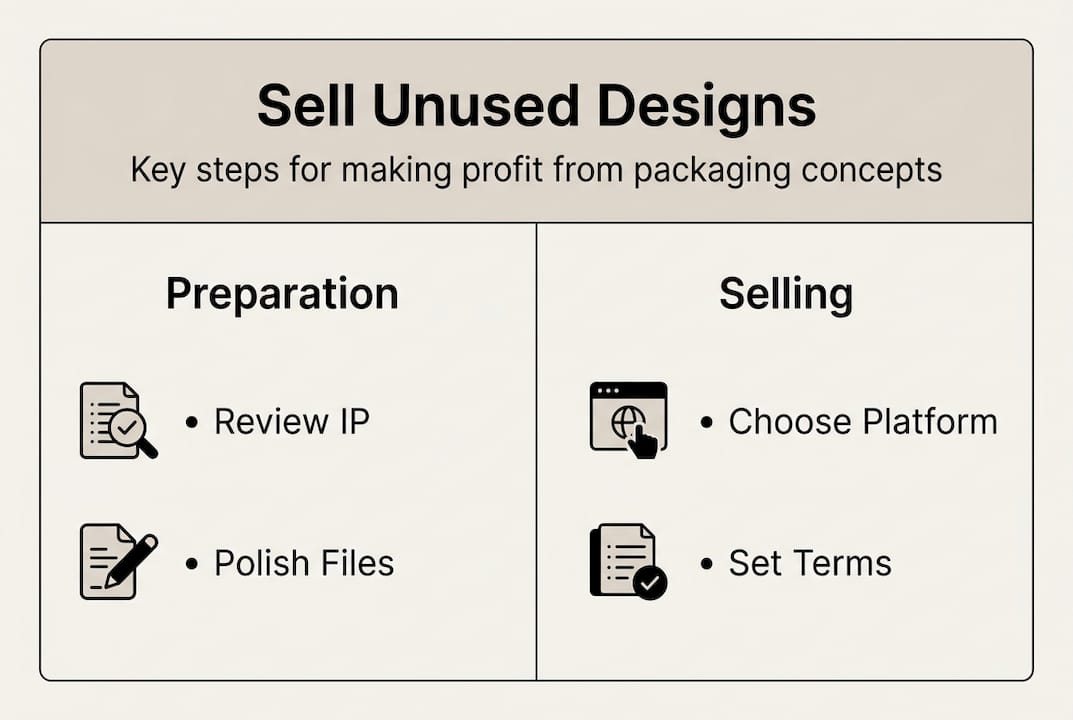
The platform you choose shapes everything: your pricing power, your buyer pool, and how much control you keep over the transaction. There's no single right answer, but there are clear tradeoffs.
Specialized design marketplaces are the fastest route to a qualified audience. Dielines and mockups sell via specialized sites like Pacdora or PackagingSeller, where buyers are already looking for exactly what you're offering. Offcut operates in this same space, connecting CPG founders with print-ready packaging concepts at a fraction of agency cost.
Direct sales give you more control and higher margins, but require more effort. You'll need to find buyers yourself, manage negotiations, and handle contracts independently.
Here's a comparison to help you decide:
| Method | Pros | Cons |
|---|---|---|
| Specialized marketplace | Built-in audience, payment protection | Platform fees, less pricing control |
| Direct to buyer | Higher margins, full control | More outreach required, slower |
| Design agency partnerships | Volume potential, recurring relationships | Longer sales cycles, lower per-unit price |
To set up a strong listing, follow these steps:
- Write a clear, benefit-focused title that names the product category and design style
- Include high-quality mockups showing the design on actual packaging formats
- List all included file formats and what's editable
- State the suggested use case and target consumer
- Price based on design quality, exclusivity, and comparable sales
Pro Tip: Exclusive designs (sold once, to one buyer) command significantly higher prices than non-exclusive licenses. If your concept is strong, lead with exclusivity.
Understanding CPG mockup types will help you present your designs in formats buyers recognize and trust. And if you want to understand what makes a concept feel premium before listing, enhance packaging appeal breaks down the visual cues that drive buyer confidence.
Promoting your unused designs to attract buyers
Having chosen where you'll sell, successful promotion becomes the main driver for making your unused designs stand out.
Listing a design and waiting is not a strategy. The CPG design marketplace is competitive, and buyers have options. You need to actively put your work in front of the right people.
Start with your presentation. A great mockup does more selling than any description. Show your design on a real-world format — a shelf, a hand holding a product, a lifestyle context. Buyers need to see the concept living in the real world, not just as a flat file.
Here's where to share your designs for maximum reach:
- Behance and Dribbble for creative community visibility and inbound interest
- LinkedIn for direct outreach to CPG brand managers and procurement leads
- Instagram and Pinterest for visual discovery, especially in food, beauty, and wellness categories
- Designer forums and Slack communities for peer referrals and agency connections
- Your own portfolio site as the central hub that all outreach points back to
Promoting your designs across relevant channels increases visibility and sale potential significantly — passive listings rarely convert without active promotion behind them.
Direct outreach is underused and highly effective. Identify CPG brands in the category your design fits, find the right contact (brand manager, marketing director, or founder), and send a short, specific pitch. Don't lead with "I have designs for sale." Lead with the value: "I have a print-ready concept for a premium snack brand that fits your current positioning."
Pro Tip: Follow up once, politely, after five to seven business days. Most deals in this space close on the second or third contact, not the first.
For handling inquiries professionally, CPG packaging workflow strategies offers practical frameworks for managing client communication without losing momentum. And when it comes to understanding what buyers actually respond to, packaging tips for consumer appeal gives you the language to describe your design's value in terms buyers care about.
A fresh perspective: The hidden upside of selling unused packaging designs
Most founders treat unused designs as a sign of wasted effort. We'd argue the opposite. The act of creating a concept that didn't get used is still creative output — and creative output has market value if you know where to look.
What's often overlooked is how selling unused designs changes your relationship with your own creative process. When you know your archive has earning potential, you stop treating exploratory work as throwaway. You document better, you protect your rights earlier, and you build a catalog instead of a graveyard.
Some of the strongest CPG brands we've seen didn't start with a commissioned design — they started with a founder who had a concept sitting in a folder and found the right buyer. That first sale often opens a door to a longer relationship: licensing deals, brand partnerships, or repeat commissions.
The designers' role in packaging is evolving. It's no longer just execution — it's strategic contribution. Selling your archive is a way to assert that contribution and get compensated for it.
The uncomfortable truth is that most design value never gets realized because creators don't treat their work as inventory. Start treating it that way, and the economics shift entirely.
Ready to turn unused concepts into profit?
If you've been sitting on packaging concepts that never made it to market, there's a straightforward path forward. Offcut is built specifically for this: a platform where designers and CPG founders can list print-ready packaging concepts and connect with buyers who are actively looking.
You don't need to chase clients or negotiate from scratch. Sell unused packaging concepts through a marketplace designed for the CPG space, where your work reaches founders who need exactly what you've already created. No agency fees, no wasted pitches. Visit Offcut to list your first concept and start turning your archive into income today.
Frequently asked questions
What types of packaging designs sell best online?
Unique, ready-to-use designs with clear mockups and flexible dielines attract the most buyers. Dielines and mockups perform especially well on specialized CPG design platforms.
Do I need to copyright or trademark my design before selling?
Protecting your IP before listing is strongly recommended to maximize your design's value and prevent ownership disputes. Protect IP before selling — including trademarks and design patents — is a foundational step.
Where can I sell my unused packaging concepts?
Specialized platforms like Offcut, Pacdora, and PackagingSeller connect you with qualified CPG buyers. Specialized sites consistently outperform general design marketplaces for packaging-specific work.
What terms should I set in my design sale contract?
Your contract should specify usage rights, payment terms, ownership transfer, and liability clauses. Clear terms prevent misunderstandings and protect both parties after the sale.
How do I price my unused design concepts?
Base your pricing on design quality, exclusivity, category demand, and comparable sales on similar platforms. Exclusive, print-ready concepts with strong mockups consistently command the highest prices.