
Picking the wrong mockup type is one of the most expensive mistakes a CPG brand can make. Your packaging design might be brilliant, but if you're testing it in isolation while your competitors are testing against real shelf environments, you're flying blind. 70-76% of CPG purchases are influenced by packaging visuals, which means the mockup you choose to evaluate your design is almost as important as the design itself. This guide breaks down every major product mockup type, when to use each one, and how to sequence them for maximum shelf impact.
Table of Contents
- How to choose product mockup types for CPG packaging
- The main types of product mockups for CPG packaging
- Comparing product mockup types: Which works best for CPG?
- When and how to use each mockup type in your packaging workflow
- Enhance your mockup process with expert solutions
- Frequently asked questions
Key Takeaways
| Point | Details |
|---|---|
| Shelf context is crucial | Shelf context mockups outperform isolated ones for CPG, simulating real retail challenges and boosting purchase influence. |
| Mockup restraint pays off | Using 3-5 strategic mockups aligned with brand touchpoints enhances clarity and storytelling for packaging design. |
| Test early and often | Iterative rounds of mockup testing—starting isolated, then on shelf—ensure your packaging stands out and wins consumer attention. |
| AI tools increase speed | Digital and AI mockups accelerate the design process, but outputs must be checked for realism and accuracy. |
| Visual hierarchy matters | Color and shape are the strongest drivers of visual attention in packaging, informing your mockup design decisions. |
How to choose product mockup types for CPG packaging
Before you pick a mockup type, you need a framework for evaluating your options. Not all mockups serve the same purpose, and using the wrong one at the wrong stage wastes time and distorts your feedback. The goal is to match the mockup type to the specific question you're trying to answer at each stage of your design process.
Here are the core criteria to guide your selection:
- Shelf relevance: Does the mockup reflect how your product will actually appear in a retail environment?
- Competitive context: Can you see your product next to real or simulated competitor packaging?
- Clarity of design elements: Does the mockup let you evaluate typography, color, and hierarchy without distraction?
- Realism: Will consumers or stakeholders respond to this mockup the way they'd respond to the real thing?
- Stage fit: Is this mockup appropriate for early concept review, mid-stage testing, or final validation?
For CPG brands, shelf context mockups consistently outperform isolated mockups because they simulate real retail competition. The recommended sequence is Round 1 isolated for design clarity, Round 2 shelf context for attention testing, and Round 3 validation against competitors. This iterative approach prevents you from falling in love with a design that looks great alone but disappears on a crowded shelf.
"The mockup you choose shapes the feedback you get. Test in a vacuum, and you'll optimize for a vacuum."
Pro Tip: Pull three to five competitor products and build a virtual shelf before you finalize any design. If your packaging doesn't stand out in that context, it won't stand out in a store. Strong concept packaging starts with knowing what you're up against. You can also use early mockup rounds to boost consumer appeal by identifying which visual elements grab attention first.
The main types of product mockups for CPG packaging
Not every mockup type belongs in every project. Here's a clear breakdown of the five major types you'll encounter, what each one does well, and where it fits in a CPG workflow.
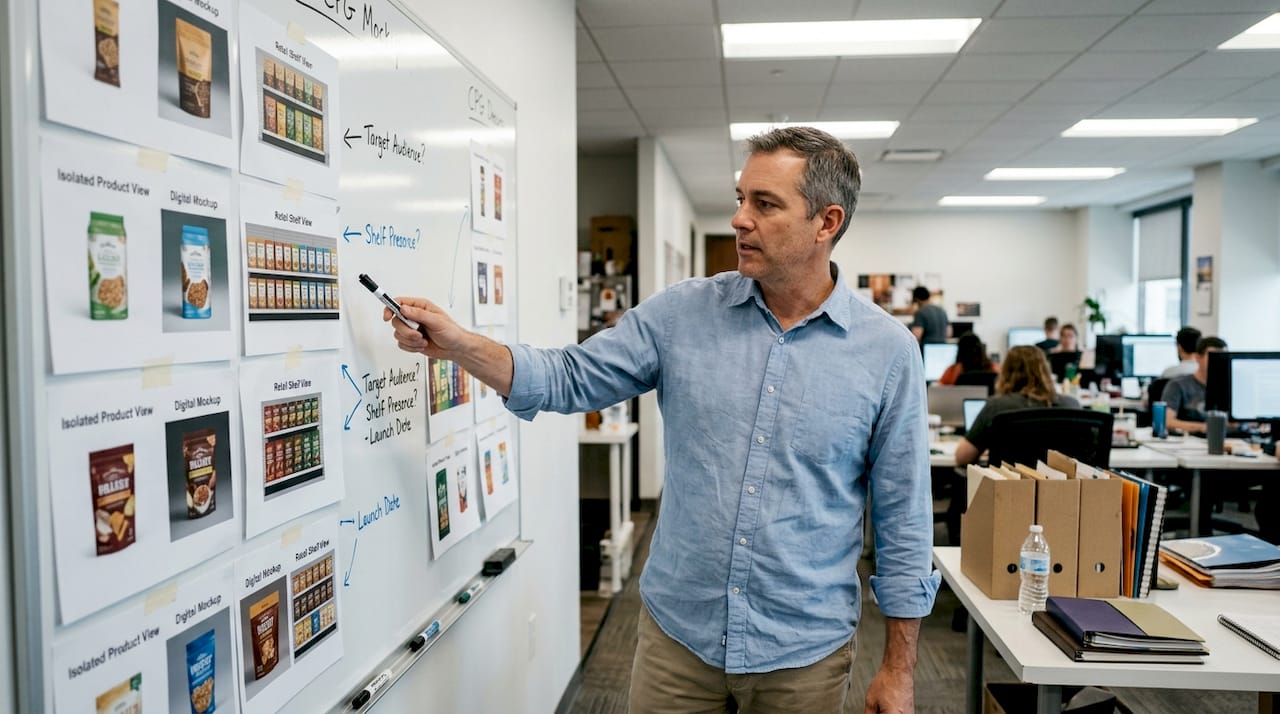
- Isolated mockup: A clean product render against a neutral or white background. This is your go-to for early-stage design review. It removes all environmental noise so you can evaluate typography, color accuracy, and label hierarchy without distraction.
- Shelf context mockup: Your product rendered on a virtual or physical retail shelf alongside competitor products. This is the most valuable mockup type for CPG because it simulates the actual purchase environment where your design has to win.
- Lifestyle mockup: Your product placed in a realistic usage scenario, like a smoothie bottle on a kitchen counter or a snack bag next to a hiking backpack. These are powerful for social media, e-commerce, and brand storytelling.
- Point-of-purchase mockup: A render showing your product on a retail display, end cap, or floor stand. Essential for brands pitching to retail buyers or planning in-store promotional campaigns.
- Digital and AI mockup: Generated using tools like Pacdora or Canva Magic Studio. These are fast and cost-effective for rapid iteration, but they require careful review for realism and accuracy.
The biggest mistake brands make is generating 20 generic mockups and calling it a strategy. Mockup restraint means using 3-5 strategic mockups aligned to your key brand touchpoints, which enhances clarity and strengthens your design story. More mockups don't mean better decisions. They mean more noise.
Pro Tip: Before committing to a mockup type, ask what decision this mockup needs to support. If you can't answer that clearly, you're not ready to build it yet. Skipping this step is one of the fastest ways to avoid costly mistakes in your packaging process. A solid step by step packaging design approach keeps your mockup choices purposeful from the start.
Comparing product mockup types: Which works best for CPG?
Every mockup type has a role, but they are not equal when it comes to predicting real-world performance. Here's a direct comparison to help you prioritize.
| Mockup type | Best use case | Key advantage | Key limitation |
|---|---|---|---|
| Isolated | Early concept review | Maximum design clarity | No competitive context |
| Shelf context | Mid-stage attention testing | Simulates real retail environment | Requires competitor assets |
| Lifestyle | Brand storytelling, social media | Emotional resonance | Low shelf relevance |
| Point-of-purchase | Retail buyer pitches | Shows in-store display impact | Narrow application |
| Digital and AI | Rapid iteration, early ideation | Speed and low cost | Realism and accuracy risks |
Shelf context mockups win for CPG because they reflect the actual decision environment. Lifestyle mockups add emotional depth but don't tell you whether your product will get noticed in aisle 7. Digital and AI mockups are genuinely useful for speed, but they need a human review pass before any consumer testing.
Here's what the science says about what actually drives consumer attention on shelf:
- Color: Medium-high saturation and cool tones increase visual attention with a model accuracy of r=0.84
- Shape: Rounded forms outperform angular ones for preference
- Hierarchy: Color registers first, then shape, then brand name
This matters because your mockup needs to test these elements in context, not in isolation. And the stakes are real. Only 37% of CPG redesigns actually lift sales, and the brands that succeed do so through early consumer testing, objective claims, and a clear focus on brand awareness. The right mockup type at the right stage is what makes early testing meaningful. For cost-effective inspiration on how to approach this without blowing your budget, there are proven frameworks worth exploring.
When and how to use each mockup type in your packaging workflow
Knowing the mockup types is one thing. Knowing when to deploy each one is what separates brands that iterate effectively from those that spin their wheels. Here's a practical sequence built around real CPG design workflows.
- Round 1: Isolated mockup. Use this at the earliest concept stage. Your goal is to evaluate the design itself, not its environment. Check color accuracy, font legibility, and label hierarchy. Get internal alignment before moving forward.
- Round 2: Shelf context mockup. Once your design holds up in isolation, place it on a virtual shelf with three to five real competitor products. This is where you find out if your packaging actually stands out. Contextual shelf mockups are the most reliable predictor of real retail performance for CPG brands.
- Round 3: Lifestyle and digital mockups. Use these for validation and storytelling. Lifestyle mockups help you test emotional resonance with target consumers. Digital and AI tools like Pacdora and Canva Magic Studio can accelerate this stage, but always verify outputs for realism and spelling accuracy before sharing externally.
Here's what to watch for at each stage:
- Round 1: Does the design communicate the product benefit clearly within two seconds?
- Round 2: Does your product draw the eye before competitors do?
- Round 3: Does the lifestyle context feel authentic to your target consumer?
Pro Tip: Never skip Round 2. Brands that test only in isolation consistently overestimate how well their design performs in a real retail environment. Understanding the designer's role in building shelf-ready concepts helps you set the right expectations from the start. And if you're moving toward production, reviewing print-ready design essentials ensures your mockup work translates accurately to the final physical product.
Enhance your mockup process with expert solutions
You now have a clear framework for selecting, sequencing, and evaluating product mockup types across your CPG packaging workflow. The next challenge is finding design concepts worth testing in the first place.
Offcut gives CPG founders access to exclusive, print-ready packaging concepts at a fraction of what an agency charges. These are real designs from professional designers, built for shelf performance and ready to move into your mockup workflow immediately. If you're a designer with unused packaging concepts sitting on your hard drive, you can sell unused packaging concepts and get paid for work that's already done. Explore what OffCut offers and see how it fits into your next packaging project.
Frequently asked questions
Why are shelf context mockups better for CPG packaging?
Shelf context mockups simulate real retail competition, which means you can predict consumer attention and performance far more accurately than with isolated renders. For CPG brands, this is the most reliable way to evaluate whether your design will actually win on shelf.
How many mockups should a brand use in its design process?
Stick to 3-5 strategic mockups aligned to your key brand touchpoints. More than that creates noise and weakens your ability to make clear design decisions.
What are the most important features to test in digital and AI-generated mockups?
Always check for visual realism and spelling accuracy. AI mockup tools generate outputs fast, but they frequently miss consumer-facing details that matter in a real retail context.
How does packaging design actually influence buying decisions?
Packaging visuals drive 70-76% of purchase decisions in CPG, which is why testing your design in realistic shelf environments is non-negotiable before production.
Can changing mockup types impact sales after a redesign?
Only 37% of CPG redesigns result in a sales lift, but brands that use early consumer testing with the right mockup sequence and a clear brand focus significantly improve their odds.