
TL;DR:
- Effective brand packaging relies on strict specifications, physical benchmarks, and digital workflows to maintain consistency. Integrating DAM with ERP, using Golden Samples, and enforcing approval processes prevent variation across SKUs and suppliers. Implementing a systematic workflow ensures quality, saves costs, and preserves brand equity at scale.
Brand consistency in packaging is the practice of aligning every visual, material, and textual element of your packaging with established brand standards across every production run. When that alignment breaks down, the cost is real. Inconsistent packaging erodes consumer trust, weakens shelf recognition, and quietly chips away at brand equity over time. The brand consistency packaging process is not a creative challenge. It is a specification and workflow challenge. This guide gives brand managers and marketing professionals the exact systems, tools, and steps needed to lock consistency from concept through production.
What are the key prerequisites for brand consistency in packaging?
The foundation of any consistent packaging program is a centralized system that controls assets, specifications, and approvals before a single file reaches a printer. Without this foundation, every production run is a gamble.

Digital Asset Management linked to ERP
Version creep through outdated files is one of the most common and damaging causes of brand inconsistency. It happens quietly: a designer pulls an old logo file, a supplier prints from a cached PDF, and the result ships with the wrong pantone or an outdated tagline. Linking a Digital Asset Management (DAM) system directly to your ERP platform automates artwork file distribution. Production teams always print from the current approved version, which eliminates costly reworks and approval loops.
Specification Freeze Documents
A specification freeze document is a locked record of every material and production parameter for a given SKU. It covers substrate paper weight, finish type (matte, gloss, soft-touch), ink type, and structural dimensions. Material drift caused by substrate differences is the silent killer of packaging brand consistency. Locking specifications early prevents suppliers from substituting materials that look similar but print differently.
Golden Samples as Physical Benchmarks
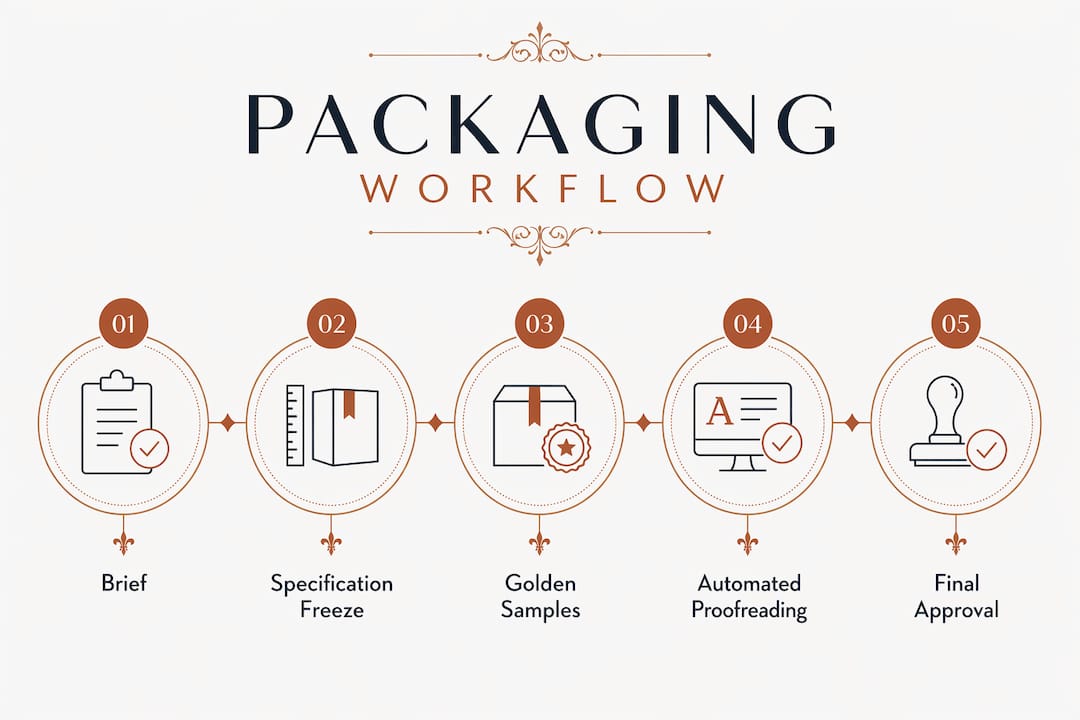
Golden Samples serve as physically approved benchmarks that remove subjectivity from quality control. Instead of asking a supplier to match "the right shade of blue," you hand them a sealed, approved physical reference. Subjectivity in approvals leads directly to inconsistency. A Golden Sample creates an objective, repeatable standard every production run must meet.
Automated Proofreading Systems
Tools like GlobalVision automate the verification of artwork and text against approved masters. Automated proofreading can verify artwork at speeds up to 1,000 characters per second. That speed dramatically reduces human error and cuts revision cycle time, which matters when you are managing dozens of SKUs across multiple markets.
| Prerequisite | Purpose | Example Tool or Method |
|---|---|---|
| DAM linked to ERP | Prevents version creep | Cway, Brandfolder + ERP integration |
| Specification freeze document | Locks material and print parameters | Internal spec sheet per SKU |
| Golden Sample | Physical quality benchmark | Sealed approved sample per colorway |
| Automated proofreading | Verifies text and artwork accuracy | GlobalVision |
Pro Tip: Build your specification freeze document before any supplier quotes are requested. Locking specs at the briefing stage prevents costly redesign loops later.
How to implement a step-by-step packaging consistency workflow
A repeatable workflow is what separates brands that maintain consistency at scale from those that fix problems after they ship. The following steps cover the full arc from concept to production.
-
Define your brand architecture and packaging design system. Document your visual hierarchy: primary logo placement, color palette with Pantone references, typography rules, and hierarchy of claims. This is your packaging design system, and it governs every SKU you produce.
-
Conduct early engineering reviews and lock specifications. Before any artwork is finalized, align with your structural engineer and print supplier on substrate, finish, and die-line. Changes made after artwork approval cost significantly more than changes made at the brief stage.
-
Produce Golden Samples and run mandatory ink drawdowns. Ink drawdowns and lab dips on production substrates establish physical color accuracy before a full production run begins. Color accuracy is verified numerically using Delta E thresholds under standardized lighting. A Delta E value above 2 is typically visible to the human eye, making this step non-negotiable for premium brands.
-
Integrate DAM with ERP for automatic version control. Once artwork is approved, it should flow directly into your ERP as the only printable file for that SKU. No email attachments. No shared drives. The system enforces the correct version automatically.
-
Run pre-shipment inspections and ongoing quality assurance. Third-party inspection firms like Bureau Veritas or SGS can verify print quality, color accuracy, and structural integrity against your Golden Sample before goods leave the factory.
-
Test packaging concepts before committing to production. Testing packaging through flat-lay social media and paid ads provides directional data on shelf impact and consumer engagement. Running a $500 paid social test before a 50,000-unit production run is one of the highest-ROI decisions a brand manager can make.
Pro Tip: When running pre-production ad tests, use the exact print-ready artwork file rather than a mockup. You want feedback on what will actually ship, not an idealized render.
| Stage | Key Action | Risk if Skipped |
|---|---|---|
| Brief | Specification freeze | Material drift across suppliers |
| Pre-production | Golden Sample approval | Color and finish inconsistency |
| Artwork sign-off | DAM-ERP integration | Version creep on print files |
| Pre-shipment | Third-party inspection | Off-spec goods reaching retail |
What causes packaging brand inconsistency and how do you fix it?
Most packaging inconsistency problems trace back to three root causes: organizational silos, material drift, and version creep. Each has a specific fix.
Organizational Silos
Organizational silos without a centralized single source of truth cause version confusion and brand dilution, especially when scaling globally. Marketing, procurement, and operations often work from different file repositories. The fix is a single DAM platform that all teams access, with role-based permissions that prevent unauthorized edits. Platforms like Cway Software are built specifically for packaging workflow centralization.
Material Drift
Suppliers change paper mills, ink formulations, or coating suppliers without notifying brand teams. The result is packaging that looks slightly different from the previous run. Strict material specification freezes, documented at the SKU level, are the only reliable defense. Require suppliers to notify you in writing before any material substitution, and mandate re-approval of Golden Samples when substitutions occur.
Version Creep
Version creep is the accumulation of small, unauthorized changes to artwork files over time. A designer tweaks a font weight. A regional team adjusts a claim. None of these changes go through formal approval. The fix is strict approval gating: no file enters the print queue without a digital sign-off trail in your DAM system.
Treating packaging as a cost-saving creative task rather than a controlled specification-driven process is the most common flaw in brand packaging programs. The brands that maintain consistency at scale treat every SKU as a specification document first and a design second.
Balancing Cost and Brand Equity
Prioritizing cost savings ahead of brand equity can harm customer lifetime value despite short-term gains. A $0.40 per unit saving on substrate or finish may reduce shelf impact and weaken the brand signal at the exact moment a consumer is making a purchase decision. The math rarely favors the shortcut when you account for lost repeat purchases.
Pro Tip: When procurement pushes for material substitutions, run a side-by-side print test on both substrates before approving the change. A visual comparison against your Golden Sample often ends the conversation quickly.
How does technology integration support packaging consistency at scale?
Scaling a packaging program across markets and SKUs without a technology backbone is where most brand consistency programs fail. The solution is treating packaging as a system, not a collection of one-off design projects.
Packaging as a System
A packaging design system defines the rules that govern every SKU: grid structure, color hierarchy, typography scale, and iconography. When a new SKU is created, it slots into the system rather than starting from scratch. This approach reduces design time and eliminates the creative drift that causes inconsistency across a product line. You can explore cost-effective packaging design ideas that still reinforce brand standards without rebuilding from zero each time.
Artwork Management Platforms
Platforms like Cway Software centralize artwork workflows, approval routing, and version history in one place. Strong packaging storytelling at scale depends more on process discipline and digital tool integration than on design alone. That is a counterintuitive truth most creative teams resist, but the data supports it.
Supplier Certification Standards
Mandating certifications like G7 (a print color accuracy standard managed by Idealliance) or GMI (Graphic Measures International) for your print suppliers creates a measurable quality floor. G7-certified printers calibrate their presses to a defined gray balance, which means your brand colors reproduce consistently across different facilities and geographies.
| Technology or Standard | Function | Benefit |
|---|---|---|
| DAM + ERP integration | Automates approved file distribution | Eliminates version creep |
| Cway Software | Centralizes artwork workflows | Single source of truth |
| G7 certification | Standardizes press color output | Consistent color across suppliers |
| GMI certification | Audits supplier print quality | Measurable compliance baseline |
- Require all primary packaging suppliers to hold G7 or GMI certification before onboarding.
- Conduct annual supplier audits using your Golden Sample library as the benchmark.
- Use structured artwork management platforms to enforce approval gating across all markets.
- Build local market adaptations within the system, not outside it, to preserve global brand coherence.
Key takeaways
A consistent brand packaging process requires locked specifications, physical quality benchmarks, and integrated digital workflows working together from brief to shipment.
| Point | Details |
|---|---|
| Lock specs before artwork | Freeze material and print parameters at the brief stage to prevent supplier-driven variation. |
| Use Golden Samples | Physical approved benchmarks remove subjectivity and create repeatable quality standards. |
| Integrate DAM with ERP | Automated file distribution prevents version creep and eliminates unauthorized artwork changes. |
| Test before production | Flat-lay social and paid ad tests validate packaging impact before committing to a full run. |
| Treat packaging as a system | A defined design system governs all SKUs and prevents creative drift at scale. |
The specification problem nobody wants to talk about
Most packaging inconsistency problems I see are not creative failures. They are process failures dressed up as creative problems. A brand will spend months refining a logo, agonizing over a pantone, and crafting the perfect copy hierarchy. Then they send a PDF to three different suppliers and get three different results. The design was never the issue. The absence of a locked specification was.
The brands that get this right share one habit: they treat every packaging SKU like an engineering document. The creative brief is the starting point, not the deliverable. The deliverable is a specification freeze, a Golden Sample, and a DAM-linked print file. That combination removes the human judgment calls that introduce variation.
I have also seen teams resist automation tools like GlobalVision because they feel it slows down the creative review process. The opposite is true. When you automate text and artwork verification, your creative team stops doing clerical checks and starts doing actual creative work. The collaboration between teams gets sharper when nobody is manually comparing font sizes across 40 SKUs.
The hardest conversation to have with leadership is the cost-versus-equity tradeoff. Saving $0.40 per unit on a substrate change sounds like a win until you see the shelf photo next to a competitor who did not cut that corner. Brand equity is built in millimeters and microns. Protect it at the specification level, not just the design level.
— Myles
How Offcut can sharpen your packaging program
Offcut exists precisely for the moment when a brand manager needs print-ready packaging concepts without the agency timeline or the agency invoice. Every design in the Offcut library is production-ready, which means it arrives with the file integrity your specification process demands.
For teams managing version control and brand alignment across multiple SKUs, starting with a professionally executed concept from Offcut removes one of the biggest variables in the consistency equation: the quality of the original artwork. When the source file is solid, every downstream step, from Golden Sample approval to pre-shipment inspection, runs cleaner. Browse print-ready packaging concepts at Offcut and give your brand consistency process a stronger starting point.
FAQ
What is a brand consistency packaging process?
A brand consistency packaging process is a structured workflow that aligns every visual, material, and textual element of packaging with established brand standards from design through production. It includes specification freezes, Golden Samples, DAM integration, and automated quality checks.
Why do golden samples matter in packaging quality control?
Golden Samples are physically approved reference units that give suppliers an objective benchmark to match. They remove subjectivity from color and finish approvals and create a repeatable standard across production runs.
How does DAM and ERP integration prevent packaging inconsistency?
Linking a DAM system to your ERP automates the distribution of approved artwork files to production teams. This prevents version creep by ensuring the correct, current file is always the one that goes to print.
What is material drift and how do you prevent it?
Material drift occurs when suppliers substitute substrates or inks without brand team approval, causing visible differences between production runs. Formal specification freeze documents and written supplier notification requirements are the primary defenses.
How can you test packaging before a full production run?
Testing packaging concepts through flat-lay social media posts and paid ads provides measurable consumer engagement data before production begins. This approach validates shelf impact and design decisions at a fraction of the cost of a full production commitment.