
TL;DR:
- Effective packaging revision management relies on centralized version control, early compliance checks, and automated workflows to minimize errors and delays. Clear, detailed briefs and strict control over approved files ensure consistency, while AI tools enhance accuracy and scalability across large SKU catalogs. Most issues stem from communication failures and vague briefs rather than software limitations, emphasizing the importance of disciplined human input.
Packaging revision management is the process of controlling, tracking, and approving every change made to a product's packaging across its full lifecycle. Done poorly, it produces mislabeled products, compliance failures, and costly reprints. Done well, it protects your brand, speeds time-to-market, and keeps every stakeholder working from the same approved file. This guide shows you exactly how to manage packaging revisions using centralized version control, early compliance integration, and AI-driven automation. Whether you oversee 10 SKUs or 10,000, the framework is the same.
What are the best tools for managing packaging revisions?
The foundation of any effective packaging revision process is a centralized artwork management system. Automated version control systems significantly reduce printing errors caused by outdated packaging files. That single shift, from shared drives and email threads to a structured platform, eliminates the most common source of revision chaos.

Here is how manual file naming compares to automated version control:
| Feature | Manual File Naming | Automated Version Control |
|---|---|---|
| Change history | Buried in email chains | Logged automatically with timestamps |
| Approval tracking | Spreadsheets or verbal sign-off | Built-in approval workflows |
| Access control | Anyone can overwrite files | Role-based permissions per file |
| Audit readiness | Difficult to reconstruct | Full traceable history on demand |
| Error risk | High, wrong file versions printed | Low, printers access approved files only |
The table makes the case clearly. Manual systems rely on human discipline. Automated systems enforce discipline by design.
Beyond storage, workflow software automates the routing of reviews and approvals. When a change is submitted, the system notifies the right stakeholders, tracks their responses, and archives the decision. Using a single system that holds the artwork file and is accessible to all stakeholders eliminates version confusion and reduces approval times significantly. That is the single source of truth principle in practice.
AI-driven image comparison adds another layer of accuracy. These tools analyze text, layout, and color to detect what changed between two file versions. They categorize updates with confidence scores, so your team knows immediately whether a change is a minor font tweak or a compliance-critical label shift.
Pro Tip: Set up role-based access so printers can only download files marked "Approved." This one control prevents the majority of costly reprints.
Key tools to evaluate for your packaging revision workflow include:
- Artwork management platforms such as Cway or Artwork Flow for centralized file storage and approval tracking
- AI image comparison tools for automated detection of label changes across large SKU catalogs
- ERP and PLM integrations that connect packaging data to formulation and regulatory records
- Audit trail features that log every comment, change, and sign-off with a timestamp
How do you design a packaging revision workflow that works?
A packaging revision workflow fails when compliance is treated as the final checkpoint. Integrating compliance checks and supplier questionnaires early in the revision workflow prevents costly recalls and audit issues. Move regulatory review to the beginning, not the end.
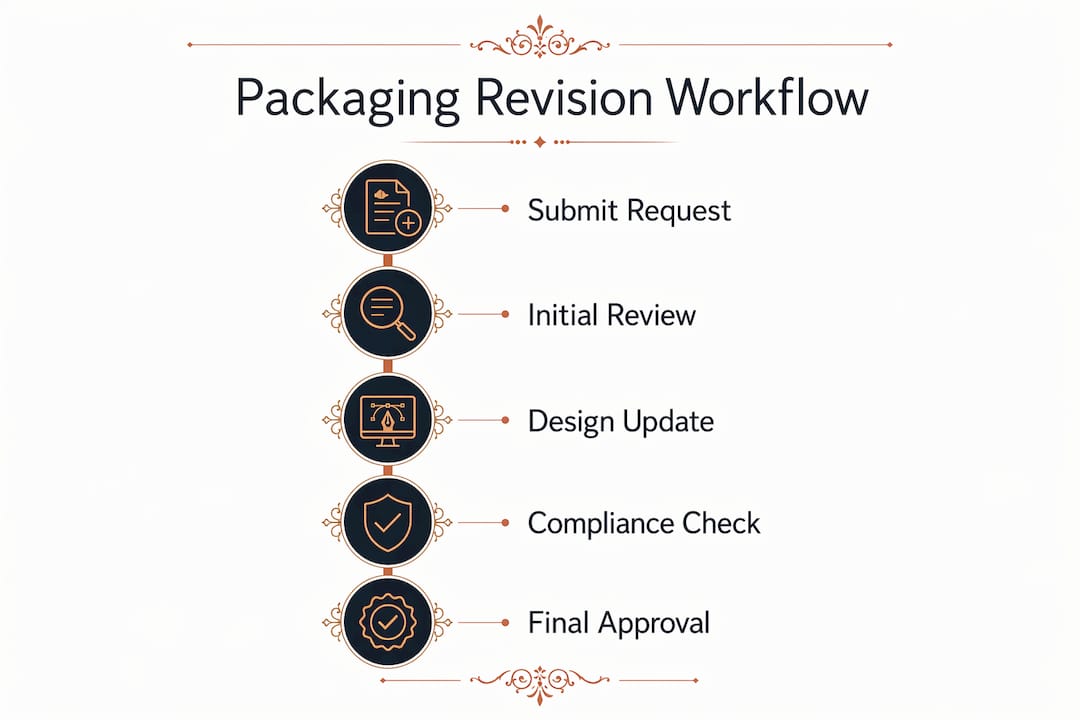
Here is a proven step-by-step structure for managing packaging updates from brief to print:
-
Initiate with a structured brief. Define what is changing, which SKUs are affected, and who holds sign-off authority. A well-defined creative brief specifying changes, affected SKUs, and sign-off authority dramatically improves revision efficiency. Vague inputs create feedback loops that no software can fix.
-
Assign roles and responsibilities. Every revision needs a project owner, a compliance reviewer, a design lead, and a final approver. Undefined roles produce duplicated effort and missed steps.
-
Run compliance checks at intake. Mandatory fields for material structure, weight, and conformity linked to unique packaging IDs create audit-ready records from day one. Do not wait until the artwork is finished to ask regulatory questions.
-
Apply the four-eyes principle. Multi-level reviews embedded in the workflow reduce recall risk by over 90%. Two independent reviewers must approve before any file reaches production-ready status. This is not bureaucracy. It is brand protection.
-
Automate validation checks. Use your workflow platform to flag missing fields, inconsistent data, or unapproved file versions before they reach the next stage. Automated plausibility checks catch errors that tired eyes miss.
-
Lock and distribute approved files. Once a file clears all reviews, lock it in the system and grant printer access through a controlled portal. Archive the previous version with its full approval history intact.
Pro Tip: Standardize your supplier questionnaires with fixed data fields. Unstructured supplier input is one of the top causes of compliance gaps in packaging revisions.
What best practices prevent common mistakes in packaging updates?
The biggest misconception in managing packaging updates is that revisions only involve artwork. Packaging revisions affect formulations, claims, and regulatory data requiring coordinated notifications across multiple teams. A label change that reflects a new ingredient must trigger updates in regulatory filings, marketing claims, and secondary packaging simultaneously.
These best practices keep your revision process accurate and your team aligned:
-
Enforce a single source of truth. Every stakeholder must access artwork from one central location. Replacing email-based file sharing with structured workflows eliminates the version drift that causes wrong files to reach production.
-
Separate work-in-progress from approved files. Allowing printers access only to approved files via locked portals prevents mistaken printing of outdated packaging. Treat your file system as an archive, not a shared folder.
-
Use connected data models. Connecting formulation changes automatically to packaging design reduces cascade failures across primary and secondary packaging. When one element changes, the system flags all dependent elements for review.
-
Review secondary and tertiary packaging. Most teams focus on primary packaging and miss changes that need to cascade to shipper boxes, inner cartons, and display units. Build secondary packaging review into every revision checklist.
-
Communicate proactively across teams. Automatic notifications to all relevant teams prevent siloed updates and non-compliance. Regulatory, marketing, supply chain, and design must all receive change alerts, not just the team that initiated the revision.
-
Write clear creative briefs before every revision. Lack of clear inputs creates chaotic feedback loops that even advanced software cannot resolve. Specify the change, the reason, the affected SKUs, and the deadline before any design work begins. You can find more on this in Offcut's guide to updating packaging design for greater brand impact.
How can AI and automation improve the packaging revision process?
AI is changing the speed and accuracy of packaging revision management at scale. AI-driven image comparison technology automates detection of packaging label changes, categorizing updates with confidence scores and precise locations. That means your team spends less time squinting at two versions of a label and more time acting on what actually changed.
The practical benefits of AI adoption in packaging revision workflows include:
-
Faster change detection. AI tools analyze text, layout, and color differences between file versions in seconds. For brands managing hundreds of SKUs, this replaces hours of manual comparison per revision cycle.
-
Confidence scoring. Structured outputs tell reviewers whether a detected change is minor (a font weight shift) or major (a regulatory claim update). That prioritization directs human attention where it matters most.
-
Automated routing. Once a change is detected and categorized, workflow software routes it to the correct reviewer automatically. No manual triage. No missed notifications.
-
Reduced human error. AI tools catch subtle differences that human reviewers miss, particularly in dense nutritional panels, ingredient lists, and barcode regions.
-
Scalability across large catalogs. Enterprise tools can process large SKU catalogs without proportional increases in review staff. That scalability is the core business case for AI investment in packaging management.
AI tools require structured input to deliver meaningful results. AI tools require structured input and context to deliver meaningful packaging change detection at scale. Feed them clean, consistently formatted files and they perform well. Feed them inconsistent inputs and confidence scores drop. The technology amplifies whatever discipline your team already has.
For teams looking to build stronger revision workflows before adding AI, Offcut's guide to CPG packaging design workflow strategies covers the foundational steps worth getting right first.
Key takeaways
Effective packaging revision management requires centralized version control, early compliance integration, and structured human oversight to protect brand accuracy and reduce costly errors.
| Point | Details |
|---|---|
| Centralize artwork storage | Use a single version control platform so every stakeholder accesses the same approved file. |
| Integrate compliance early | Run regulatory checks at intake, not as a final step, to prevent recalls and audit failures. |
| Apply the four-eyes principle | Require two independent reviews before any file reaches production-ready status. |
| Separate approved from in-progress | Lock approved files in controlled portals so printers never access outdated versions. |
| Use AI for change detection | AI image comparison tools categorize label changes with confidence scores, reducing manual review time. |
Where most packaging teams get the process wrong
I have worked with enough packaging managers to know the real problem is rarely the software. Teams invest in artwork management platforms, set up approval workflows, and still end up with the wrong label on a production run. The breakdown almost always traces back to communication, not technology.
The creative brief is where most revision cycles go wrong. A brief that says "update the front panel" is not a brief. It is an invitation for five rounds of revisions, three conflicting interpretations, and a missed deadline. The teams that manage packaging revisions well write briefs that specify the exact change, the regulatory reason behind it, the affected SKUs, the file format required, and the name of the person who signs off. That level of specificity feels like extra work upfront. It saves two weeks on the back end.
The other pattern I see consistently is treating packaging revision management as a design problem when it is actually a data problem. The artwork is the output. The real work is managing the formulation data, the regulatory claims, the supplier confirmations, and the compliance records that feed into the artwork. When those upstream data points are disorganized, no amount of version control software fixes the downstream chaos.
My honest recommendation: audit your revision process at the brief stage, not the approval stage. If your briefs are vague, fix that before you buy new software. The technology works best when the human inputs are clean.
— Myles
How Offcut helps packaging managers work smarter
Managing packaging revisions means managing files, approvals, and creative assets across multiple stakeholders. Offcut is built for exactly that intersection. Packaging managers and brand owners get access to print-ready packaging concepts with transparent version histories, so you are never hunting for the right file or wondering which version your printer received.

Offcut connects brand owners directly with designers who have already done the creative work. That means shorter revision cycles, cleaner handoffs, and concepts that arrive ready for production review rather than requiring rounds of back-and-forth. For teams that need to move fast without sacrificing accuracy, Offcut's designer platform gives you a starting point that is already closer to finished. Explore how Offcut can cut your revision cycles and keep your packaging assets organized from concept to print.
FAQ
What is packaging version control?
Packaging version control is a system that tracks every change made to a packaging file, including who made it, when, and why. It replaces manual file naming with a structured history that supports audit readiness and prevents outdated files from reaching production.
How do you track packaging changes across multiple skus?
Use a centralized artwork management platform that assigns unique IDs to each packaging file and logs all changes with timestamps. AI image comparison tools can then detect and categorize differences across large SKU catalogs automatically.
When should compliance checks happen in a revision workflow?
Compliance checks should happen at the start of the revision process, not at the end. Integrating regulatory review at intake prevents costly recalls and ensures audit-ready documentation is built into the workflow from the beginning.
What is the four-eyes principle in packaging management?
The four-eyes principle requires two independent reviewers to approve a packaging file before it reaches production-ready status. This multi-level review process reduces recall risk by over 90% by catching errors before they reach the printer.
How does a creative brief reduce packaging revision rounds?
A clear creative brief specifying the exact change, affected SKUs, and sign-off authority gives designers and reviewers a shared reference point. Without it, feedback loops multiply and revision cycles extend significantly.