
TL;DR:
- Minimalist packaging is an engineering discipline focused on removing only non-essential elements while ensuring product protection and brand clarity. It requires strict structural and visual design discipline, careful material selection for recyclability, and a comprehensive workflow that incorporates compliance testing. True minimalism emphasizes functional necessity, sustainability, and precise communication, not just aesthetic simplicity.
Every packaging designer eventually faces the same wall: clients want sustainable, brand-forward, cost-efficient packaging, and assume "minimalist" is the shortcut to all three. This guide to minimalist packaging challenges that assumption head-on. Minimal packaging is not a reduction strategy. It is a precision engineering discipline that removes only what is non-essential, while protecting everything that matters, including the product, the brand, and your regulatory standing. What follows covers the design principles, material science, production workflow, and compliance requirements you need to do it right.
Key takeaways
| Point | Details |
|---|---|
| Minimalism is engineering, not decoration | Effective minimal packaging removes non-functional elements while maintaining transit durability and brand clarity. |
| Material choice drives sustainability | Monomaterial or separable components dramatically improve real-world recyclability beyond surface-level aesthetics. |
| Right-sizing beats lightweighting | Fitting packaging to product dimensions reduces material use and shipping costs without sacrificing protection. |
| Compliance is non-negotiable | UK EPR regulations require data reporting by material type and weight; visual simplicity does not substitute for documentation. |
| Process discipline creates results | A defined design workflow from brief through fulfillment testing prevents costly late-stage redesigns. |
The core guide to minimalist packaging design principles
Minimalist packaging, more formally called reductive or lean packaging design, is the practice of engineering only what serves function. That means removing decorative layers, redundant inserts, excess material, and visual noise that serve no structural or communicative purpose. The result is not necessarily bare or cheap looking. Done well, it signals confidence and clarity.
There are two distinct pillars you need to hold simultaneously.
Visual minimalism governs what the eye sees. This includes limiting your color palette to two or three values, using whitespace as an active design element rather than empty space, and applying strict information hierarchy. Every element on the surface, whether a logo, usage instruction, or regulatory mark, earns its place or gets cut. Typography does heavy lifting here, replacing illustration and pattern when the brand is strong enough to carry it.
Structural minimalism governs what the hands touch and what survives a warehouse conveyor belt. It means right-sizing the box or pouch to the product, choosing materials that serve multiple functions (protection and barrier, for example), and eliminating unnecessary inner components like foam inserts or secondary sleeves. The goal is fewer parts with higher individual utility.
- Limit spot colors to reduce print complexity and plate costs
- Remove inner tissue or filler that serves only aesthetic padding
- Consolidate legal copy into a single panel without reducing compliance
- Use negative space to signal premium positioning without adding material
- Apply a single typeface family at varied weights rather than multiple fonts
Pro Tip: Before you cut any element from a design, write down its function. If you cannot state a clear functional reason for it to exist, structural or communicative, it goes. This single discipline prevents the "it just looks nice" trap that stalls minimalist packaging projects.
Branding restraint is worth calling out separately. Many brands confuse minimalist packaging with stripped branding. The discipline actually demands sharper brand decisions. When you remove noise, every remaining element carries more weight. A poorly chosen typeface or an off-brand color becomes glaring without surrounding elements to dilute it.
Material selection and structural engineering
Material choice is where minimalist packaging either delivers on its sustainability promise or falls apart. The wrong material, regardless of how clean the design looks, can undermine real recyclability at the design stage before the product ships.

Common materials and their trade-offs
| Material | Sustainability profile | Packaging fit |
|---|---|---|
| SBS paperboard | Widely recyclable; FSC certification available | Cartons, folding boxes, sleeves |
| Kraft board | Unbleached, high recycled content options | Mailer boxes, outer shipper cartons |
| Molded pulp | Biodegradable; replaces foam inserts effectively | Product cradles, protective inserts |
| Mono-layer PP film | Recyclable where collected; no laminate contamination | Flexible pouches, wraps |
| Recycled PET (rPET) | Closed-loop potential; high clarity for retail | Clamshells, clear windows |
The design-for-recycling (D4R) framework is the clearest guide for making these calls. D4R demands monomaterial or readily separable components, careful adhesive selection, and color choices that do not contaminate recycled streams. A paperboard box with a glued-in plastic window, for instance, often fails at the sorting facility because separating the two materials at scale is not economical.
Avoid laminations and coatings that bond incompatible materials. Gloss UV coatings on paperboard are a common culprit. They extend shelf appeal but reduce recyclability by contaminating pulp streams. Water-based or clay coatings are a better call when you need print protection.
Right-sizing matters more than most designers realize. A packaging optimization study demonstrated an approximately 8% material reduction is achievable through geometric redesign alone, maintaining full product protection. Eight percent sounds modest until you are ordering half a million units.
Pro Tip: When specifying packaging for e-commerce fulfillment, use the ISTA 2A or 3A test protocols as your structural benchmark before finalizing wall thickness or closure method. Passing a vibration and drop sequence with minimal material is the engineering proof that your minimalist design is not just thin. It is right.
Molded pulp inserts deserve special attention. They replace expanded polystyrene in a structurally rigorous way, conform precisely to product geometry, and are both curbside recyclable and compostable in most cases. For electronics, cosmetics, or artisan food brands, they deliver a premium unboxing feel without adding a secondary non-recyclable material.
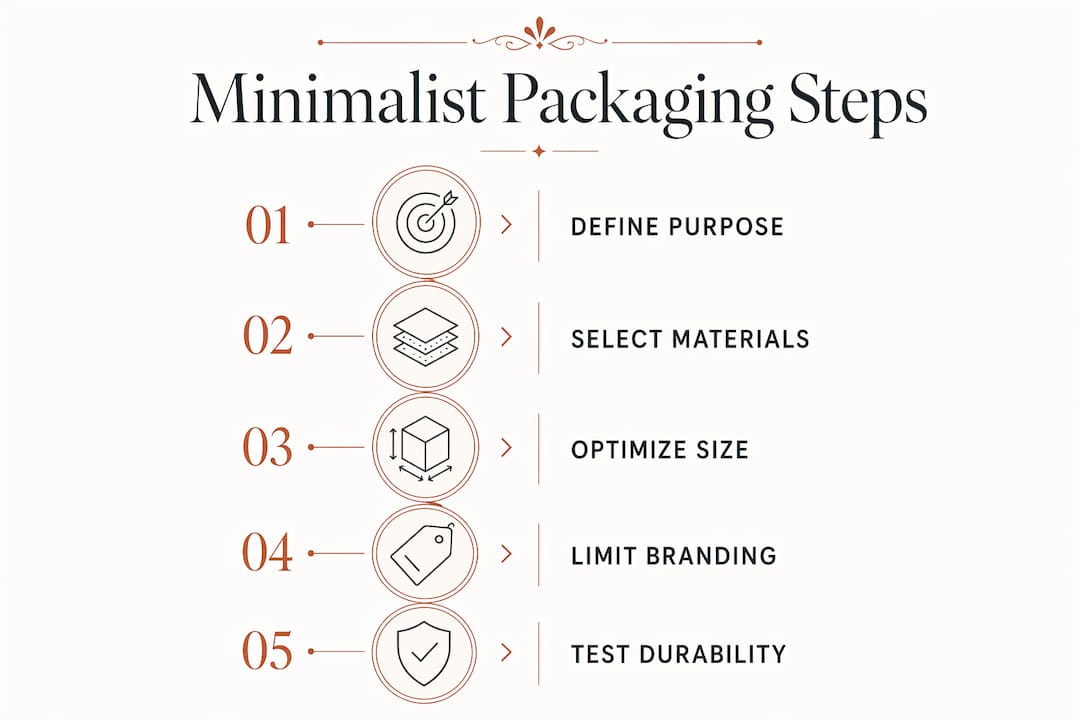
The design and production workflow
Getting minimalist packaging to manufacturing without cost blowouts or protection failures requires a defined process. Skipping steps is where most projects lose money or credibility.
-
Define the product and customer brief. Document the product dimensions, fragility rating, retail or e-commerce channel, target price per unit, and brand positioning. A direct-to-consumer candle brand and a retail electronics accessory have very different structural requirements, even if both want minimal aesthetics.
-
Audit the competition. Study what is already on shelf or arriving in mailboxes in your category. Identify where competitors are overpackaging. This reveals real white space for differentiation, not just visual style. Check out packaging design inspiration resources that focus on cost-effective material approaches.
-
Develop three structural concepts before any graphic work. Engineers and designers routinely get this backward. Nail the box style, closure mechanism, and insert configuration first. Graphics are a surface layer applied to a solved structure.
-
Simplify print complexity. Fewer colors reduce plate counts and ink usage. Flexographic or digital printing on natural kraft board often eliminates the need for a base coat entirely, cutting a full print pass. According to Shopify's e-commerce packaging guidance, less clutter lowers costs and improves consumer comprehension at the moment of unboxing.
-
Engineer closures and openings for fulfillment speed. Tear strips, magnetic closures, or tuck-lock configurations that operate without tools are worth specifying from the start. Each second saved on a fulfillment line at volume translates directly to labor cost. For more on this balance between experience and cost, the approach to e-commerce packaging efficiency is worth reviewing.
-
Build a flat-pack or nesting configuration where possible. Packaging that ships flat and assembles at point-of-use saves significant freight and warehousing costs, often more than the material savings from weight reduction.
-
Test before you finalize. Run prototypes through your intended distribution sequence, drop, vibration, compression, before approving dielines. Packaging that fails in transit is the most expensive minimalist packaging mistake you can make.
Compliance, reporting, and sustainability verification
Minimalist packaging that carries a sustainability narrative must be backed by documentation, not just design intent. This is an area where even experienced designers get caught short.
In the UK, the Extended Producer Responsibility for Packaging framework is now active. Producers must meet recycling obligations and pay disposal costs for household packaging, with legal reporting and evidence requirements in force since October 2025. That means your packaging data, including material type, packaging class, and weight per unit placed on the market, must be submitted in the correct format.
The EPR data submission requires detailed CSV files reporting packaging type, classification (primary P1, shipment P3, and others), material codes, and weight. If you change your packaging material or reduce gauge, you must update your submission. Visual simplicity does not satisfy a legal data obligation.
EPR recycling targets by material (2025 to 2027)
| Material | 2025 target | 2026 target |
|---|---|---|
| Paper/board | 75% | 77% |
| Glass | 74% | 76% |
| Aluminum | 60% | 62% |
| Plastic | 55% | 57% |
UK EPR base fees vary significantly by material: £196 per tonne for paper and £423 per tonne for plastic in 2025 to 2026. From year two onward, fees are modulated by a recyclability assessment matrix (RAM) rating of green, amber, or red. A green-rated material costs less in fees. That is a direct financial incentive to design for recyclability, not just design to look minimal.
FSC chain-of-custody certification for paper-based materials is worth pursuing independently of the EPR process. It gives you a verified, auditable claim that the fiber in your packaging comes from responsibly managed sources. Visual claims like "eco-friendly packaging" without certification behind them are increasingly scrutinized by regulators and consumers alike.
The gap between visual minimalism and verified sustainability is where brands get into trouble. A clean white box with a single logo looks sustainable. Without D4R compliance, correct material documentation, and recycling-target-aligned material selection, it is only aesthetic.
My honest take on minimalist packaging
I have worked through enough packaging briefs to say with confidence that most brands underestimate what it takes to do minimal well. The assumption is that removing things is simple. It is not. Removal is a decision that requires you to know exactly what each element was doing before you cut it.
What I have found is that the brands producing genuinely excellent minimal packaging treat it more like product engineering than graphic design. They run structural prototypes before finalizing graphics. They check material specs against recycling targets before committing to a substrate. They understand that their EPR data submission needs to match their actual packaging weight, not an estimate from two product iterations ago.
The pitfall I see most often is what I call superficial minimalism: a white box with a small logo and not much else, but with mixed-material components, an unverified sustainability claim, and zero transit testing. It photographs well. It fails everywhere else.
My recommendation is to build a packaging brief that treats compliance and engineering as design constraints from day one, not checklist items at the end. When you do that, the visual simplicity that results is not a style choice. It is the outcome of solving real problems with exactly the right amount of material, information, and structure. That is minimalist design in practice, and it is significantly harder and more rewarding than it looks.
— Myles
How Offcut can support your packaging process

If you are working through the kind of decisions this article covers, from concept development to material selection and structural engineering, Offcut is built for exactly this stage of the process. Offcut is where great packaging design concepts go instead of a hard drive. Founders get exclusive, print-ready packaging concepts at a fraction of agency cost, and designers get paid for work that would otherwise sit unused. Whether you need a minimal retail carton, a D4R-compliant mailer, or a complete packaging design workflow from brief to dieline, Offcut connects you with proven concepts ready to take into production. Browse available designs at Offcut.
FAQ
What is minimalist packaging?
Minimalist packaging, also called lean or reductive packaging design, is the practice of removing non-essential structural and visual elements while maintaining full product protection, legal compliance, and brand communication. It is an engineering discipline, not just a visual style.
Why choose minimal packaging over standard packaging?
Minimal packaging reduces material costs, lowers shipping weight, and improves consumer comprehension at unboxing. It also positions brands as confident and considered, and when done correctly with D4R principles, delivers genuine sustainability gains.
What materials work best for minimalist packaging?
Monomaterial options like SBS paperboard, kraft board, or molded pulp are the strongest choices because they are widely recyclable and structurally effective without needing laminated layers or foam inserts that complicate recycling.
How does UK EPR affect minimalist packaging decisions?
UK EPR requires producers to report packaging data by material and weight and pay disposal fees based on recyclability ratings. Choosing higher-rated materials like paper over plastic directly reduces your EPR fee liability from 2026 onward.
What is the first step to simplify packaging for my product?
Start with a structural brief that documents your product dimensions, fragility, channel, and regulatory requirements before any graphic work begins. Solving the structure first prevents costly redesigns and keeps the final design genuinely functional.