
TL;DR:
- Packaging budget planning involves forecasting all related costs to ensure accurate unit pricing and protect margins. It requires tracking fixed and variable costs, accounting for landed costs, and continuously updating actual expenses to prevent overruns. Effective strategies include right-sizing, standardization, and regular cost re-evaluation to optimize expenses without sacrificing quality.
Packaging budget planning is the process of forecasting and allocating all packaging-related expenses across a product line to protect margins and control costs at every stage of production and fulfillment. For entrepreneurs and finance managers in consumer goods, this means accounting for far more than the price printed on a supplier's quote. Materials, labor, freight, warehousing, quality losses, and design fees all feed into the true cost of getting a product to shelf. Packaging spending for consumer goods typically ranges between 10% and 40% of retail price, depending on product fragility, brand positioning, and channel requirements. That range alone tells you how much financial exposure sits inside a packaging decision.
What is packaging budget planning and why does it matter?
Packaging budget planning is defined as the structured forecasting and allocation of all packaging-related spend, from raw materials and print production through to freight, warehousing, and contingency reserves. The goal is a reliable cost-per-unit figure calculated by dividing total packaging costs by total units produced. That number becomes your margin anchor for pricing, procurement, and cash flow decisions.
The reason this matters more than most finance teams expect is that packaging budgets fail when treated as a single line item. A box price of $0.44 per unit can easily exceed $1.00 once you add setup fees, sampling, and freight. That gap between the quote and the real number is where margin disappears. Treating packaging as a system, rather than a purchase, is what separates brands that scale profitably from those that get surprised by cost overruns every quarter.
For consumer goods companies, packaging financial planning also connects directly to cash flow. Packaging orders often require payment weeks or months before the product generates revenue, which means your budget must account for timing, not just totals.
What are the main components of a packaging budget?
A packaging budget splits into two categories: fixed costs and variable costs. Understanding both is the foundation of accurate packaging expense analysis.
Fixed costs are incurred once per project or per production run setup, regardless of volume:
- Structural design and engineering fees
- Dieline creation and artwork development
- Printing plates, dies, and tooling
- Prototypes and physical sampling
- Compliance testing and certification
Variable costs scale with production volume and shipment frequency:
- Raw materials (paperboard, corrugated, plastic, glass, film)
- Printing and finishing (labels, coatings, embossing)
- Labor for assembly, filling, and quality inspection
- Domestic and international freight
- Warehousing and inventory holding costs
- Returns, damaged goods, and quality losses
The cost-per-unit formula ties these together. Take every cost bucket, add them up across a production run, and divide by total units. A run of 10,000 units with $3,000 in fixed setup costs, $4,000 in materials, and $2,000 in freight produces a cost per unit of $0.90 before warehousing or returns. That figure is what you build your pricing model on.
| Cost component | Typical range per unit | Notes |
|---|---|---|
| Raw materials | $0.10 to $0.80 | Varies by substrate and complexity |
| Printing and finishing | $0.05 to $0.40 | Higher for short runs or specialty finishes |
| Setup and tooling (amortized) | $0.02 to $0.30 | Decreases as run volume increases |
| Freight (domestic) | $0.10 to $0.50 | Affected by DIM weight and carrier rates |
| Warehousing | $0.03 to $0.15 | Based on storage duration and cubic footage |
| Returns and quality losses | $0.02 to $0.10 | Often excluded from initial budgets |
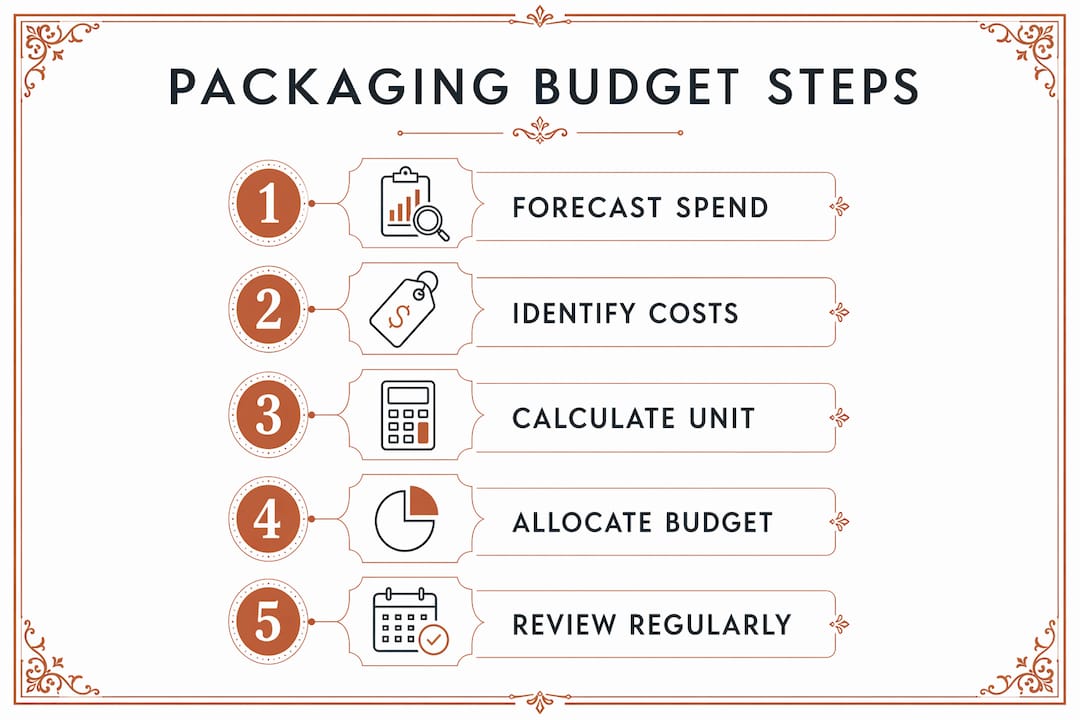
Pro Tip: Build a packaging cost tracker in a spreadsheet that separates fixed and variable costs by SKU. Update it with every invoice, not just supplier quotes. The gap between quoted and actual costs is where most budget overruns originate.
Exploring cost-effective packaging ideas early in the design process can also reduce fixed costs before they are locked in.
How to calculate the true cost of packaging beyond the unit price
The factory price on a supplier invoice is the starting point, not the finish line. The concept that captures the real number is landed cost: the total expense of getting a unit of packaging from the manufacturer to your warehouse, ready for production. Landed cost includes freight, import duties, insurance, compliance costs, and any operational adjustments required after delivery.
Here is where most packaging financial planning breaks down. A finance manager sees a $0.44 unit price and builds a margin model around it. The actual landed cost, after international freight, customs duties, port handling, domestic trucking, and insurance, can be double that figure. Choosing suppliers solely on unit price misleads budget planning when freight, tariffs, and container loading efficiency are ignored.
DIM weight surcharges alone can add $0.30 to $2.50 per order, a range wide enough to swing a product from profitable to break-even. Dimensional weight pricing penalizes oversized packaging even when the box is light, which means right-sizing your packaging is a financial decision, not just a design preference.
| Cost element | Invoice price view | True landed cost view |
|---|---|---|
| Unit price | $0.44 | $0.44 |
| International freight | Not included | $0.18 |
| Import duties and tariffs | Not included | $0.09 |
| DIM weight surcharge | Not included | $0.12 |
| Domestic trucking | Not included | $0.06 |
| Amortized setup costs | Not included | $0.15 |
| Total per unit | $0.44 | $1.04 |
Amortizing setup costs matters here too. Tooling, plates, and design fees amortized over multiple production runs reduce the per-unit cost impact significantly. A $3,000 tooling fee spread over 50,000 units adds $0.06 per unit. The same fee spread over 5,000 units adds $0.60. Your run size directly determines how much those fixed costs hurt your margin.
Pro Tip: Request a landed cost breakdown from your freight forwarder before finalizing any packaging supplier decision. Compare total landed cost across at least two suppliers, not just the unit price on the quote sheet.
What strategies optimize packaging budgets without sacrificing quality?
Effective packaging strategies for cost management do not require compromising on brand presentation. The biggest savings come from engineering and process decisions made before production begins.
Right-size and lightweight your packaging. Small changes in packaging dimensions can significantly reduce freight costs per unit by improving container loading density. Optimizing box dimensions allows more units per container, lowering per-unit freight cost even when the unit price stays constant. A 5% reduction in box volume can translate to a 10% to 15% reduction in freight spend across a full year of shipments.

Standardize components across SKUs. Using the same substrate, finish, or structural format across multiple products reduces tooling costs, simplifies supplier negotiations, and cuts artwork revision cycles. Brands that streamline packaging artwork across a product line consistently report lower per-unit costs and faster time to market.
Balance custom versus stock packaging. Custom structural packaging carries higher setup costs and longer lead times. Stock packaging formats with custom print finishes deliver strong brand differentiation at a fraction of the tooling investment. For early-stage brands or new SKU launches, stock structures with premium label work often outperform full custom packaging on a cost-per-impression basis.
Manage cash flow through payment timing. Packaging investment timing must align with forecast reliability and sales velocity to avoid cash flow strain on launches. Negotiating net-30 or net-45 payment terms with suppliers, or splitting deposits across production milestones, reduces the working capital gap between packaging spend and revenue realization.
Pro Tip: Ask suppliers for tiered pricing at two or three volume thresholds above your current order quantity. The incremental cost to reach the next price break is often less than the per-unit saving it unlocks, especially for fast-moving SKUs.
What are common pitfalls that cause packaging budget overruns?
Most packaging budget overruns trace back to a predictable set of errors. Recognizing them before a project starts is the most cost-effective form of risk management.
-
Underestimating design and setup fees. Structural design, dieline engineering, and print plate creation are often excluded from initial budget estimates. A project that looks affordable at the material level can carry $5,000 to $15,000 in setup costs that were never accounted for.
-
Ignoring freight and logistics costs. Freight is frequently treated as a separate operations budget item rather than a packaging cost. This creates a false picture of packaging profitability and leads to margin erosion that only becomes visible at the P&L level.
-
Skipping contingency reserves. Custom packaging expenses carry hidden layers including structural sampling, freight, and warehousing that raise costs well above headline quotes. A 10% to 15% contingency buffer on total packaging spend is the standard recommendation for any new project.
-
Not tracking actuals against forecasts. A reliable budgeting cadence includes forecast-versus-actual expense tracking and rebaselining per shipment to catch variances early. Teams that review packaging costs only at quarter-end consistently miss the window to renegotiate or adjust before costs compound.
-
Underestimating revision cycle costs. Every round of artwork revisions adds time and, in many cases, direct cost through reprinting proofs or re-sampling. Approval delays also push production timelines, which can trigger expedited freight charges that dwarf the original design savings. Reviewing why packaging design fails before briefing a project is one of the most practical ways to protect your budget from the start.
Key takeaways
Packaging budget planning requires a system-level view of costs, not a single line item, to protect margins and support accurate pricing decisions.
| Point | Details |
|---|---|
| Define cost per unit correctly | Include materials, freight, setup, warehousing, and quality losses in every unit cost calculation. |
| Landed cost is the real number | Factory price is the starting point; duties, freight, and DIM surcharges determine your true spend. |
| Amortize fixed costs over volume | Tooling and design fees shrink per unit as run size grows, making volume planning a margin lever. |
| Build in contingency reserves | Allocate 10% to 15% above quoted costs to cover sampling, revisions, and freight variances. |
| Track actuals per shipment | Rebaseline your budget against real invoices every shipment cycle to catch overruns before they compound. |
Why most packaging budgets I've seen are built on the wrong number
I've reviewed packaging budgets across dozens of consumer goods brands, from early-stage founders to established CPG teams, and the same mistake appears almost every time. The budget is built on the supplier's quoted unit price. That number is real, but it is not the number that determines whether your product is profitable.
The brands that manage packaging costs well share one habit: they build their budget from the landed cost up, not from the quote down. They know their freight cost per unit before they finalize a supplier. They amortize tooling fees across realistic run projections, not optimistic ones. And they track actual invoices against budget every single shipment, not every quarter.
The other thing I've found is that packaging cost surprises are almost never random. They come from the same places: revision cycles that nobody budgeted for, freight quotes that were placeholders, and setup fees that were buried in the fine print. A 15-minute review of a supplier contract against a proper cost checklist eliminates most of them before a purchase order is signed.
Consistent reforecasting with feedback loops on actual costs per shipment is what separates brands that grow their margins from those that watch them erode. The budget is not a document you file at the start of the year. It is a working tool you update every time a container lands.
— Myles
How Offcut helps you spend less on packaging design
Packaging design is one of the largest fixed costs in any packaging budget, and it is also one of the most negotiable. Offcut gives entrepreneurs and finance managers access to print-ready, exclusive packaging concepts at a fraction of what a traditional agency charges. These are real designs built by professional designers, available immediately, without the revision cycles and sampling delays that inflate project budgets. For brands that need great packaging design without the agency timeline or the agency invoice, Offcut is the most direct path from brief to production-ready artwork. Explore the catalog and see what your packaging budget can actually buy.
FAQ
What is packaging budget planning?
Packaging budget planning is the process of forecasting and allocating all packaging-related costs, including materials, freight, design, labor, and warehousing, to calculate an accurate cost per unit and protect product margins.
What costs are typically included in a packaging budget?
A packaging budget includes fixed costs like tooling, design, and setup fees, plus variable costs like raw materials, printing, freight, warehousing, and quality losses. Contingency reserves of 10% to 15% are standard practice for new projects.
What is landed cost in packaging?
Landed cost is the total cost of packaging after adding freight, import duties, insurance, and handling to the supplier's unit price. It is the only cost figure that accurately reflects what packaging actually costs your business.
How do you reduce packaging costs without hurting brand quality?
Right-sizing packaging dimensions, standardizing components across SKUs, and using stock structures with custom print finishes are the three most effective methods. Each reduces freight, tooling, or revision costs without changing how the product presents on shelf.
How often should a packaging budget be reviewed?
A packaging budget should be reviewed and rebaselined against actual invoices every shipment cycle, not quarterly. Catching cost variances early allows for supplier renegotiation before overruns compound across multiple production runs.