
TL;DR:
- Tertiary packaging is the outermost layer used for bulk handling and transportation, protecting goods during the supply chain. Its effective design improves freight efficiency, reduces damage, and impacts brand reputation by ensuring products arrive intact. Treating tertiary packaging as a strategic, engineered system offers significant operational, cost, and sustainability advantages.
Tertiary packaging is the outermost layer of packaging designed to consolidate, protect, and facilitate the bulk handling and transportation of products through the supply chain. Composed of pallets, stretch wrap, strapping, and edge protectors, it never reaches the consumer directly. Its job is to survive forklifts, warehouse racking, long-haul freight, and cross-docking without failing. For packaging professionals and supply chain managers, understanding the tertiary packaging definition is not academic. It is the difference between product arriving intact and a costly returns process.
What is tertiary packaging and why does it matter?
Tertiary packaging is the third and outermost tier in the three-layer packaging system, sitting above primary and secondary packaging. Where primary packaging contacts the product directly and secondary packaging groups units for retail, tertiary packaging handles bulk transport and storage. Think of a wooden pallet loaded with 48 corrugated master cartons, wrapped in stretch film, banded with polypropylene strapping, and fitted with cardboard edge protectors at each corner. That entire assembly is tertiary packaging.
The function of tertiary packaging centers on three core jobs: protection from physical damage during transit, load unitization for forklift-ready handling, and consolidation that reduces the number of individual moves in a warehouse. Each job directly affects cost. Damaged product generates returns, credit notes, and reshipment costs. Slow warehouse handling drives up labor hours. Poor trailer utilization means paying for air.
Properly designed tertiary systems improve trailer utilization by 10 to 20 percent through standardized stacking dimensions. That figure translates directly to fewer truck movements per distribution cycle, which compounds into significant freight savings at scale. For a mid-size CPG brand running 500 truckloads per year, even a 10 percent improvement in cube efficiency removes 50 trucks from the annual freight bill.
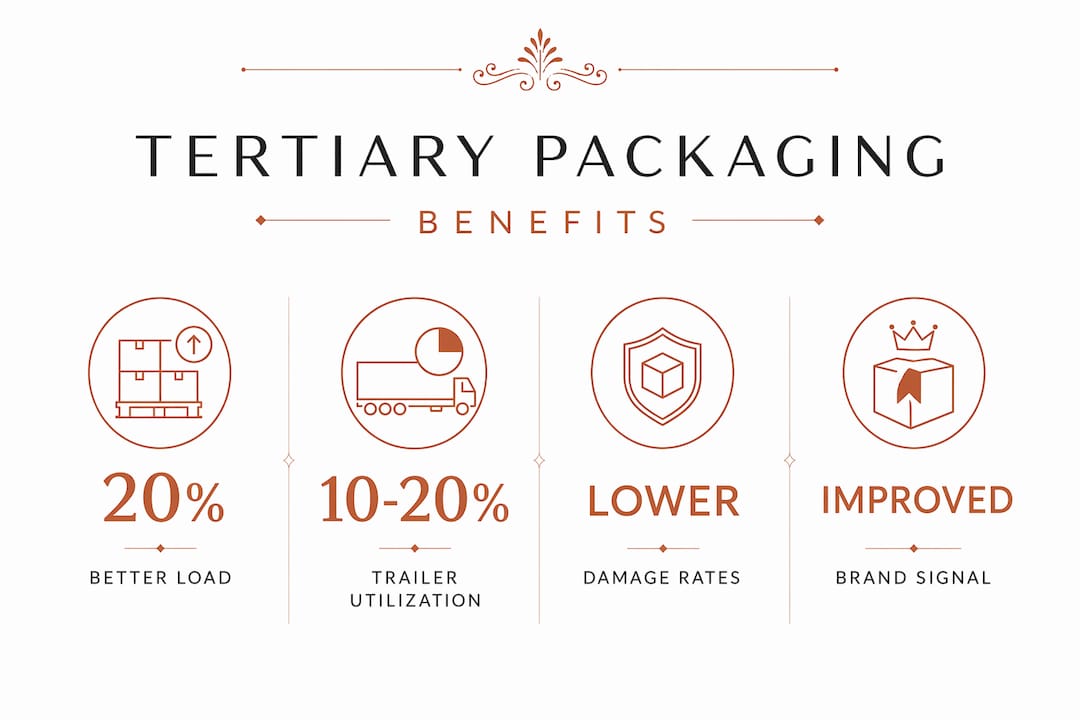
Tertiary packaging is also the first physical signal a retailer or distribution center receives about how seriously a supplier takes its logistics. Arriving loads that are tight, square, and stable communicate operational competence before a single conversation happens.
What are the primary functions and benefits of tertiary packaging?
The benefits of tertiary packaging extend well beyond keeping boxes from falling off a pallet. Here is what a well-designed tertiary system delivers:
- Damage reduction. Stretch wrap containment force, edge protectors, and stable stacking patterns absorb the vibration and impact of road and rail transport. Fewer damaged units mean fewer deductions from retail partners and fewer consumer complaints.
- Forklift-ready unitization. A palletized load moves as a single unit. Without tertiary packaging, warehouse teams handle individual cases, multiplying labor time and injury risk.
- Trailer cube optimization. Standardized pallet footprints and consistent stack heights allow transport planners to load trailers to maximum legal weight and volume. Random or irregular tertiary packaging destroys that math.
- Warehouse throughput speed. Distribution centers using automated conveyor systems and AS/RS (Automated Storage and Retrieval Systems) depend on consistent tertiary packaging dimensions to maintain throughput rates.
- Freight cost control. Lighter, right-sized tertiary packaging reduces dimensional weight charges on parcel and LTL shipments. Every kilogram of unnecessary packaging material is a cost that compounds across thousands of shipments.
The importance of tertiary packaging becomes clearest when it fails. A pallet that collapses in a trailer destroys not just the load but the relationship with the retailer receiving it. Chargebacks, compliance fines, and delisted SKUs are the downstream consequences of tertiary packaging that was selected on price alone.
Pro Tip: Track damage-in-transit rates by SKU and correlate them with tertiary packaging specifications. The data almost always reveals that the cheapest packaging option is not the lowest-cost option once damage claims are included.
What materials and types of tertiary packaging are commonly used?
Material selection is where tertiary packaging decisions get genuinely complex. The right choice depends on the product category, distribution channel, freight mode, regulatory environment, and sustainability targets. The table below summarizes the most common options and their trade-offs.

| Material | Best use case | Key trade-off |
|---|---|---|
| Wooden pallets (ISPM-15 compliant) | International freight, heavy loads | Heavier than plastic; requires heat treatment for customs clearance |
| Plastic pallets | Food, pharma, and hygiene-sensitive sectors | Higher upfront cost; better for closed-loop systems |
| Stretch/shrink wrap film | Universal load containment | Single-use plastic; recyclable grades available |
| Polypropylene strapping | Heavy or high-value loads | Adds tensile strength; minimal weight penalty |
| Corrugated master cartons | Grouping retail units for distribution | Lightweight and recyclable; limited moisture resistance |
| Intermediate Bulk Containers (IBCs) | Liquids, granules, and bulk chemicals | High capacity; reusable but requires return logistics |
| Edge protectors | Corners of palletized loads | Low cost; significant reduction in corner crush damage |
Plastic pallets dominate food and pharmaceutical sectors for hygiene reasons, while corrugated master cartons remain the default for lightweight, recyclable grouping in consumer goods. The selection logic always balances durability against freight cost impact and sustainability requirements.
One regulatory factor that catches importers off guard: ISPM-15 compliant wood pallets are mandatory for international shipments to prevent the spread of invasive pests. Non-compliant pallets can trigger customs rejection, shipment seizure, or costly delays at the border. If your supply chain crosses international borders, ISPM-15 compliance is not optional.
Intermediate Bulk Containers deserve specific attention for bulk liquid and granular products. An IBC holds between 275 and 330 gallons in a single forklift-movable unit, replacing dozens of smaller containers. The trade-off is return logistics: reusable IBCs require a reverse supply chain to recover value.
Pro Tip: When evaluating sustainable packaging materials, calculate total lifecycle cost rather than unit cost. A recyclable stretch wrap that costs 15 percent more per roll may reduce waste disposal fees and ESG reporting liabilities enough to justify the premium.
How does tertiary packaging differ from primary and secondary packaging?
The three-layer packaging model assigns distinct roles to each tier, and confusing them leads to misallocated design budgets and functional gaps. Primary packaging directly contacts the product and is the consumer-facing layer. Secondary packaging groups primary packages for retail display or easier handling. Tertiary packaging groups secondary packages for bulk transport and storage.
| Layer | Contact with product | Consumer visibility | Primary function |
|---|---|---|---|
| Primary | Direct | High | Product containment and protection |
| Secondary | Indirect | Medium | Retail grouping and branding |
| Tertiary | None | None | Bulk transport and warehouse handling |
The practical implication of this distinction is significant for budget allocation. Primary packaging justifies investment in premium materials and graphics because it drives purchase decisions. Secondary packaging supports shelf presence and retail compliance. Tertiary packaging justifies investment in structural performance and regulatory compliance because it protects everything inside it.
A common mistake in smaller CPG operations is treating tertiary packaging as an afterthought, specifying it last and cheapest. The result is that beautifully designed primary and secondary packaging arrives at the retailer crushed, wet, or shifted. The packaging lifecycle only delivers value when all three layers perform their roles. Tertiary packaging failure negates every dollar spent on the layers inside it.
What are best practices for optimizing tertiary packaging?
Optimizing tertiary packaging requires discipline across design, material selection, and operational integration. The following practices separate high-performing supply chains from those constantly firefighting damage and cost overruns.
-
Right-size before you specify materials. Excess tertiary packaging increases freight costs and labor without adding structural benefit. Measure your actual case dimensions and design pallet configurations to minimize overhang and void space before choosing wrap gauge or strapping tension.
-
Design for a self-supporting stack. Load stability depends on stacking pattern and containment force. Stretch wrap cannot rescue a poorly stacked pallet. Column stacking maximizes compression strength; interlocking patterns improve lateral stability. Choose based on the compression demands of your specific load.
-
Separate unitizing from stabilizing. Unitizing means grouping packages into a single movable unit. Stabilizing means securing that unit against shift and collapse. Treating them as one step leads to either over-wrapping (wasted material and weight) or under-wrapping (load failure). Address each function with the right tool.
-
Validate compatibility with automated systems. Tertiary packaging must integrate with conveyor and AS/RS systems to avoid jams and operational downtime. Protruding strapping tails, inconsistent pallet heights, and non-standard footprints are the most common causes of automation failures in distribution centers.
-
Audit damage data quarterly. Damage-in-transit rates, retailer chargebacks, and warehouse damage reports are the feedback loop for tertiary packaging performance. Without structured data review, packaging decisions default to habit rather than evidence.
Pro Tip: Run a packaging design audit annually that includes tertiary specifications alongside primary and secondary. Most CPG teams review graphics regularly but let structural specifications drift for years.
How does tertiary packaging affect brand reputation?
Tertiary packaging protects brand reputation by determining whether the product arrives in the condition it left the factory. Outer packaging damage signals poor handling quality to every person who touches the load before it reaches the shelf or the consumer.
The brand impact operates at multiple levels:
- Retailer relationships. A distribution center that consistently receives damaged or unstable loads will flag the supplier for compliance review. Repeated failures lead to chargebacks, increased inspection frequency, and eventually delisting.
- Consumer perception. In direct-to-consumer and e-commerce channels, the tertiary packaging is often what the consumer physically receives. A crushed outer box communicates carelessness regardless of what is inside.
- Returns and lost sales. Damaged product at the tertiary level generates returns that cost two to three times the original product value when labor, reshipping, and disposal are factored in.
Tertiary packaging is often mislabeled as just shipping supplies. It is a strategic asset that either protects or erodes the brand equity built through product development, marketing, and retail placement. Choosing quality tertiary packaging is not a logistics decision in isolation. It is a brand decision with measurable financial consequences.
Key takeaways
Tertiary packaging is the outermost structural layer of the supply chain, and its performance directly determines whether product quality, freight efficiency, and brand reputation survive the journey from factory to shelf.
| Point | Details |
|---|---|
| Core definition | Tertiary packaging consolidates and protects goods for bulk transport using pallets, stretch wrap, strapping, and master cartons. |
| Efficiency impact | Well-designed tertiary systems improve trailer cube utilization by 10 to 20 percent, reducing freight costs at scale. |
| Material selection | Choose between wood and plastic pallets, stretch film, IBCs, and corrugated cartons based on product category, freight mode, and regulatory requirements. |
| Regulatory compliance | ISPM-15 compliant wood pallets are mandatory for international shipments to prevent customs rejection and border delays. |
| Brand protection | Tertiary packaging condition is the first physical brand signal a retailer or consumer receives; damage at this layer erodes trust before the product is opened. |
Tertiary packaging as a strategic asset, not an afterthought
I have reviewed packaging specifications for brands across consumer goods, food service, and industrial distribution, and the pattern is consistent. Primary packaging gets the design budget, secondary packaging gets the retail compliance review, and tertiary packaging gets whatever is cheapest and available. That sequence is backwards.
The brands that run the tightest supply chains treat tertiary packaging as a designed system, not a commodity purchase. They specify pallet configurations the same way they specify label substrates. They validate stretch wrap containment force against actual load weights. They audit damage data and trace it back to specific packaging decisions. That discipline is rare, and it is exactly where competitive advantage hides.
The sustainability dimension adds urgency. Recyclable stretch films, reusable plastic pallets in closed-loop systems, and right-sized corrugated master cartons are not just environmental choices. They reduce weight, cut disposal costs, and increasingly satisfy retailer and regulatory ESG requirements. The brands that figure out sustainable packaging design at the tertiary level now will not be scrambling to retrofit their supply chains when compliance deadlines arrive.
Automation integration is the next pressure point. As more distribution centers deploy AS/RS and robotic picking systems, tertiary packaging specifications will need to meet tighter dimensional and material tolerances. Packaging that was fine for manual handling will cause expensive downtime in automated facilities. The time to design for that reality is before the automation goes live, not after the first jam.
— Myles
How Offcut helps packaging professionals design better
Tertiary packaging decisions require the same design rigor as consumer-facing packaging, and the concepts that drive those decisions have real value. Offcut is where that value gets captured instead of lost on a hard drive.

Offcut connects packaging professionals and supply chain managers with print-ready design concepts developed by experienced designers. Founders get exclusive tertiary and structural packaging concepts at a fraction of agency cost. Designers get paid for work that solves real logistics problems rather than sitting unused. If you are building or refining a tertiary packaging system and need design concepts that balance protection, sustainability, and cost, explore what Offcut offers for packaging professionals who need ideas that are ready to execute.
FAQ
What is the tertiary packaging definition?
Tertiary packaging is the outermost packaging layer used to consolidate and protect goods for bulk transport and storage. It includes pallets, stretch wrap, strapping, edge protectors, and master cartons, and it never reaches the end consumer directly.
What are common examples of tertiary packaging?
Common tertiary packaging examples include wooden or plastic pallets, stretch film-wrapped pallet loads, polypropylene strapping, corrugated master cartons, slip sheets, and Intermediate Bulk Containers (IBCs) used for liquids and bulk materials.
How does tertiary packaging differ from secondary packaging?
Secondary packaging groups individual primary packages for retail display or easier handling, while tertiary packaging consolidates secondary packages into bulk units for transport and warehouse storage. Tertiary packaging has no consumer visibility and focuses entirely on logistics performance.
Why is ISPM-15 compliance important for tertiary packaging?
ISPM-15 compliance is mandatory for wood pallets used in international shipments to prevent the spread of invasive pests. Non-compliant pallets can result in customs rejection, shipment seizure, or significant border delays that disrupt supply chain timelines.
How does tertiary packaging impact freight costs?
Properly designed tertiary packaging improves trailer cube utilization by 10 to 20 percent through standardized stacking dimensions, directly reducing the number of truck movements required per distribution cycle and lowering total freight spend.