
TL;DR:
- Most founders mistakenly believe great software ideas come from sudden insight, but validation reveals most startups fail due to building products nobody wants.
- A software idea is viable only if it demonstrates validated demand, revenue potential, reasonable competition, and technical feasibility verified through evidence-based tests.
Most entrepreneurs believe a great software idea strikes like lightning. It doesn't. Around 42% of startups fail because they build products nobody wants, not because they lack engineering talent or funding. Finding the right software idea is a deliberate process, and most founders skip the most important steps entirely. This article walks you through how to identify promising software development ideas, test them against real market signals, and decide which ones are worth building. No guesswork. No mythology about genius founders. Just a practical, repeatable system.
Table of Contents
- Key takeaways
- What makes a software idea viable in 2026
- How to discover promising software ideas
- How to validate software ideas before you build
- Prioritizing which software ideas to pursue
- My honest take on validation traps
- Start your next software project with Offcut
- FAQ
Key takeaways
| Point | Details |
|---|---|
| Viability has four criteria | Every software idea must show validated demand, revenue potential, reasonable competition, and technical feasibility. |
| Problems beat solutions | Validate the problem first. Validating your solution leads to false positives and wasted months. |
| Weak signals are not validation | Polite interest and survey responses are noise. Pre-orders and deposits are signal. |
| Speed matters in validation | Build-Measure-Learn cycles of about one week reduce overbuilding and accelerate real learning. |
| Competitor reviews reveal gaps | Negative reviews on platforms like G2 or Capterra are some of the clearest market gap data available. |
What makes a software idea viable in 2026
Not every problem worth solving is a problem worth building software around. Before you spend a single hour writing code or hiring a developer, you need to know whether your software idea clears a basic viability bar. A viable software idea must satisfy four criteria: validated demand, proven revenue potential, reasonable competition, and technical feasibility.
These four criteria sound obvious, but most founders collapse them into gut feeling. Validated demand means people are actively searching for a solution, spending money on workarounds, or complaining loudly in communities. It is not someone telling you your idea "sounds interesting." Revenue potential means there is a clear, defensible path to charging for the software. Reasonable competition means a market exists and competitors have paying customers, but no single player dominates so completely that differentiation is impossible.
Here is how to read these criteria with actual data rather than assumptions:
- Demand signals: A smoke test landing page should convert at 5% or higher with cold traffic to indicate strong validation. Organic keyword searches of 100 or more per month, combined with 20 or more independent complaints in forums or communities, reinforce that demand is real.
- Revenue signals: Look for existing products charging $50 or more per month in your space. If nobody is paying anything, either the pain is not acute enough or the market expects free tools.
- Competition signals: Zero competitors is a red flag, not a green light. It often means the problem is too small or was already tried and abandoned.
- Technical feasibility: With AI and no-code tools, the bar for building a first version has dropped significantly. Still, validate demand before you estimate buildability.
Pro Tip: Run the four criteria as a checklist before you fall in love with any idea. Write each criterion down and require evidence, not opinion, to check it off.
How to discover promising software ideas
The best software project inspiration rarely comes from sitting in a room and brainstorming. It comes from studying systems where friction already exists. This is called the market system approach, and it works because you are following evidence instead of hunches.
Upstream signals like patent filings, capital flows into adjacent industries, and clusters of user complaints reveal problems before they trend on social media. If venture capital is flooding into a vertical and the existing tools have dozens of one-star reviews, that vertical is worth investigating hard.
Here are five discovery methods ranked by signal quality:
- Competitor review mining. Read every one-star and two-star review for leading products in your target category on G2, Capterra, or the App Store. Recurring complaints about pricing, UX, or missing features are not just feedback. They are a product brief written by your future customers.
- Community search. Search Reddit, Slack communities, and niche forums for phrases like "I wish there was a tool that..." or "does anyone know how to automate..." Real frustration expressed in real language is the rawest form of software project inspiration you can find.
- The Search Test. Look up keyword search volumes for your proposed solution. 100 or more monthly searches indicate real demand. Between 10 and 100 suggests a niche worth investigating. Fewer than 10 means there is likely no market yet, or you have not found the right search phrase.
- Capital flow mapping. Check Crunchbase or PitchBook for recent funding rounds in adjacent categories. Where money is moving, problems are being recognized. Follow the money upstream to the problem, not the solution.
- Customer persona interviews. Talk to ten people in a target segment with specific, open-ended questions. Ask about their workflows, what breaks, what they pay for, and what they have tried. Listen for patterns across multiple conversations, not endorsements of your idea.
"The biggest mistake founders make is validating the solution rather than the problem, leading to false-positive feedback." — How to Validate Startup Ideas 2026
This quote deserves more weight than it typically gets. When you describe your solution to someone and they say "that sounds great," they are usually being polite. When you ask them to describe the most frustrating part of their current workflow and they mention the exact problem you are solving unprompted, that is gold.
How to validate software ideas before you build
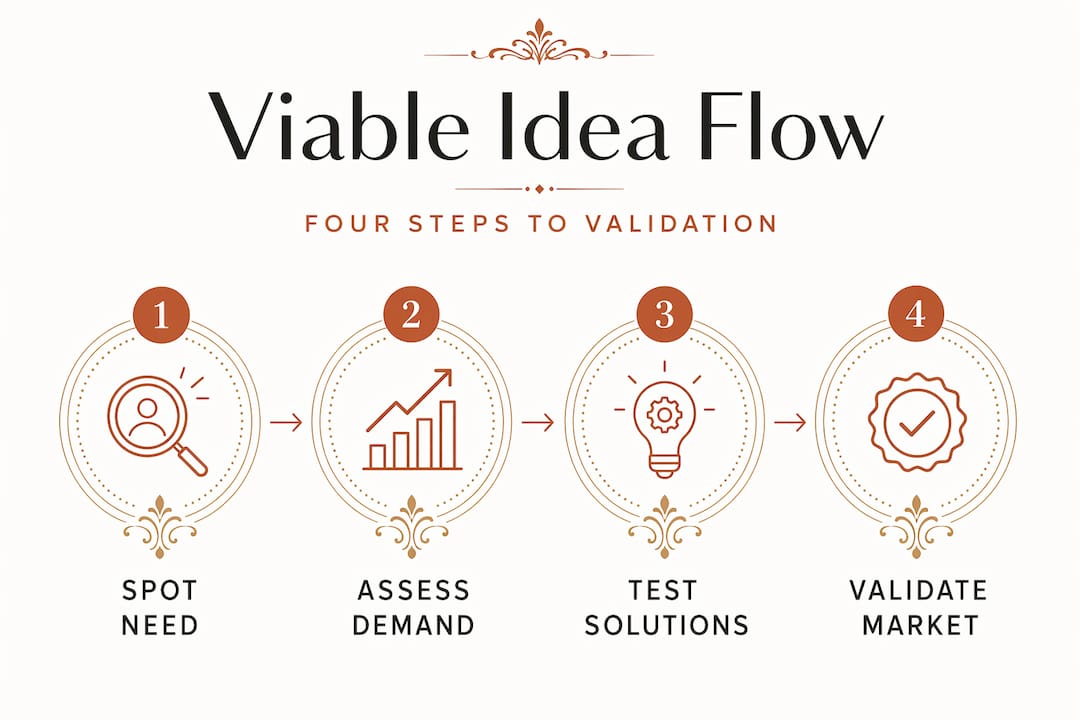
Discovery gives you a hypothesis. Validation is how you stress-test it before committing real resources. The Build-Measure-Learn loop from Lean Startup methodology, when applied to software idea validation, should run in cycles of about one week. Longer cycles encourage overbuilding and delay the feedback you actually need.

Here is a comparison of the most common validation methods by speed, cost, and signal strength:
| Method | Speed | Cost | Signal strength |
|---|---|---|---|
| Smoke test landing page | 1-3 days | Very low | Medium (intent) |
| Concierge MVP | 1-2 weeks | Low | High (product-market fit) |
| Pre-order or deposit | 1 week | Very low | Very high (willingness to pay) |
| Survey or interview | 1-3 days | Very low | Low (interest only) |
| Full MVP build | 4-12 weeks | High | Variable |
A smoke test puts a landing page in front of cold traffic before you write a single line of product code. If the page converts at 5% or above for signups or waitlist joins, you have preliminary validation. Under 2% usually means the value proposition is unclear or the pain is not acute enough.
The concierge MVP takes a different angle. Many successful SaaS companies started by delivering their product's value manually before automating it. You do the work by hand, charge for it, and learn what customers actually value versus what you assumed they would.
Pre-orders and deposits are the strongest signal available. Financial commitment from early customers, even a small amount, separates real intent from polite interest. A Letter of Intent from a business customer carries more validation weight than 500 survey responses.
Pro Tip: Before you launch any validation test, write down your success metric and the minimum threshold that would make you move forward. This prevents you from moving the goalposts after you see the results.
Pre-registering your hypotheses and decision rules is not bureaucracy. It is the only reliable way to avoid confirmation bias. Teams that skip this step almost always find a way to interpret weak data as green lights.
Prioritizing which software ideas to pursue
Once you have run validation experiments, you need a system to act on the data rather than endlessly iterate. A scorecard approach forces honest evaluation across four dimensions: problem reality, pain severity, willingness to pay, and customer reachability.
Score each dimension on a 1 to 5 scale with evidence, not opinion:
- Problem reality: Did multiple users describe the same problem independently, without prompting? Score 5 if yes, 1 if you had to explain the problem to them.
- Pain severity: Is this a daily irritation or a monthly inconvenience? Is it costing them money, time, or customers? The more acute and frequent the pain, the higher the score.
- Willingness to pay: Did anyone offer money or a deposit during validation? Scoring here requires real financial signal, not "I would probably pay for that."
- Customer reachability: Can you find and reach this customer segment through specific channels? A well-defined audience you can target with $500 in ad spend scores better than a diffuse one requiring brand building over years.
If your idea scores below 12 out of 20, you are not killing a bad idea. You are redirecting your energy toward a better one. There are four types of pivots worth knowing: a customer pivot (different segment, same problem), a problem pivot (different problem, same segment), a solution pivot (different approach, same problem and customer), and a full exit. Validated learning tells you which pivot is warranted.
Balancing unique app ideas with market signals is a real tension. The most original ideas sometimes fail to show early demand because no existing search volume or community exists yet. When this happens, ask whether you are seeing a future market forming or a market that does not exist. The former requires patience and deeper qualitative research. The latter requires letting go.
My honest take on validation traps
I have watched dozens of founders go through the motions of validation without actually doing it. They talk to their friends. They post in startup forums and collect "great idea" reactions. They count Twitter followers as proof of demand. None of that is validation.
The trap I see most often is confusing interest with intent. Customer interest and intent are entirely different things, and the gap between them is where most software ideas die. Someone saying "I'd totally use that" is interest. Someone handing over a credit card number or signing a letter of intent is intent. Only one of those tells you anything real about whether your software idea has a market.
What I have found genuinely useful is getting uncomfortable in customer conversations. Ask "how much are you currently spending on this problem?" and then stop talking. Ask "what have you already tried?" and listen for whether they have actually spent money or just thought about it. Polite feedback is the enemy of real validation.
The other thing most guides miss about Build-Measure-Learn is the measure part. Validated learning requires documented hypotheses and decision rules before the experiment runs. Not after. Without that discipline, you will rationalize your way into building something nobody wants and call it a pivot.
AI tools are genuinely useful for accelerating discovery and pattern recognition across review data, search trends, and community complaints. They do not replace the conversation where a customer tells you something you never expected to hear. Both matter. Treat them as complementary, not interchangeable.
— Myles
Start your next software project with Offcut
If your software idea touches product design, packaging, or the CPG space, you already know how expensive and slow the traditional design workflow is. Offcut gives founders access to exclusive, print-ready packaging concepts without the agency price tag.
Designers get paid for work that would otherwise sit on a hard drive. Founders get production-ready concepts they can use to prototype, pitch, and validate faster. If you are exploring software ideas for CPG or packaging workflows, the Offcut blog covers practical validation and design strategy tailored to that exact market. Start there, then explore Offcut to see what is available for your next project.
FAQ
What is a software idea viability test?
A viability test checks whether your software idea has validated demand, revenue potential, reasonable competition, and technical feasibility before you build. Smoke test landing pages converting at 5% or higher with cold traffic are one reliable signal of early viability.
How do I generate software ideas from scratch?
Mine competitor reviews on G2 or Capterra for recurring complaints, search niche communities for unmet needs, and run keyword research to find problems people are actively searching for. The most reliable software project inspiration comes from documented friction in existing markets.
What is the fastest way to validate a software idea?
A smoke test landing page paired with a small paid traffic budget can return meaningful conversion data in two to three days. Pre-orders or deposits provide stronger validation but require a slightly longer setup, usually under one week.
Why do most software ideas fail before launch?
Most software development ideas fail because founders validate their solution instead of the problem, collecting polite interest rather than financial commitment. Building before confirming willingness to pay is the single most common and most avoidable mistake.
How do I know when to pivot or kill a software idea?
Use a scorecard across problem reality, pain severity, willingness to pay, and customer reachability. A total score below 12 out of 20 after a full validation cycle is a clear signal to pivot or stop. Documented decision rules set before the experiment help you make that call without rationalization.