
TL;DR:
- Most CPG startup founders make the costly mistake of selecting a framework before clarifying their product scope, leading to unnecessary complexity and delays. The article emphasizes validating the problem and defining scope first, then choosing architecture and tools like Laravel or React Native to ensure faster, more cost-effective development. Adopting a risk-driven, MVP-first approach with layered architecture and incremental microservices minimizes overengineering, supporting scalable and maintainable growth.
Most CPG startup founders make the same expensive mistake: they pick a framework for application development before they know what they're building. The technology decision comes first, and everything else follows. That is exactly backward. The framework should follow the product scope, not lead it. This guide walks you through the right sequence, from validating your idea to choosing architecture patterns and picking concrete tools like Laravel or React Native, so you ship faster, spend less, and avoid rebuilding from scratch six months in.
Table of Contents
- Understanding the MVP development framework
- Budgeting and timeline considerations for your MVP
- Choosing and applying architectural frameworks to build maintainable apps
- Microservices and event-driven frameworks for resilient applications
- Selecting web and mobile app frameworks for CPG startups
- Rethinking framework adoption: MVP-first and risk reduction for CPG startups
- Leverage expert design frameworks with OffCut to accelerate your packaging CPG apps
- Frequently asked questions
Key Takeaways
| Point | Details |
|---|---|
| Prioritize MVP phases | Validate the problem and define scope before choosing your technology stack to save time and costs. |
| Budget smartly | Plan your MVP budget using a 20/60/20 allocation for planning, development, and testing with a 15% contingency. |
| Use Clean Architecture | Adopt layered architecture to isolate business logic and improve maintainability and scalability. |
| Apply microservices wisely | Introduce event-driven frameworks like Dapr only when your app’s complexity and scale require resilient distributed systems. |
| Match frameworks to skills | Pick Laravel for web and React Native for mobile considering your development team's expertise and product needs. |
Understanding the MVP development framework
Before you write a single line of code or choose between web development frameworks, you need to know what problem you're solving and for whom. This is not a formality. Founders who skip this step routinely build technically polished apps that nobody uses.
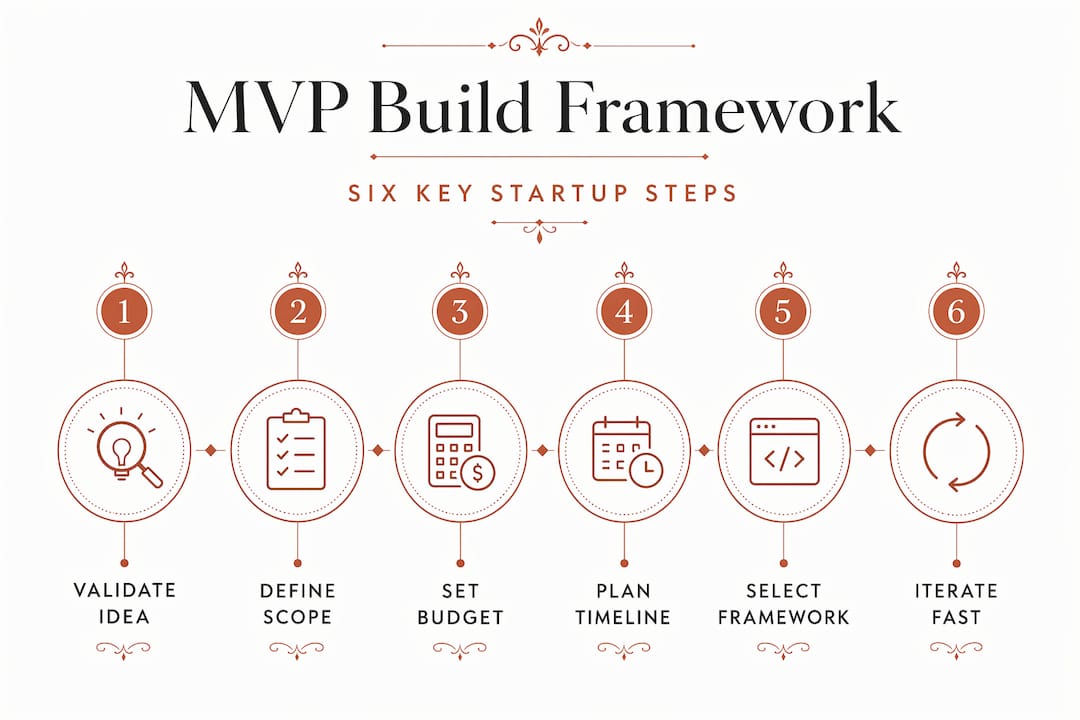
A practical way to structure this is the MVP development framework, which treats technology selection as a phase that comes after validation and scope definition, not before. Here's how those phases break down:
- Weeks 1–2: Validate the problem. Talk to at least 20 potential customers. Analyze competitors. Confirm that the problem is real, frequent, and worth solving.
- Weeks 2–3: Define scope. List every possible feature, then ruthlessly cut to Must Haves only. A focused MVP ships faster and teaches you more.
- Week 3: Choose technology. Only now do you evaluate application architecture frameworks and select a stack. Your requirements drive the decision.
- Weeks 5–10: Develop. Build only what's in scope. Resist feature creep.
- Weeks 10–12: Launch and learn. Release to a small audience, collect data, and decide what to iterate.
What should validation actually look like for a CPG startup? It means interviewing buyers at independent grocers, running a landing page with a waitlist, or testing a low-fidelity prototype at a trade show. It does not mean building a survey and calling it done.
When defining scope, sort features into three buckets:
- Must Have: Core functionality that makes the app usable (e.g., product catalog, order form, barcode scanner integration)
- Should Have: Features that improve experience but aren't blockers (e.g., saved orders, reorder shortcuts)
- Won't Have (yet): Everything else
For MVP budgeting and timeline for packaging design, this discipline of ruthless scoping is what separates a three-month build from a nine-month one.
Budgeting and timeline considerations for your MVP
Now that you understand the MVP phases, realistic numbers matter. Founders routinely underestimate costs because they scope loosely, assume smooth execution, and forget that testing takes real time.
MVP cost planning in 2026 shows the following ranges across complexity levels:
| Complexity | Cost range | Timeline |
|---|---|---|
| Simple web MVP | $15,000–$35,000 | 4–8 weeks |
| Mid-complexity MVP | $35,000–$75,000 | 8–14 weeks |
| Complex MVP | $75,000–$150,000+ | 14–24 weeks |
The budget allocation that works across most of these categories follows a 20/60/20 rule:
- 20% on planning: Requirements, wireframes, architecture decisions, and team setup
- 60% on development: Backend, frontend, integrations, and core testing
- 20% on testing, launch, and buffer: QA, staging environment, deployment, and unexpected fixes
There's one more number to bake in: a 15% contingency on top of your total estimate. Surprising complexity in third-party integrations, regulatory requirements for food labeling apps, or a mid-project pivot will eat that buffer faster than you expect.
Pro Tip: If your MVP cost overview for a packaging tech feature feels high, it usually means the scope isn't tight enough yet. Cut one Must Have to a Should Have and rerun the estimate.
One thing CPG founders get wrong consistently: treating time as a free variable. A 14-week build at $60,000 is not better than an 8-week build at $40,000 just because it includes more features. The faster you get real users on the product, the faster you stop spending money on assumptions.
Packaging MVP timelines follow the same principle. Design and development work in parallel when scoping is done well.
Choosing and applying architectural frameworks to build maintainable apps
With budget and timeline in place, how you structure your codebase determines how painful future changes will be. Architecture might feel like a concern for later, but a few decisions made early can save weeks of refactoring at Series A.

Clean Architecture is the most practical framework to understand here. Its central rule is simple: code dependencies always point inward toward business logic. Outer layers like your UI or database depend on the core. The core depends on nothing external.
The four layers work like this:
- Domain: Your core business rules. For a CPG app, this might be pricing logic, inventory thresholds, or product classification rules.
- Application: Use cases that orchestrate the domain. "Create a purchase order" is a use case, not a UI function.
- Infrastructure: Database connectors, third-party API clients, email services. These can be swapped without touching business logic.
- Presentation: Your UI layer, whether that's a web frontend or a mobile screen.
"Clean Architecture's dependency rule insulates business logic from outer framework layers, keeping code maintainable and testable across changes." — Md Sanwar Hossain
The practical payoff: when you need to swap your database from PostgreSQL to something else, or change from a REST API to GraphQL, you do it in the Infrastructure layer only. The rest stays intact. That kind of maintainable code structure is worth a lot when your product direction shifts after launch.
One honest tradeoff: mapping data between layers adds boilerplate. Tools like MapStruct (for Java-based projects) automate this, but it is still overhead. For a first MVP, you do not need Clean Architecture in full. Adopt it progressively as your codebase grows in complexity and team size increases.
Pro Tip: Introduce Clean Architecture one layer at a time. Start by isolating your business rules into a separate module. Add the use case layer next. The Infrastructure and Presentation separation follows naturally once you see where coupling causes pain.
Microservices and event-driven frameworks for resilient applications
Clean Architecture addresses how you structure a single application. As your CPG app grows, you may need to connect multiple services: a fulfillment system, a CRM, a packaging artwork approval workflow, and an order management tool. That is when microservices and event-driven patterns become relevant.
Dapr (Distributed Application Runtime) is one of the best cross-platform development tools available for this use case. It provides prebuilt building blocks for common distributed system needs so your team doesn't write custom plumbing for every integration.
What Dapr offers:
- Pub/sub messaging: Decouple services so they communicate through events, not direct calls
- State management: Built-in APIs for storing and retrieving application state across services
- Workflow orchestration: Coordinate long-running business processes across service boundaries
- Actors: Manage concurrency and state for individual entities like orders or products
"Dapr provides building blocks for reliable microservice apps, simplifying resilient application development for complex event-driven systems."
The key architectural detail is Dapr's sidecar pattern. Dapr runs as a separate process alongside your app, so your code calls Dapr's APIs rather than vendor-specific SDKs. If you later switch from Azure Service Bus to RabbitMQ, your application code doesn't change.
Here's the sensible adoption sequence for a CPG startup:
- Start with a monolithic app during MVP. Ship fast, learn fast.
- Identify which services grow in complexity or team ownership.
- Extract those into separate services with clear API contracts.
- Introduce Dapr for the CPG app architecture when you need pub/sub or state management across services.
- Add workflow orchestration only when multi-step business processes become error-prone.
Dapr is not a tool for week one. It's a tool for when real complexity arrives.
Selecting web and mobile app frameworks for CPG startups
Having covered architectural patterns, let's get concrete. At some point you pick actual tools. For most CPG startups, the decision comes down to backend, web frontend, and mobile.
| Framework | Best for | Requires | Watch out for |
|---|---|---|---|
| Laravel | Full-stack web apps and APIs | PHP knowledge | Server rendering adds complexity at scale |
| React Native | Cross-platform mobile apps | JavaScript, basic iOS/Android knowledge | Build tooling can be brittle |
| Next.js | Web apps needing server rendering or SEO | React fundamentals | Overkill for internal tools |
| Supabase / Firebase | MVP backends with minimal ops | Basic SQL or noSQL | Vendor lock-in at scale |
Laravel is a strong choice for startups building web applications with server-side logic. It comes with built-in queuing, authentication, testing utilities, and database migrations. You get a lot of infrastructure decisions made for you, which matters when you're moving fast. For a CPG ordering portal or a B2B catalog app, Laravel can carry you from MVP to $10M ARR without a rewrite.
React Native makes sense when your product lives primarily on mobile and you want a single codebase for iOS and Android. Consumer-facing CPG apps, like loyalty programs or scan-to-reorder tools, benefit from the native feel React Native delivers without building two separate apps.
A few selection principles that hold regardless of which framework you pick:
- Match the stack to your team's existing skills. A week of framework ramp-up time is a week of not shipping.
- Check ecosystem health. Active communities, recent releases, and good documentation reduce your support risk.
- Evaluate testing support early. Frameworks that make unit and integration testing easy are cheaper to maintain.
Pro Tip: When evaluating frameworks for packaging design software, lean on managed backend services like Supabase during your MVP phase. You eliminate DevOps overhead and focus entirely on product logic until you have enough users to justify custom infrastructure.
For choosing frameworks for packaging SaaS, the best app development frameworks are the ones your team can move fast in today, not the ones that look impressive on a pitch deck.
Rethinking framework adoption: MVP-first and risk reduction for CPG startups
Here is where most framework advice falls short: it treats technology selection as a quality problem, when it's actually a risk problem.
Founders who adopt Clean Architecture, Dapr, and React Native simultaneously before validating a single user journey aren't being thorough. They're front-loading risk. Every layer of complexity you add before you have paying users is a layer that could become wasted work if your assumptions are wrong.
Framework selection is fundamentally risk reduction. Start with the simplest verifiable user journey. One screen, one action, one data point. Then expand into layered architecture or microservices only as real complexity and team scale demand it.
There's a name for what happens when founders skip this: architectural overengineering. It looks like a beautifully structured codebase that solves problems you don't have yet, built on top of a product that customers don't want yet. The architecture is a monument to untested assumptions.
Dapr's contract-first integration model actually encodes this wisdom into its design. By treating building blocks as integration points with clear APIs, Dapr separates your app logic from the plumbing. You can add it incrementally as complexity arrives, rather than committing to it upfront.
The mindset shift for CPG founders specifically: your product is not the app. The app is the delivery mechanism for a product people want to buy. If the packaging design is wrong, if the product-market fit isn't there, no amount of technical elegance fixes that. Validate the product, then engineer for scale.
Separation of concerns in architecture mirrors separation of concerns in product strategy. Know what problem each layer solves. Don't let infrastructure decisions masquerade as product decisions.
Leverage expert design frameworks with OffCut to accelerate your packaging CPG apps
Applying a sound framework for application development means your tech stack is only as strong as the product it delivers. For CPG founders, that product includes packaging, and packaging is often where brand decisions live or die in retail and digital shelf environments.
Offcut gives CPG founders access to exclusive, print-ready packaging concepts created by professional designers, at a fraction of what an agency charges. Designers get paid for work that would otherwise sit on a hard drive. Founders get real design assets they can integrate directly into product development workflows, from mockup stages through to app-ready visual assets. If you're building a CPG app and need packaging design that keeps pace with your development timeline, Offcut is where that work gets done faster.
Frequently asked questions
What is the best order to choose a framework for startup application development?
First, validate your problem and define your MVP scope. Technology decisions come after validation and scoping to avoid switching costs and learning-curve delays.
How much should a startup budget for an MVP in 2026?
Costs range from $15,000 for a simple web MVP to $150,000 or more for complex builds, with a 20/60/20 split across planning, development, and testing plus a 15% contingency.
What advantages does Clean Architecture offer for startup apps?
Clean Architecture keeps business logic independent of external frameworks by pointing all code dependencies inward, making it easier to test, refactor, and swap UI or database components without breaking core logic.
When should a startup use microservices frameworks like Dapr?
Introduce Dapr when your app grows to include multiple services, workflows, or teams. Dapr building blocks simplify resilient microservice development for complex, event-driven systems.
How do I pick between Laravel and React Native for my startup app?
Laravel supports full-stack web apps with server-side rendering and API backends, while React Native is built for cross-platform mobile development. Match the choice to your team's skills and where your users actually spend time.