
TL;DR:
- Most entrepreneurs overlook their business plan introduction, which determines investor engagement and credibility. Writing it last after completing detailed sections ensures accuracy and clarity, making it a compelling, data-supported snapshot of the business. Tailoring the introduction to the audience and avoiding vague claims increases the chances of securing funding or interest.
Most entrepreneurs treat their business plan introduction as an afterthought. They write it first, keep it vague, and wonder why investors stop reading on page two. The introduction is not a formality. It is the single section that determines whether a lender schedules a meeting or files your plan away. SBA guidance makes clear that your opening pages must answer what you do, who you serve, why you'll win, and exactly what funding you need. Get those answers right, and your entire plan lands differently.
Table of Contents
- Key takeaways
- What a business plan introduction actually is
- Essential components to include
- When to write your introduction
- Common mistakes that kill credibility
- Tailoring your intro to different audiences
- My honest take on business plan introductions
- How Offcut helps entrepreneurs make their first impression count
- FAQ
Key takeaways
| Point | Details |
|---|---|
| Write the introduction last | Draft every other section first, then extract accurate data for your introduction to avoid contradictions. |
| Cover five core elements | Include company overview, value proposition, target market, financials, and your marketing approach. |
| Tailor tone to your audience | Investors want growth potential; lenders want repayment logic. Adjust your framing for each. |
| Every claim needs backup | Each statement in your introduction should point to a verifiable section later in the plan. |
| Treat it as a living document | Update your introduction whenever major financial or market assumptions shift. |
What a business plan introduction actually is
There is a persistent confusion between three terms: the executive summary, the business description, and the business plan introduction. They overlap, but they are not the same thing.
The introduction functions as your reader's first impression of the entire document. Think of it as a compressed version of your plan's most persuasive arguments. It typically includes a short executive summary and a company snapshot: who you are, what you sell, where you operate, and why the market needs you. The business description, by contrast, lives deeper in the plan and covers operational specifics in full detail.
The introduction's job is not to explain everything. Its job is to make the reader want to keep reading and, ultimately, to act. According to M&T Bank, the executive summary is often make-or-break. Missing the mark here misrepresents your capacity to achieve goals and repay financing.
Three purposes the introduction must accomplish:
- Capture attention with a specific problem, market stat, or bold business claim grounded in evidence
- Summarize your concept so any reader understands your business model within 60 seconds
- Justify your funding ask with enough logic that investors or lenders feel compelled to dig deeper
Pro Tip: If your introduction cannot be understood by someone outside your industry, rewrite it. Clarity beats cleverness every time.
Essential components to include
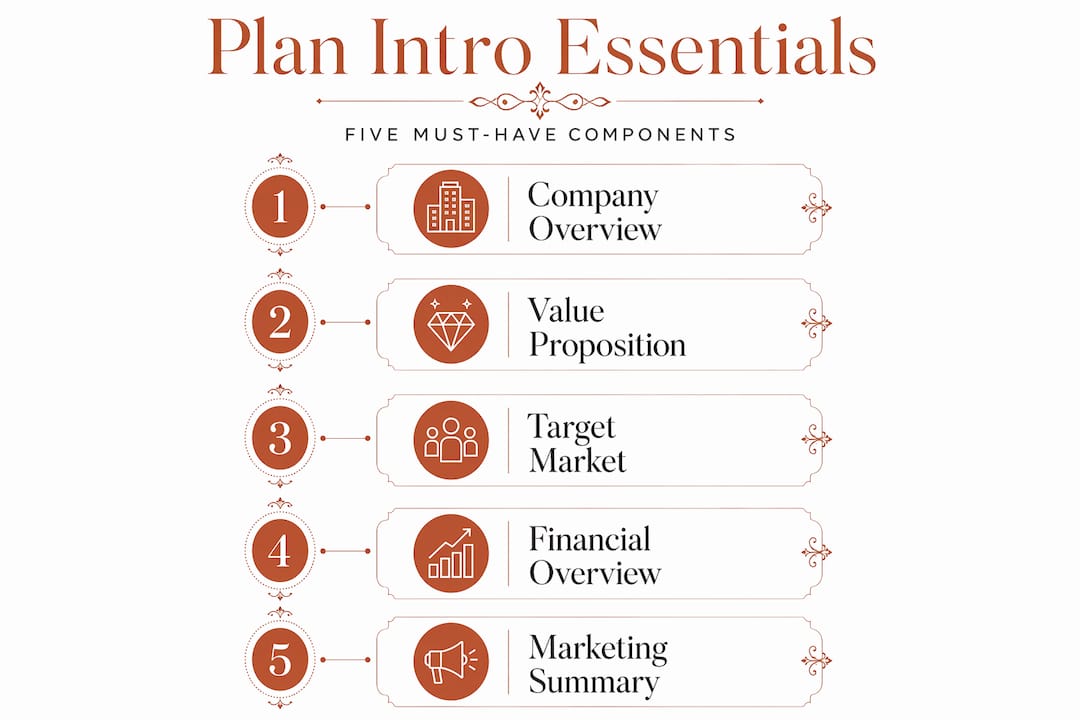
A strong business plan introduction is not a paragraph of mission statements. It is a structured snapshot covering five distinct areas. Each area answers a specific question your reader is already asking.
Company overview
Open with your business name, legal structure, location, founding date, and the core product or service. Keep it to two or three sentences. This is not where you sell the vision. This is where you prove you know what you are building.

Unique value proposition
What makes you different, and why does that difference matter to customers? Be specific. Saying "we offer better customer service" tells an investor nothing. Saying "our SaaS tool reduces inventory errors by 34% compared to manual tracking" tells them everything. Specificity and current data increase credibility with investors while vague claims reduce funding chances. Supporting your value proposition with concrete figures or examples is one of the clearest signs of a prepared founder.
Target market
Define who your customer is and quantify the opportunity. Include market size, growth rate, and a short customer profile. Even a rough figure, like "the U.S. specialty food packaging market is valued at $4.2 billion," does more work than a generic claim about "growing demand." Reference your target market research to show you understand who is buying and why.
Financial overview and funding ask
This is the section most new entrepreneurs either skip or fumble. State clearly how much money you are requesting, what you will spend it on, and how the business will generate enough revenue to repay it. Linking funding asks explicitly with marketing strategy and repayment projections aligns your introduction with what banks and investors actually underwrite. Do not ask for $200,000 without explaining that $80,000 goes to equipment, $70,000 to working capital, and $50,000 to a six-month marketing push tied to your sales projections.
Marketing and sales summary
Close with a one or two sentence overview of how you will reach customers and drive revenue. This does not need detail. It needs to be plausible and consistent with the rest of the plan.
Pro Tip: Think of your introduction as a compressed evidence map. Every statement should point to a verifiable section later in the document. If a claim has no backup, cut it.
The five components listed above are not optional extras. They are the minimum a lender or investor needs to make a decision about reading further.
When to write your introduction
Here is where most first-time founders go wrong: they write the introduction first.
It feels logical. You want to set the stage before filling in the details. But writing your introduction before the rest of the plan forces you to guess at figures, approximate market size, and estimate a funding ask before you have actually done the math. Those guesses rarely survive contact with the detailed sections, creating contradictions that erode credibility.
University of Washington Libraries recommend writing the executive summary last, after drafting all plan sections. The logic is simple. Once your financial projections, market analysis, and operations plan are complete, you can extract the most accurate, compelling version of each data point and drop it into the introduction. No guessing required.
A practical workflow:
- Complete your market analysis section fully before writing any market claims in the introduction
- Finalize your financial projections before stating a funding ask
- Confirm your operational plan before describing your timeline or milestones
- Draft the introduction as a distillation, pulling the strongest facts from each completed section
- Review for internal consistency: every number in the introduction must match the corresponding section
One more point on this. Your business plan is a living document. When your market assumptions shift, your revenue projections change, or you pivot your model, the introduction needs to be updated too. A stale introduction attached to an updated plan signals to investors that the founder is not paying attention to detail.
Pro Tip: Date-stamp your business plan and keep version notes. When you send an updated version to a lender, reference what changed. It shows discipline.
Common mistakes that kill credibility
Knowing what to include is only half the battle. The other half is knowing what to avoid.
Being too vague. Generic language like "we serve a wide range of customers" or "our product meets growing demand" adds no value. Replace every vague phrase with a specific data point or concrete example.
Overpromising. Claiming you will capture 30% of your market in year one without supporting analysis is a red flag, not a confidence signal. Investors and lenders have seen hundreds of plans. Unrealistic claims tell them you have not done your homework. Clear and credible language tuned to investor expectations is what earns a second meeting.
Ignoring the funding logic. Your introduction should show the path from money in to money out to money repaid. Many founders list a funding amount with no explanation of use or repayment mechanism. That is not a business plan introduction. That is a wish list.
Using industry jargon. Your reader may be a banker, a venture capital associate, or a potential partner with no background in your specific industry. Write for the intelligent non-specialist.
Failing to connect the introduction to the plan. If your introduction claims $500,000 in projected revenue but your financial section shows $380,000, you have a problem. Every figure in the introduction must match the plan exactly.
Pro Tip: Read your introduction out loud before sending it. If you stumble over a sentence, rewrite it. If a claim sounds hollow when spoken, it will read that way too.
Tailoring your intro to different audiences
The content of your business plan introduction stays roughly the same across audiences. The emphasis and tone shift considerably.
| Audience | Primary focus | Tone | Key signal they want |
|---|---|---|---|
| Investors | Growth potential and return on investment | Ambitious but evidence-based | Scalability, competitive advantage, market size |
| Bank lenders | Repayment ability and risk minimization | Measured and data-forward | Cash flow, collateral, funding use breakdown |
| Business partners | Mission, leadership, and market position | Collaborative and vision-oriented | Shared values, operational competence |
For investors, front-load your market opportunity and what makes your position defensible. A compelling hook using market data or a bold statement works well here. For lenders, lead with financial stability signals and a clean funding use breakdown. For partners, emphasize your team's experience and where the business is headed.
The most common mistake is sending the same introduction to every audience without adjusting the first paragraph. Spend 20 minutes tailoring the opening for each reader type. That small investment materially changes how your plan lands.
My honest take on business plan introductions
I have read hundreds of business plans through various capacities over the years. The single most consistent problem I see in plans from new founders is that the introduction tries to be everything at once. It reads like a press release, a pitch deck, and a financial statement all crammed into three paragraphs.
In my experience, the plans that get funded have introductions with one clear quality: they make the decision easy. The reader does not have to work to understand what the business does, why it will succeed, or where their money goes. That clarity does not come from writing talent. It comes from writing the introduction last, after you genuinely understand your own numbers and market.
I have also seen founders hold back on the funding ask, burying it on page three or softening it with qualifiers. That is a mistake. State the number clearly, state what it funds, and state how it comes back. Funders respect directness.
Treat your introduction as a discipline check. If you cannot write a tight, specific, two-page introduction, you probably do not know your business well enough yet. Writing it will show you the gaps. And updating it every time your plan materially changes will keep you honest about where your business actually stands.
— Myles
How Offcut helps entrepreneurs make their first impression count
A strong business plan introduction gets you in the room. What happens next often depends on how your brand looks and feels in the physical world.

At Offcut, we understand that founders need more than a polished document. They need packaging concepts that match the ambition described in their plan. Offcut connects entrepreneurs with print-ready packaging designs created by professional designers, at a fraction of what an agency charges. If your business plan calls out branding and product presentation as a competitive advantage, those claims need to be backed by visuals that actually deliver. Explore Offcut's designer platform to see how exclusive, ready-to-use packaging concepts can bring your business introduction to life on the shelf.
FAQ
What should a business plan introduction include?
A business plan introduction should cover your company overview, unique value proposition, target market, financial overview, and funding ask. Each element should be specific and supported by data from the rest of your plan.
How long should a business plan introduction be?
M&T Bank advises keeping the executive summary under two pages. The goal is to give readers enough to make a decision about continuing, not to explain every detail.
Should I write the introduction first or last?
Write it last. University of Washington Libraries recommend completing all other sections first so your introduction accurately reflects your final figures, market data, and operational plans without contradictions.
What is the difference between an executive summary and a business plan introduction?
The terms are often used interchangeably, but the introduction can also include a brief company overview before the executive summary begins. Both serve the same purpose: giving readers a clear, concise picture of your business and funding needs upfront.
How do I make my business plan introduction stand out to investors?
Lead with a specific market stat or problem statement, state your value proposition in concrete terms, and tie your funding ask directly to a repayment path. Data-backed assumptions signal to investors that your projections are grounded in reality, not optimism.