
TL;DR:
- Most small business owners treat SEO like a one-time task, expecting it to last forever.
- Effective SEO requires ongoing effort, structured content, technical health, and authoritative backlinks to improve visibility.
Most small business owners treat SEO like painting a room. You do it once, step back, and expect it to last. That thinking is exactly what keeps your competitors ranking above you. Organic search drives 53% of all global website traffic, and the top three results capture 75% of all clicks. If your site is not structured, written, and maintained with SEO in mind, you are invisible to the people already searching for what you sell. This guide breaks down the most effective seo tips and tricks for entrepreneurs who want real traffic growth, not theory.
Table of Contents
- Key Takeaways
- The SEO tips and tricks every small business needs first
- On-page SEO techniques that move the needle
- Technical SEO basics you cannot afford to ignore
- Off-page SEO and link building that actually works
- What SEO looks like in 2026
- My honest take on SEO for small businesses
- Good SEO starts with a site worth ranking
- FAQ
Key Takeaways
| Point | Details |
|---|---|
| SEO is ongoing, not one-time | Treat your site like a living system that needs regular updates to stay competitive. |
| Search intent beats keyword volume | Ranking depends on matching what users actually want, not just stuffing popular terms. |
| Technical health matters as much as content | Fast load times, clean structure, and mobile design directly affect your rankings. |
| Backlinks are still votes of confidence | One strong, relevant backlink outperforms dozens of low-quality ones. |
| AI search requires structured answers | Format content so Google and AI tools can extract and feature your responses. |
The SEO tips and tricks every small business needs first
Before you worry about backlinks or schema markup, you need to understand the four pillars your entire SEO strategy rests on: keyword research, on-page optimization, technical SEO, and off-page authority. Skip any one of these and the others underperform.
Keyword research is where most beginners go wrong. They target high-volume terms like "packaging design" and wonder why they never rank. The smarter move is matching search intent. A user searching "how to find packaging design for a startup" has a completely different need than someone searching "buy packaging design." Intent matching can trump keyword volume as a ranking factor, and Google's algorithm rewards pages that satisfy what the user actually came to find.
Long-tail keywords are your best starting point if your site is new or has low domain authority. Phrases like "affordable packaging design for CPG brands" have less competition, clearer intent, and convert at a higher rate. Tools like Google Search Console, Ubersuggest, and Semrush's free tier can help you find these opportunities. Once you find a target phrase, build a cluster of related content around it to demonstrate topical authority rather than chasing isolated keywords.
- Target keywords with clear intent, not just high search volume
- Use long-tail phrases to compete where your domain has a realistic chance
- Build topic clusters: one pillar page supported by several related posts
- Keep keyword density between 1 and 2% to avoid over-optimization penalties
- Avoid keyword cannibalization by assigning one primary keyword per page
Pro Tip: Before writing a new page, search your target keyword yourself and read the top three results. Your content needs to answer the same question better, faster, or with more depth than what's already ranking.
On-page SEO techniques that move the needle
On-page SEO is the part you control completely. That makes it the best place to start. Title tags should stay between 50 and 60 characters and include your primary keyword naturally, without making the title sound robotic. Your meta description does not directly affect rankings, but it controls whether someone clicks. Treat it like a 155-character ad for your page.
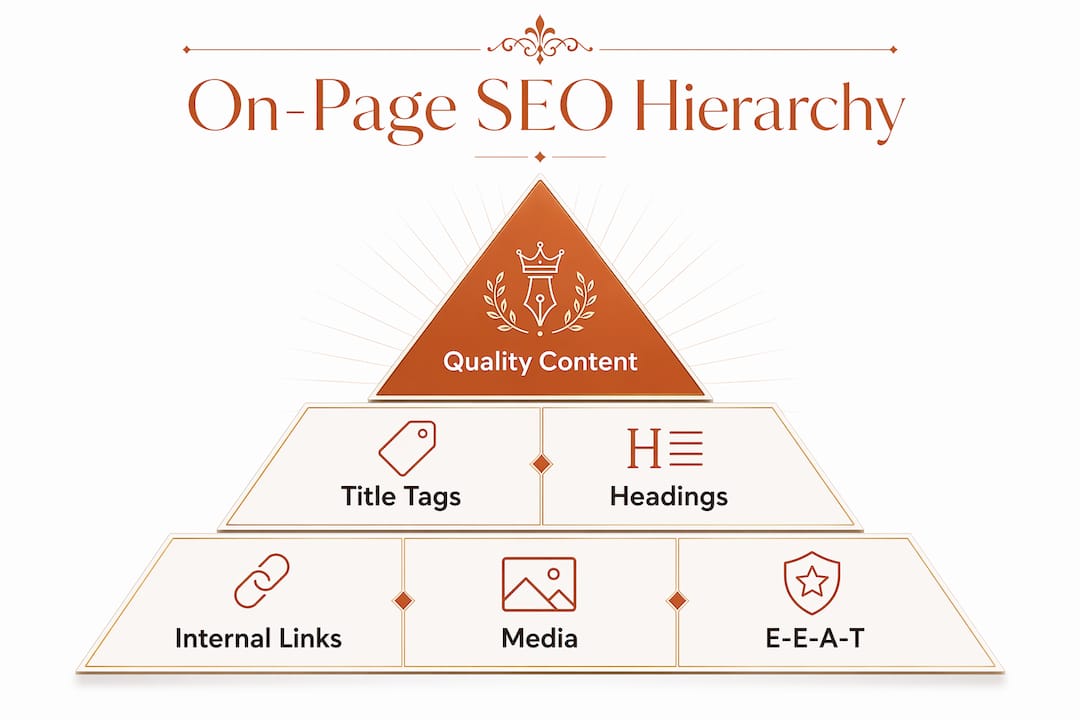
Your heading structure tells both users and search engines what your content is about. One H1, multiple H2s for major sections, and H3s for sub-points. This hierarchy should reflect the natural flow of your topic, not just keyword placement. Pages that follow clear heading structures tend to rank better and hold readers longer.
Here is a practical on-page SEO checklist you can apply to every page you publish:
- Write a title tag that includes your keyword within the first 30 characters
- Add a meta description that explains the value of the page in plain language
- Use your primary keyword in the first 100 words of your body copy
- Break up content with H2 and H3 headings that reflect actual sub-topics
- Add alt text to every image using descriptive, keyword-relevant phrases
- Compress images before uploading to protect your page load speed
- Link internally to at least two related pages on your site
- Include the author's name and credentials somewhere on the page
That last point matters more than most people realize. Author credentials are a ranking factor under Google's E-E-A-T framework. A short bio with real experience signals to Google that your content comes from someone qualified to write it. If you are publishing packaging design tips, mention that you have worked in CPG branding. Specificity builds trust.
Internal linking is also more powerful than most small business owners use it. Linking a blog post about packaging design inspiration to a related post on sourcing strategy keeps users on your site longer and helps Google crawl your content more efficiently.
Pro Tip: Use Google Search Console's "Coverage" report to find pages that are indexed but getting zero clicks. Update the title and meta description on those pages before creating new content. It is faster and often more effective.
Technical SEO basics you cannot afford to ignore
Technical SEO sounds intimidating. In practice, it comes down to making your site easy for Google to find, read, and trust. Most entrepreneurs can handle the basics without hiring a developer.

Start with your robots.txt file and XML sitemap. Your sitemap tells Google which pages exist. Your robots.txt file tells it which ones to crawl. Both should be submitted through Google Search Console. If a page is accidentally blocked in robots.txt, Google cannot rank it, no matter how good the content is.
| Technical factor | What to check | Target benchmark |
|---|---|---|
| Page speed (LCP) | Largest Contentful Paint | Under 2.5 seconds |
| Layout stability (CLS) | Cumulative Layout Shift | Under 0.1 |
| HTTPS | Secure padlock in browser | Active on all pages |
| Mobile usability | Google Mobile-Friendly Test | Pass with no errors |
| Crawl errors | Google Search Console Coverage | Zero 4xx or 5xx errors |
Core Web Vitals directly affect rankings, so page speed is not optional. Compress images, eliminate render-blocking scripts, and use a content delivery network if your hosting plan allows it. A page that loads in one second converts significantly better than one that takes four.
Structured data markup is where you get a real edge. Schema markup for FAQs, HowTos, and Articles significantly increases the chance your content appears in rich results and AI answer boxes. Adding FAQ schema to a product or blog page can double your visible real estate in search results without improving your actual position. That is a rare free win.
- Use HTTPS across every page, not just your homepage
- Fix redirect chains: A redirecting to B redirecting to C wastes crawl budget
- Run a technical audit quarterly using tools like Screaming Frog or Ahrefs Site Audit
- Check for duplicate content and use canonical tags to point to your preferred version
Off-page SEO and link building that actually works
Getting other reputable websites to link to yours is still one of the strongest signals Google uses to measure authority. Backlinks from relevant, authoritative sites carry more weight than dozens of links from unrelated or low-quality pages. One mention from an industry publication beats fifty links from blog comment sections.
The tactics that work for small business owners are practical and do not require a PR budget:
- Guest blogging: Write a high-quality article for a niche publication in your industry. Include a natural link back to a relevant page on your site.
- Digital PR: Get quoted as an expert in news stories or round-up articles. Journalists regularly use source platforms like HARO (now Connectively) to find contributors.
- The Skyscraper Technique: Find a popular article in your niche, write a more detailed or updated version, and reach out to sites linking to the original.
- Local citations: If you serve a local area, list your business consistently across Google Business Profile, Yelp, and industry directories. Consistent name, address, and phone data builds local SEO signals.
- Review generation: Positive Google reviews improve your local pack ranking. Ask satisfied customers directly via email or SMS within 24 hours of a positive interaction.
Pro Tip: Before building any new backlinks, check your existing profile using a free tool like Ahrefs Backlink Checker. You might find broken links pointing to old URLs you can reclaim with a simple redirect, which is instant link equity recovered.
Avoid buying links, using private blog networks, or participating in link exchange schemes. Google's spam detection has improved dramatically, and a manual penalty can drop your site from the index entirely. The short-term gain is not worth the long-term risk.
What SEO looks like in 2026
The rules have not changed. The pace has. Keeping up in 2026 means adapting your content for AI-driven search features while reinforcing the fundamentals that have always worked.
- Optimize for AI Overviews. AI Overviews appear for roughly 30% of queries, and they pull from pages that give direct, structured answers. Write clear summaries at the top of your posts. Use numbered steps and concise definitions.
- Refresh content on a schedule. Experts recommend updating content two to three times a year. Stale posts with outdated statistics or broken links lose rankings gradually. A content audit every six months protects what you have already built. Posts like repurposing existing content show how updating your existing assets often outperforms creating new ones.
- Use semantic keyword variations. Keyword stuffing triggers penalties, but using related terms and synonyms naturally throughout your content signals topical depth. Instead of repeating "packaging design tips," use phrases like "brand packaging advice" or "how to design product packaging."
- Improve user experience signals. High bounce rates and low time-on-page tell Google your content is not satisfying users. Add clear calls to action, break up walls of text, and include visuals that support the content rather than decorate it.
- Add video. Pages with embedded video keep visitors engaged longer and rank for video-specific queries. Even a short two-minute explainer can move your dwell time metrics significantly.
My honest take on SEO for small businesses
I have watched business owners obsess over ranking hacks they found in a forum, only to see their traffic collapse after the next algorithm update. What I have learned is that sustainable SEO is boring in the best way.
The owners who grow steadily are the ones treating their site like a product they maintain. They fix technical errors before chasing new backlinks. They rewrite their worst-performing pages before publishing ten new ones. They check Search Console every month instead of every crisis. SEO works best as a growth system, not a launch checklist, and the businesses that internalize that early compound their results faster than anyone doing monthly "SEO sprints."
The biggest thing small business owners miss is that content quality now means content with actual experience behind it. Content showing real experience and original insights ranks better as AI-generated content floods the web. Your opinion, your process, your specific outcome matters. Generic content is everywhere. Yours should not be.
— Myles
Good SEO starts with a site worth ranking
If your content strategy is improving but your website still looks like it was built in 2018, you are working against yourself. Google rewards sites that keep users engaged, and design plays a direct role in that. Pages with poor visual hierarchy, slow load times, and no clear calls to action lose visitors within seconds.
At Offcut, we work with founders who understand that brand presentation and SEO are connected. A well-structured, visually sharp site gives your content the best possible chance to rank and convert. Whether you are looking to refresh your brand's packaging visuals or present your product more professionally online, explore what Offcut offers to see how print-ready design work can support the credibility your SEO strategy is building. Better design is not just aesthetic. It is a ranking signal.
FAQ
What are the most important SEO tips and tricks for beginners?
Start with keyword research focused on search intent, write clear title tags under 60 characters, and fix any technical errors in Google Search Console. Foundational SEO practices like internal linking and structured headings deliver the most consistent results before you move to advanced tactics.
How long does SEO take to show results?
Most sites see measurable ranking improvements within three to six months of consistent effort. Technical fixes and on-page updates often show faster results than link-building campaigns, which compound over time.
What is the difference between on-page and off-page SEO?
On-page SEO covers everything you control on your site, including titles, content, images, and internal links. Off-page SEO refers to external signals like backlinks and brand mentions that indicate your site's authority to search engines.
How do I rank for AI Overviews and featured snippets?
Structure your content with direct, concise answers near the top of the page, use numbered lists and FAQ sections, and add schema markup where applicable. Pages that answer a question clearly and completely are most likely to be extracted by AI search features.
How often should I update my website content for SEO?
Updating key pages every three to six months keeps your content fresh and competitive. Focus first on pages that rank on page two of search results, as those are closest to capturing significantly more traffic with minimal additional effort.