
TL;DR:
- Packaging not only protects products but also builds trust and brand identity for small brands.
- Affordable, sustainable, and right-sized solutions, combined with minimal design and personal touches, enhance customer experience while controlling costs.
Your packaging is doing more work than you think. It protects your product, yes. But it also tells a stranger whether you're worth trusting before they've even opened the box. For small brands, finding packaging ideas that balance cost, durability, and brand identity is one of the hardest practical challenges you'll face. This article cuts through the noise and gives you concrete, affordable options you can actually act on, whether you're shipping 50 units a month or 5,000.
Table of Contents
- Key Takeaways
- 1. Set a realistic packaging budget first
- 2. Choose the right criteria before picking materials
- 3. Use minimalist design to cut printing costs
- 4. Stamp and sticker your way to custom branding
- 5. Right-size your packaging to save on every shipment
- 6. Add sustainable materials without sacrificing protection
- 7. Include personal touches that cost almost nothing
- 8. Use QR codes to extend packaging functionality
- 9. Compare packaging types before you commit
- 10. Build a packaging brief before talking to suppliers
- 11. Leverage tiered packaging to control costs
- 12. Test prototypes before printing at volume
- Myles's take on what actually matters
- Ready to find packaging that fits your brand
- FAQ
Key Takeaways
| Point | Details |
|---|---|
| Budget your packaging spend | Packaging costs should stay between 3% and 8% of your product's sale price to protect margins. |
| Right-sizing saves real money | Reducing void space cuts shipping costs by $1.50 to $3.00 per package through lower dimensional weight. |
| Minimalism cuts print costs | One or two-color designs can reduce printing costs by up to 20% compared to full-color layouts. |
| Test before you commit | Structural prototype testing prevents expensive redesigns and product damage in transit. |
| Simple branding scales well | Custom stamps and stickers deliver handcrafted appeal at a fraction of custom print runs. |
1. Set a realistic packaging budget first
Before you pick a box or choose a material, you need a number. Packaging costs should fall between 3% and 8% of your product's sale price. That means if you're selling a $30 candle, you have roughly $0.90 to $2.40 to work with per unit.
This constraint sounds tight, but it's actually clarifying. It rules out over-engineered solutions quickly and pushes you toward smart, focused choices. Many small brand owners blow their packaging budget by treating it like a branding exercise instead of a business expense with a measurable ceiling.
Pro Tip: Calculate your per-unit packaging cost before you finalize any design. Include materials, printing, tape, tissue, and inserts. What looks affordable in isolation often adds up fast when you include every component.
2. Choose the right criteria before picking materials
Not all packaging decisions start with aesthetics. The smarter ones start with function. Before you fall in love with a box style, work through these key factors:
- Protection level. What's your damage rate? Fragile items need cushioning; lightweight apparel can ship in a poly mailer.
- Material sustainability. Customers notice. And sustainable packaging can match traditional durability when properly specified and tested.
- Dimensional weight. Carriers charge based on size, not just actual weight. Oversized packaging costs you money on every single shipment.
- Regulatory requirements. Food, cosmetics, and supplements all carry labeling rules that packaging must accommodate from the start.
- Brand visibility. Even a plain kraft mailer can carry your brand. But you need to plan for it, not hope for it.
Getting these criteria locked down before you start shopping saves you from ordering 500 units of the wrong thing.
3. Use minimalist design to cut printing costs
Full-color, photographic packaging looks incredible in concept presentations. It also costs significantly more to produce. For most small brands, one or two-color printing is the smarter starting point. It signals a clean, modern brand identity, and it costs less at every volume level.
Think about brands like Aesop or Glossier in their early days. Restrained color palettes, simple typography, and consistent placement of a single logo. The minimalism wasn't a budget compromise. It was a brand choice that happened to be affordable.
When you're scoping affordable packaging ideas, design simplicity is your biggest cost lever. Less ink, simpler setup, faster printing turnaround.
4. Stamp and sticker your way to custom branding
You don't need a custom print run to have branded packaging. Custom rubber stamps cost between $15 and $40 as a one-time purchase and can brand hundreds of plain kraft boxes, bags, or tissue sheets. Pair that with a roll of custom stickers from an online printer, and you have a complete unboxing experience for almost nothing.
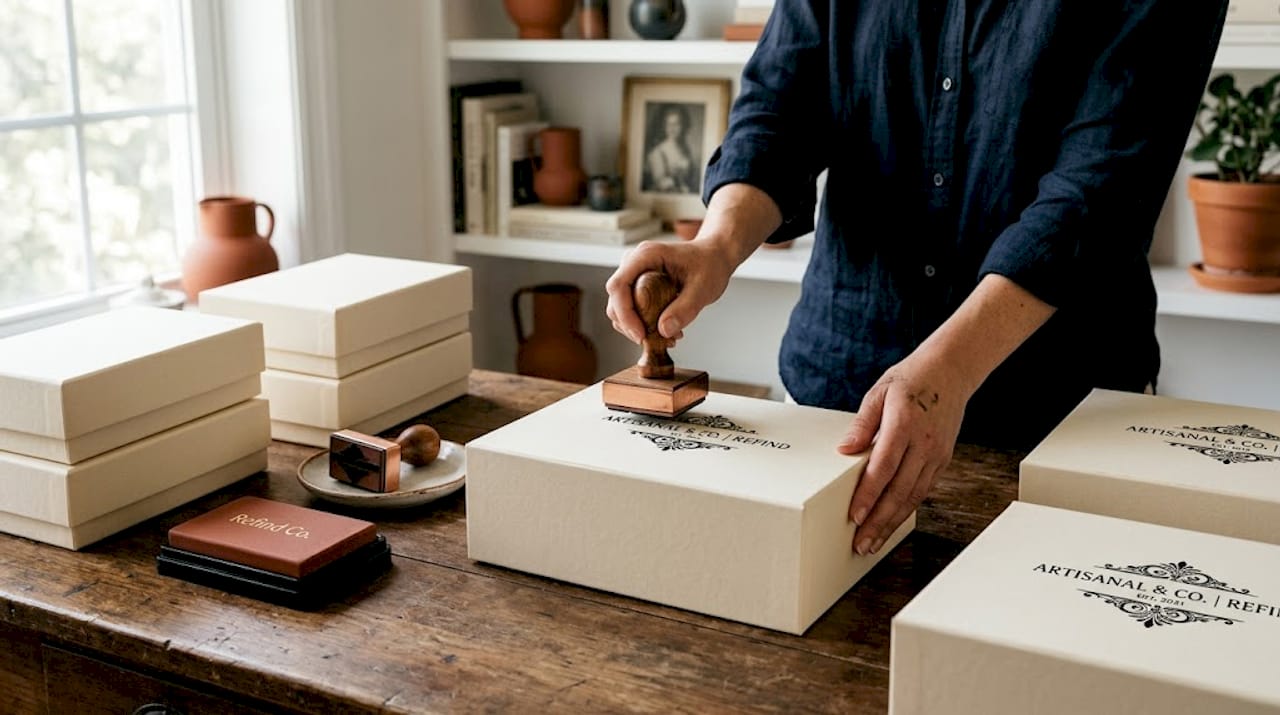
This approach works especially well for brands that sell handmade, artisan, or small-batch products. The hand-stamped look isn't a limitation. It's part of the brand story.
Stickers also give you flexibility. You can update your messaging seasonally, add a limited edition label, or include a QR code sticker without reprinting your entire box run. That kind of adaptability is genuinely valuable when your product line is still evolving.
Pro Tip: Order sticker sheets in bulk from digital print services to drop the per-unit cost significantly. At 500 units, most online printers bring the per-sticker price under $0.05.
5. Right-size your packaging to save on every shipment
This one is underestimated consistently. Right-sizing your packaging can save $1.50 to $3.00 per package by reducing dimensional weight charges from carriers like UPS, FedEx, and USPS. Over 500 shipments a month, that's $750 to $1,500 back in your pocket.
The rule of thumb: keep void space under 30% of total box volume. When your product is rattling around in a box two sizes too large, you're paying a shipping surcharge and getting worse product protection. Neither outcome is acceptable.
Standardize your carton sizes around your top two or three SKUs. You don't need a custom size for every product. You need the right two or three sizes, sourced in volume.
6. Add sustainable materials without sacrificing protection
Sustainable packaging for brands isn't just a trend. It's increasingly a customer expectation. But the switch needs to be done carefully. 100% post-consumer recycled corrugated passes ISTA 3A transit testing for products up to 15 pounds. That's a real data point, not marketing copy.
Materials worth considering include kraft paper, recycled corrugated, compostable mailers, and mushroom-based cushioning for fragile items. Each has trade-offs in cost, weight, and print compatibility.
The honest reality? Switching to sustainable packaging without testing it structurally can result in more damaged products and more replacements. That's worse for the environment and your bottom line. Test every new material before you roll it out.
7. Include personal touches that cost almost nothing
Handwritten notes. A sheet of branded tissue paper. A small sticker that says "made with care." These micro-additions to the unboxing experience cost very little but create a connection that customers remember and talk about.
Consumers will pay 10 to 15% more for products with premium-feeling packaging. You don't have to spend more to create that feeling. You have to be more thoughtful.
For small brands, the personal touch is actually a competitive advantage over larger players who can't realistically offer it at scale. Use it deliberately. A handwritten thank-you on a small card costs you maybe 15 seconds and $0.08 in materials. The loyalty it can generate is worth considerably more.
8. Use QR codes to extend packaging functionality
A printed QR code on the inside of a box lid turns packaging into a content channel. You can link to a care guide, a behind-the-scenes brand story, a discount code for the next order, or a product registration page.
This is one of those unique product packaging ideas that costs you nothing in materials, requires no additional printing run (just include it in your design file), and creates a post-purchase brand touchpoint that most small brands completely ignore.
For brands in food, beauty, or wellness, a QR code linking to sourcing information or ingredient transparency is particularly effective. It builds trust in a way that box copy alone can't.
9. Compare packaging types before you commit
Different packaging formats serve different needs. Here's a direct comparison of the most common options for small brands:
| Packaging type | Best for | Cost level | Sustainability | Protection |
|---|---|---|---|---|
| Corrugated mailer box | Fragile or premium products | Medium | High (recyclable) | Excellent |
| Poly mailer | Soft goods, apparel | Low | Variable (recycled options available) | Moderate |
| Kraft paper bag | Retail, food, small items | Low | High | Low to moderate |
| Folding carton | Cosmetics, small retail items | Medium | Medium | Good |
| Rigid box | Luxury, gift products | High | Medium | Excellent |
| Compostable mailer | Eco-focused brands | Medium-high | Very high | Moderate |
The effective packaging approach accounts for protection, presentation, and shipping cost together. No packaging type wins on all three dimensions. Your job is to find where your product's needs intersect with your budget.
10. Build a packaging brief before talking to suppliers
Skipping the brief is one of the most expensive mistakes small brand owners make. A proper packaging brief includes your product dimensions, target packaging dimensions, preferred materials, print method, finish type, quantity, and timeline.
When you send suppliers a detailed packaging spec, you eliminate guesswork. You get more accurate quotes. You avoid back-and-forth that wastes weeks. And you reduce the risk of receiving packaging that technically fits but functionally doesn't work.
Treat the brief like a contract with yourself. Write down what you need before you know what's possible. Then adapt.
11. Leverage tiered packaging to control costs
Think of your packaging in three layers. Primary packaging touches the product directly (a glass jar, a poly bag, a folding carton). Secondary packaging groups or protects primary units (a corrugated shipper, a gift box). Shipping packaging gets the whole thing to the customer.
Each layer has its own cost and branding opportunity. You don't need to invest heavily in all three. Small brands often focus their budget on the primary layer because that's what the customer handles, and use plain or minimal secondary and shipping packaging to save money.
Pro Tip: Bulk purchasing across all three tiers through a single supplier often unlocks tiered pricing that individual layer purchases won't. Ask your supplier explicitly about consolidated order discounts.
12. Test prototypes before printing at volume
This step gets skipped constantly. Brands finalize artwork, place a volume order, and discover the box doesn't close properly around the product or the mailer tears under normal shipping stress.
Structural prototype testing before committing to final artwork is non-negotiable if you're ordering any meaningful quantity. Most suppliers will produce a sample run or a physical mock-up for a modest fee. That cost is insurance against a much larger mistake.
Run your prototypes through a basic drop test. Ship a few units through the actual carrier you plan to use. If products arrive damaged in testing, they'll arrive damaged in real life. Fix the structure before you fix the label.
Myles's take on what actually matters
I've reviewed a lot of packaging briefs and watched a lot of small brand launches. The pattern I see consistently is this: founders spend hours on logo placement and color choices, and almost no time on structural decisions and cost per unit. That imbalance shows up in chargebacks, in customer complaints about damaged products, and in shipping bills that quietly kill margins.
The brands that get packaging right early share one trait: they treat it as an operational problem first and a branding problem second. That doesn't mean the aesthetics don't matter. They absolutely do. But a beautiful box that arrives crushed, or a custom mailer that adds $2.00 in unnecessary dimensional weight to every order, is not a packaging win.
I've also seen brands transform their customer relationships with almost no budget. A thoughtful insert, a stamp, a handwritten note. These things signal that a real person made this decision. That signal is worth more than a foil finish or a rigid gift box for most products and most audiences.
The packaging design decisions that actually move the needle are the ones that solve a real problem for the customer or create a real moment. Everything else is just cost.
— Myles
Ready to find packaging that fits your brand
Small brand owners shouldn't have to choose between packaging that looks good and packaging they can afford. Offcut exists to close that gap. It's where print-ready packaging concepts live instead of a designer's hard drive. You get exclusive, production-ready designs at a fraction of what an agency charges.
Whether you're looking for packaging design inspiration that fits your budget or want to explore the latest packaging design trends for 2026, Offcut gives you a real head start. Browse ready-to-use concepts at offcut.design and find something worth printing.
FAQ
How much should small brands spend on packaging?
Packaging costs should target 3% to 8% of the product's sale price. For a $30 product, that means keeping total packaging spend between $0.90 and $2.40 per unit.
What is the most affordable way to brand plain packaging?
Custom rubber stamps are the most cost-effective custom branding option. They cost $15 to $40 once and can brand hundreds of packages, making them ideal for small runs.
Can sustainable packaging handle real shipping conditions?
Yes. 100% post-consumer recycled corrugated passes ISTA 3A transit testing for products up to 15 pounds when properly specified and tested before use.
How does right-sizing packaging save money?
Carriers charge based on dimensional weight, which factors in box size. Reducing void space below 30% of box volume can save $1.50 to $3.00 per shipment in dimensional weight charges.
Do customers really notice packaging quality?
They do. Research shows consumers would pay 10 to 15% more for products with premium-feeling packaging, which means your unboxing experience directly influences your pricing power.