
TL;DR:
- Cost-effective packaging concepts include detailed dielines, 3D mockups, and compliance-ready files.
- Sourcing design work from vetted freelancers or studios balances quality and affordability for startups.
- Proper validation and avoiding over-decorating can significantly reduce reprint and sales losses.
Most CPG founders hit the same wall early: you need packaging that stops shoppers cold, but a traditional agency quote lands in your inbox and suddenly the budget conversation gets very uncomfortable. Print-ready packaging concepts start from $36 on freelance platforms, yet most founders still default to expensive agency retainers out of habit or fear. That gap between what you actually need to spend and what you think you have to spend is exactly where brands get stuck. This guide walks you through the tools, process, and shortcuts that let you source, test, and sell packaging concepts without handing a big chunk of your margin to a traditional agency.
Table of Contents
- What you need: Core resources for selling packaging concepts
- Step-by-step: Creating and preparing your packaging design for sale
- Troubleshooting: Common mistakes and hidden costs in packaging design
- Expected results: What successful founders achieve with cost-effective concepts
- Why nimble studios and vetted freelancers beat big agencies
- Next steps: Sell your packaging concepts with OffCut
- Frequently asked questions
Key Takeaways
| Point | Details |
|---|---|
| Tools streamline the process | Freelance platforms and design software provide cost-effective access to print-ready packaging concepts. |
| Testing saves money | Short-run tests help prevent costly reprints or compliance errors that could exceed $15,000. |
| Avoid DIY traps | Cheap, inconsistent designs can lead to hidden costs and lost sales if not properly vetted. |
| Success delivers measurable results | Founders can achieve up to 40% shipping savings and conversion boosts with smart packaging design. |
| Nimble studios outperform agencies | Partnering with boutique studios or vetted freelancers offers strategic depth and affordability for startups. |
What you need: Core resources for selling packaging concepts
Before you can sell a packaging concept, you need to know what a complete, sellable concept actually looks like. A rough sketch or a pretty mockup is not enough. Buyers, whether they are retailers, co-manufacturers, or direct-to-consumer platforms, need files they can hand straight to a printer.
Here is what a complete packaging concept package should include:
- Print-ready dieline (a flat, scaled template showing fold lines, bleed areas, and cut marks)
- 3D mockup rendered in context, so buyers can visualize the product on shelf
- Production notes covering material specs, ink types, and finish recommendations
- Compliance-ready label zones for nutrition facts, barcodes, and regulatory copy
- Source files in formats printers actually accept (PDF, AI, or EPS)
For cost-effective packaging inspiration that converts, the material choice matters as much as the visual. Kraft and corrugated options tend to photograph well, signal sustainability, and cost less per unit than rigid plastics. Sustainable packaging options are also increasingly required by major retailers, so building them into your concept from the start saves rework later.
Now, where do you actually source the design work? Here is a quick comparison:
| Route | Cost range | Turnaround | Best for |
|---|---|---|---|
| Fiverr (vetted sellers) | $36 to $300 | 3 to 7 days | Simple label updates |
| 99designs contest | From $449 | 7 to 14 days | Multiple concepts fast |
| Upwork freelancer | $200 to $750 | 5 to 14 days | Mid-complexity projects |
| Boutique studio | $1,500 to $5,000 | 2 to 4 weeks | Brand-level strategy |
| Traditional agency | $10,000+ | 6 to 12 weeks | Enterprise rollouts |
For most CPG startups, the sweet spot sits between a vetted Upwork freelancer and a boutique studio. You get production-tested expertise without the overhead. When sourcing packaging design at this level, always ask for a print portfolio, not just a visual portfolio. Anyone can make something look good on screen. Not everyone understands bleed, CMYK color profiles, or dieline tolerances.
Step-by-step: Creating and preparing your packaging design for sale
With your toolkit ready, here is precisely how to create and prep your concept for sale.
- Define your brand positioning. Before a single pixel gets placed, write one sentence: who buys this, why they choose it over alternatives, and what emotion the packaging should trigger in three seconds or less.
- Choose your layout style. Minimal, clean layouts cost less to print and tend to perform better on shelf. Resist the urge to fill every inch of space.
- Select your materials. Eco-friendly and cost-effective are not mutually exclusive. Kraft paper, recycled corrugated, and water-based inks all keep unit costs down while signaling quality.
- Build your dieline. Use your printer's exact template if possible. Errors here cause the most expensive mistakes downstream.
- Produce your mockups. Photorealistic 3D mockups let you test visual impact before spending a cent on production.
- Collaborate with your printer early. Share your files before finalizing. Printers catch issues designers miss, and catching them now is free.
- Run a small-batch validation test. Print 50 to 100 units and put them in front of real buyers before committing to a full run.
The validation step is where most founders skip ahead and pay for it later. A $500 test can save you $15,000+ in reprints if the design misses the mark. That is not a hypothetical. That is a real number from founders who skipped the test.
| Phase | Time investment | Cost estimate |
|---|---|---|
| Positioning and brief | 1 to 2 days | $0 (internal) |
| Design and dieline | 3 to 7 days | $200 to $750 |
| Mockup production | 1 to 2 days | $50 to $150 |
| Small-batch print test | 3 to 5 days | $200 to $500 |
| Final file prep | 1 day | Included in design fee |
Pro Tip: Follow a proven step by step packaging process and use your printer's dieline template from day one. It eliminates the most common and most expensive source of rework.
For teams managing multiple SKUs, having documented packaging workflow strategies keeps everyone aligned and prevents version-control disasters when files get passed between designers, printers, and brand managers.

Troubleshooting: Common mistakes and hidden costs in packaging design
Even the best concepts can hit obstacles. Here is how to avoid the ones that sink brands.
The most common and most preventable mistakes fall into three categories:
- Over-decorating. Foil stamping, embossing, and spot UV finishes look impressive in a pitch deck. On a startup budget, they can double your unit cost overnight. Save premium finishes for hero SKUs once you have proven the concept.
- Inconsistent files. Sending RGB files to a CMYK printer, missing bleed areas, or using low-resolution logos are the fastest ways to trigger a costly reprint.
- Skipping compliance review. Nutrition panels, allergen declarations, and net weight statements are not optional. A packaging concept that fails a compliance check cannot go to market, full stop.
"Cheap DIY packaging leads to reprints, compliance issues, and low shelf conversion resulting in 20 to 40% lost sales. The upfront savings rarely survive contact with reality."
The shelf conversion number is the one that should keep you up at night. A 20 to 40% sales loss from weak packaging is not a design problem. It is a revenue problem. Fixing it after launch costs far more than getting it right before.
Pro Tip: Before committing to a full print run, run a predictive purchase intent test. Show your mockup to 20 to 30 target consumers and ask one question: would you pick this up? If fewer than 60% say yes, redesign before you print.
When you are repurposing packaging designs across SKUs or line extensions, maintain a master brand file with locked-down fonts, color codes, and logo clear-space rules. Inconsistency across a product line signals amateur execution to buyers and retailers.
For a deeper look at what actually moves the needle on shelf, these packaging design tips cover consumer psychology, color hierarchy, and the structural cues that drive purchase decisions.
Expected results: What successful founders achieve with cost-effective concepts
Avoiding mistakes sets the stage for measurable wins. Here is what founders can expect when they get it right.
The results from well-executed, cost-effective packaging concepts are not marginal. They are significant and well-documented:
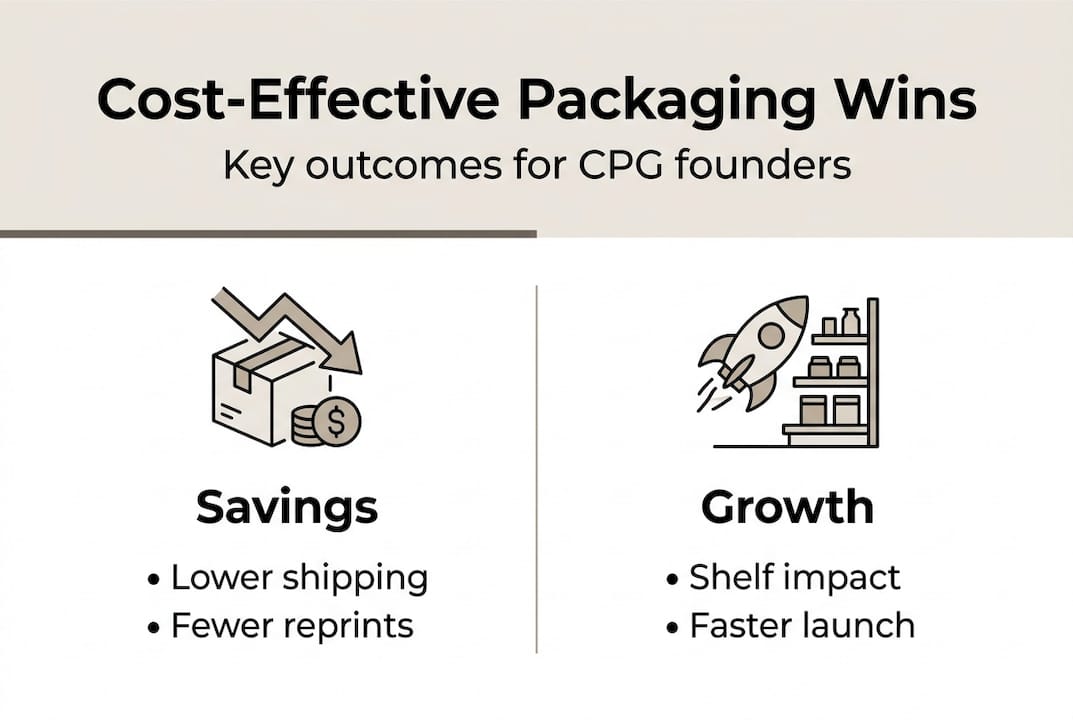
- Glossier reduced shipping costs by 40% by switching to custom corrugated mailers sized to their actual products, eliminating void fill and oversized box waste.
- A snack brand cut design time by 30% and saved $8,000 per product launch by standardizing their design brief and dieline process.
- A global CPG company saved 20% on total packaging spend through procurement optimization, consolidating suppliers and standardizing materials across their portfolio.
- A keto microbrand saw a 40% conversion uplift after updating label hierarchy to lead with the benefit claim rather than the brand name.
| Outcome | Benchmark result | Primary driver |
|---|---|---|
| Shipping cost reduction | 40% | Right-sized corrugated packaging |
| Design time savings | 30% / $8K per launch | Standardized brief and dieline |
| Procurement savings | 20% | Supplier consolidation |
| Shelf conversion uplift | 40% | Label hierarchy and benefit clarity |
The keto microbrand result is worth pausing on. No new photography. No new product. Just a label that led with what the consumer actually cared about. That is the leverage point most founders miss: packaging is not decoration, it is your highest-volume salesperson.
For founders thinking beyond cost savings, understanding sustainable packaging impact is increasingly tied to retailer listing requirements and consumer trust scores, not just environmental values.
If you have existing design assets sitting unused, there is also a real opportunity in selling unused designs rather than letting them collect dust on a hard drive.
Why nimble studios and vetted freelancers beat big agencies
Here is the opinion you will not hear from a big agency: for most CPG startups, hiring one is a strategic mistake, not just a budget problem.
Big agencies are structured for big clients. Their processes, timelines, and pricing reflect the needs of brands managing hundreds of SKUs across global markets. When a startup hires them, they are paying for infrastructure they will never use. Worse, the junior team member assigned to your account has less production experience than a vetted freelancer who has spent five years doing nothing but CPG dielines.
The founders who get the best outcomes prioritize print and production expertise over pure aesthetics. A beautiful concept that cannot survive the press is worthless. Nimble boutiques and vetted freelancers consistently outperform agencies on the metrics that matter to startups: speed, cost, and production accuracy.
The right move is to find someone who has worked directly with printers, understands material constraints, and has a portfolio of concepts that actually went to market. When choosing the right designer, ask for press-ready samples, not just rendered mockups. That single question filters out most of the risk.
Validate fast, validate cheap, and never bet $15,000 on a concept that has not been tested. That is not caution. That is strategy.
Next steps: Sell your packaging concepts with OffCut
If you are ready to stop leaving packaging concepts on a hard drive and start turning them into revenue, OffCut is built exactly for that.
OffCut connects CPG founders with pre-verified, print-ready packaging concepts at a fraction of agency cost. Designers get paid for work that would otherwise go nowhere. Founders get exclusive concepts they can take straight to production. Whether you want to sell packaging concepts with OffCut or browse ready-to-buy designs for your next launch, the platform removes the guesswork and the markup. No agency retainer. No months-long process. Just great packaging that moves.
Frequently asked questions
How much should I expect to pay for a freelance packaging designer?
Most freelance packaging design projects range from $36 to $750 for print-ready files, and contests on 99designs typically start at about $449 depending on complexity.
How can I avoid costly packaging design mistakes?
Validate with short-run tests before full production and avoid over-decorating or poorly prepared files, since reprints can cost $15,000+ and erase any upfront savings.
Is using cheap online platforms risky for packaging design?
Unvetted cheap platforms offer upfront savings but routinely cause long-term losses from reprints, compliance errors, and 20 to 40% shelf conversion losses that hurt revenue far more than the original design fee.
What measurable benefits do cost-effective packaging concepts deliver?
Well-executed concepts can drive 40% conversion uplift, cut shipping costs by 40%, and save thousands in design time and production spend across a product line.
Recommended
- Graphic design portfolio tips to attract CPG clients
- 5 strategies to improve CPG packaging design workflow
- How to sell unused designs and profit from packaging concepts
- Streamline designer packaging portfolio workflow: CPG guide
- 7 Things for Customers to Consider When Designing Packaging - www.printcafeusa.com