
TL;DR:
- Packaging trends evolve rapidly due to consumer preferences, regulations, and economic pressures demanding continuous adaptation. Effective teams integrate shopper insights, regulatory compliance, and sustainability into phased redesign programs supported by digital tools and cross-functional governance. Most redesigns fail to boost sales when they break brand recognition or lack proper testing, highlighting the importance of deliberate, evidence-based innovation.
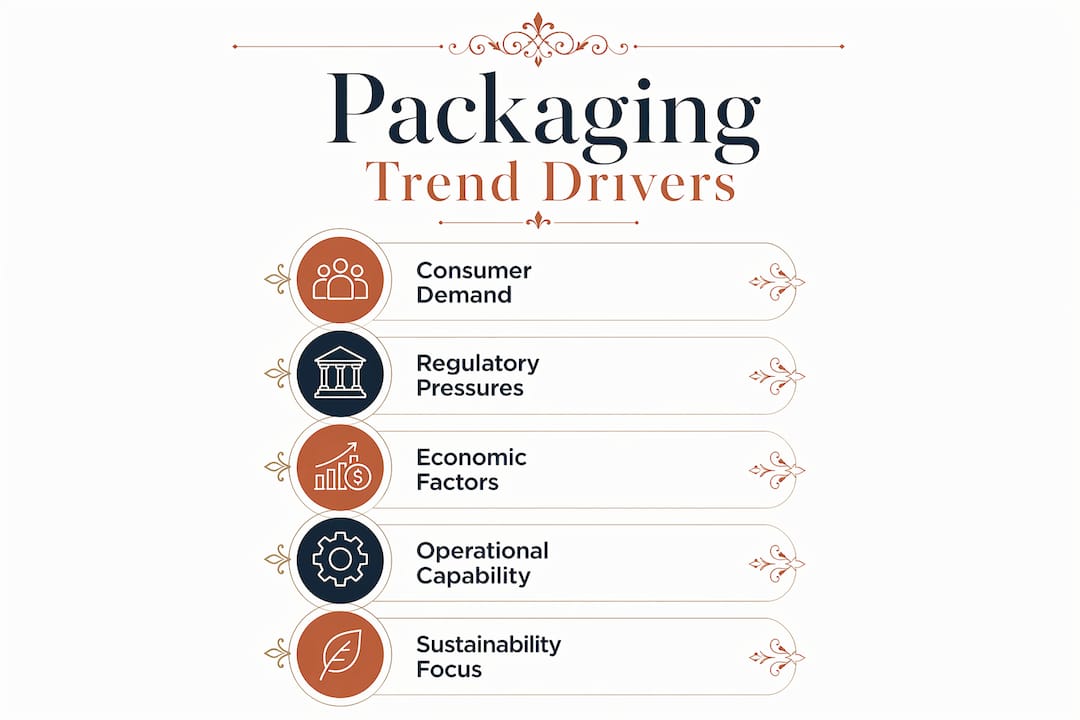
Packaging trends change because brand owners must simultaneously satisfy shifting consumer expectations, tightening regulatory mandates, sustainability imperatives, and relentless cost pressure. No single force drives packaging trend evolution in isolation. According to L.E.K. Consulting's 2026 study, about 99% of CPG and foodservice brand owners expect to change their packaging within the next three years. That near-universal figure tells you everything: packaging redesign is no longer a periodic refresh. It is a continuous operational reality shaped by consumer behavior, EU regulation, sustainability goals, and economics all pressing at once.
Why packaging trends change: consumer behavior leads
Consumer preferences are the most visible catalyst for packaging design shifts. Shoppers now evaluate packaging on environmental impact, ease of recycling, and usability before they evaluate aesthetics. A 2026 pan-European survey found that 66% of consumers factor environmental impact into purchasing decisions, and 75% say sustainability matters to them. That is not a niche sentiment. It is a mainstream purchase filter that forces brand owners to redesign.

Younger demographics raise the stakes further. Consumers under 35 place higher value on packaging design and sustainability than older cohorts, which means brands targeting growth segments cannot afford to ignore these signals. The practical implication is that packaging design shifts must address usability and end-of-life clarity, not just visual appeal.
Pro Tip: Test packaging changes with actual shoppers in a retail context before full rollout. Consumer surveys capture stated preferences, but shelf behavior often tells a different story.
What consumers say they want breaks down into three consistent priorities:
- Environmental impact: Recyclability, recycled content, and reduced material use are now baseline expectations, not differentiators.
- Usability: Resealability, portion control, and clear disposal instructions directly influence repeat purchase.
- Transparency: Consumers want honest labeling on material composition and end-of-life options, not vague "eco-friendly" claims.
The impact of consumer behavior on packaging is now measurable at the shelf level. Brands that treat packaging as a pure aesthetic exercise are losing ground to those treating it as a functional communication tool.
How EU regulations are accelerating packaging trend evolution
Regulation is the second major driver of packaging trend evolution, and in 2026 it is moving faster than most teams anticipated. The EU's Packaging and Packaging Waste Regulation (PPWR), formally Regulation (EU) 2025/40, entered into force on February 11, 2025. General application begins August 12, 2026, with phased category obligations running through 2030 and beyond.
The PPWR imposes four structural requirements that directly reshape packaging architecture:
- Recyclability by design: All packaging placed on the EU market must be designed to be recyclable. This eliminates material combinations that cannot be separated in existing waste streams.
- Recycled content minima: Minimum percentages of post-consumer recycled material are mandated by packaging category, with thresholds increasing toward 2030.
- Packaging waste reduction targets: Brand owners must reduce total packaging weight and volume, which drives lightweighting and format consolidation.
- Restrictions on single-use formats: Specific single-use packaging formats face restrictions or bans, forcing substitution with reusable or refillable alternatives.
The operational burden is significant. Recyclability and recycled-content data management require 6–12 months of lead time to compile technical files before legal deadlines. That timeline means packaging teams working toward 2026 compliance should already be deep into documentation. Teams that start late face either incomplete compliance or costly emergency redesigns.
| PPWR Requirement | Timeline | Operational Impact |
|---|---|---|
| Recyclability by design | August 12, 2026 | Material substitution, format redesign |
| Recycled content minima | 2030 (phased) | Supplier qualification, cost increases |
| Packaging waste reduction | 2030 targets | Lightweighting, SKU consolidation |
| Single-use restrictions | 2026 onward | Format elimination, reuse system design |
Pro Tip: Treat PPWR technical file preparation as a project with a 12-month runway, not a compliance checkbox. Assign a dedicated data owner for material classification and supplier documentation from day one.
Compliance does not just change materials. It changes labeling, supplier relationships, and the entire architecture of how a packaging brief is written. That is why sustainable design for CPG brands has moved from marketing priority to legal requirement.
Do economic pressures shape how fast trends are adopted?
Economic realities determine the pace of packaging trend adoption more than most brand teams publicly admit. Geopolitical shocks and energy price volatility are reshaping FMCG packaging strategy by altering the cost of energy-intensive materials like glass and aluminum. When input costs spike, packaging decisions shift from "what is best" to "what is affordable."
The data is direct: 41% of European brand owners cite the inability to absorb or pass on costs as the primary barrier to sustainable packaging adoption. That is not a lack of commitment. It is a margin reality that no amount of sustainability ambition can override without structural solutions.
Packaging teams are responding with three economic strategies:
- Downsizing and lightweighting: Reducing material volume defends margins while simultaneously meeting waste reduction targets. A lighter package costs less to produce and ship.
- Multisourcing: Qualifying multiple suppliers for the same material reduces exposure to single-source price shocks and improves negotiating leverage.
- SKU rationalization: Consolidating packaging formats across a portfolio reduces tooling costs, simplifies procurement, and creates scale economies for sustainable materials.
Multisourcing and SKU optimization, supported by digital tools and AI, are now standard practice among leading CPG teams. The brands executing these strategies are not just cutting costs. They are creating the financial headroom to invest in compliant, sustainable formats without destroying margins.
Why do most packaging redesigns fail to lift sales?
The most counterintuitive finding in recent packaging research is this: following trends does not guarantee commercial success. Research across 1,336 redesigns from 744 brands found that nine out of ten packaging redesigns fail to deliver meaningful sales uplift. That figure should recalibrate how every packaging professional thinks about trend adoption.
"Successful redesigns depend on evidence-based execution, retailer and shopper context, and brand consistency rather than purely revolutionary aesthetics." — William Caruso, 2026 doctoral research
The research identifies a clear pattern. Revolutionary redesigns, those that dramatically depart from established brand cues, consistently underperform compared to evolutionary approaches that maintain recognizable elements while updating specific features. Shoppers build visual memory around packaging. Disrupting that memory creates friction at the shelf, not excitement.
The causes of packaging changes that actually drive sales uplift share three characteristics. First, the redesign maintains strong similarity to prior packaging so existing buyers recognize the product. Second, the new design has sufficient time in market before performance is judged. Third, the launch is supported by retailer and shopper adoption programs that help consumers find and accept the change.
Pro Tip: Before committing to a full redesign, run a similarity audit against your current packaging. Identify which visual elements carry the most brand recognition and treat those as protected assets, not candidates for reinvention.
The lesson for packaging professionals is not to avoid change. The lesson is to change with evidence. Trend adoption driven by aesthetics alone, without shopper testing and brand consistency analysis, is the primary reason packaging design fails to deliver commercial returns.
How do packaging teams operationalize trend changes?
Knowing why packaging trends change is only half the job. The harder half is building the operational infrastructure to execute changes at scale, on time, and within budget. The L.E.K. 2026 European brand owner survey makes clear that sustainability is now implemented through broader redesign programs balancing emissions tracking, supplier practices, recycled-content availability, consumer usability, and compliance. No single team owns all of that.
The most effective packaging teams in 2026 operate with two structural advantages:
- Digital tools and AI for data management: Compliance with PPWR requires accurate material classification, recycled-content evidence, and lifecycle data. Teams using digital platforms to centralize this data reduce the risk of incomplete technical files and speed up supplier qualification.
- Cross-functional redesign governance: Packaging decisions now sit at the intersection of procurement, legal, marketing, and operations. Teams with formal cross-functional review processes catch compliance gaps earlier and avoid costly late-stage redesigns.
| Approach | Traditional Model | 2026 Best Practice |
|---|---|---|
| Sustainability | Recyclability only | Emissions, usability, supplier practices, compliance |
| Data management | Spreadsheets, manual | Centralized digital platforms, AI classification |
| Redesign trigger | Aesthetic refresh cycle | Phased program tied to regulatory and commercial milestones |
| Supplier strategy | Single-source | Multisourcing with qualified alternatives |
CPG packaging design workflow improvements consistently show that teams treating compliance documentation as a parallel workstream, rather than a post-design task, meet deadlines without emergency costs. The 6–12 month lead time for PPWR technical files is not a bureaucratic inconvenience. It is a structural constraint that must be built into every project plan from brief to launch.
Key takeaways
Packaging trends change because consumer expectations, regulatory requirements, economic pressures, and operational capabilities all shift simultaneously, and brands that treat these forces as separate problems consistently underperform those that address them as one integrated challenge.
| Point | Details |
|---|---|
| Consumer behavior drives design | 66% of consumers factor environmental impact into purchases, making usability and end-of-life clarity non-negotiable design inputs. |
| PPWR reshapes packaging architecture | EU regulation effective August 2026 mandates recyclability by design, recycled content, and waste reduction across all packaging categories. |
| Economics set the pace | 41% of European brand owners cite cost absorption as the top barrier, making SKU rationalization and multisourcing critical enablers. |
| Most redesigns miss on sales | Nine out of ten packaging redesigns fail to lift sales; evolutionary, consistency-focused updates outperform revolutionary aesthetic changes. |
| Operational readiness determines success | PPWR compliance requires 6–12 months of lead time for technical files, making early data management a competitive advantage. |
The uncomfortable truth about packaging trend cycles
I have watched packaging teams spend six months on a brand-new structural format, only to watch it underperform a minor label refresh on the same SKU. The research confirms what practitioners already sense but rarely say out loud: most packaging trend adoption is reactive, not strategic. Teams chase what looks current rather than what their specific shopper base actually responds to.
The brands I respect most in 2026 are not the ones with the most progressive packaging. They are the ones that have built the operational infrastructure to execute changes deliberately. They run shopper testing before committing to tooling. They start PPWR documentation 12 months out, not 3. They use SKU rationalization to fund sustainable material premiums rather than treating sustainability as a budget line to cut when margins compress.
The hardest lesson in packaging trend evolution is that consumer insight, regulatory readiness, and economic feasibility are not three separate workstreams. They are one decision. Teams that separate them produce packaging that is either compliant but unsellable, or beautiful but non-compliant, or sustainable but financially unviable. The integration is the work.
My practical recommendation: build your 2026 packaging strategy around phased redesign programs with defined milestones for compliance, shopper testing, and commercial review. Incremental innovation with strong adoption planning consistently outperforms the revolutionary redesign that wins awards but loses shelf space.
— Myles
How Offcut helps packaging teams stay ahead of trends
Packaging professionals navigating the causes of packaging changes in 2026 need more than trend reports. They need print-ready concepts that reflect current market realities without the six-figure agency retainer.
Offcut is where great packaging designs go instead of a hard drive. Founders and brand teams get exclusive, print-ready concepts at a fraction of agency cost. Designers get paid for work that would otherwise sit unused. If your team is managing a phased redesign program, evaluating sustainable format options, or simply needs fresh packaging design concepts that align with 2026 consumer and regulatory expectations, Offcut gives you a direct line to professional work that is ready to use. Explore the catalog and find the concept your next brief has been waiting for.
FAQ
Why do packaging trends change so frequently?
Packaging trends change because consumer preferences, regulatory requirements, and material economics shift continuously and often simultaneously. The L.E.K. 2026 study found 99% of CPG brand owners plan packaging changes within three years, reflecting how constant these pressures have become.
What is the biggest driver of packaging design shifts in 2026?
Regulatory compliance, specifically the EU's PPWR effective August 2026, is the single most structurally disruptive driver. It mandates recyclability by design, recycled content minima, and waste reduction targets that require fundamental packaging architecture changes, not just material swaps.
Why do most packaging redesigns fail to increase sales?
Research across 1,336 redesigns found nine out of ten fail to deliver meaningful sales uplift. Revolutionary changes that break established brand visual cues create shopper confusion at the shelf, while evolutionary updates that maintain recognizable elements consistently outperform them.
How does sustainability affect packaging trend evolution?
Sustainability in 2026 is no longer limited to recyclability. It now encompasses emissions tracking, supplier practices, recycled-content sourcing, and consumer usability, making it an integrated operational lens rather than a single material decision.
How far in advance should packaging teams plan for regulatory compliance?
PPWR technical file preparation requires 6–12 months of lead time for recyclability assessments and recycled-content documentation. Teams that treat compliance as a post-design task consistently miss deadlines or face costly emergency redesigns.