
TL;DR:
- Modular packaging combines sustainability with design flexibility using interchangeable components.
- It involves standardized, easy-to-disassemble parts supporting recycling and SKU variation.
- Best suited for brands with many products, refill programs, and sustainability goals, but adds complexity.
Most CPG founders assume that going sustainable means going plain. The thinking goes: recyclable materials are rigid, eco-friendly equals generic, and real customization is a luxury reserved for brands with agency budgets. Modular packaging flips that assumption entirely. Instead of forcing a choice between sustainability and design flexibility, it gives you both through a system of standardized, interchangeable components that can be mixed, matched, and adapted across your entire SKU lineup. This article breaks down exactly what modular packaging is, how it works, what it costs you, where it shines, and where it falls short so you can make a smarter call for your brand.
Table of Contents
- What is modular packaging?
- How modular packaging works: Standards, disassembly, and sustainability
- Benefits and challenges: The reality of modular packaging in CPG
- Actionable examples: Modular packaging in practice
- When modular packaging makes sense—and when it doesn't
- A fresh perspective: Reading between the lines of modular packaging adoption
- Ready to explore modular packaging solutions?
- Frequently asked questions
Key Takeaways
| Point | Details |
|---|---|
| Modular packaging defined | It consists of interchangeable, standardized components for easy customization and recycling. |
| Sustainability advantages | Prioritizing mono-materials and easy disassembly helps brands lower waste and maximize recycling. |
| Practical hurdles exist | Brands must plan for up-front costs, inventory management, and user-friendly design. |
| Best-fit scenarios | Modular packaging is ideal for brands with lots of SKUs, custom needs, or circularity goals. |
| Not a one-size solution | Success means matching modular design to the right products and business realities. |
What is modular packaging?
Now that you've had a glimpse of why modular packaging is worth reconsidering, let's clarify exactly what it means and how it works in practice.
Modular packaging design refers to packaging systems composed of interchangeable, standardized components that can be configured, replaced, or upgraded without redesigning the entire package from scratch. Think of it less like a single box and more like a construction kit where each piece has a defined role and a defined interface.
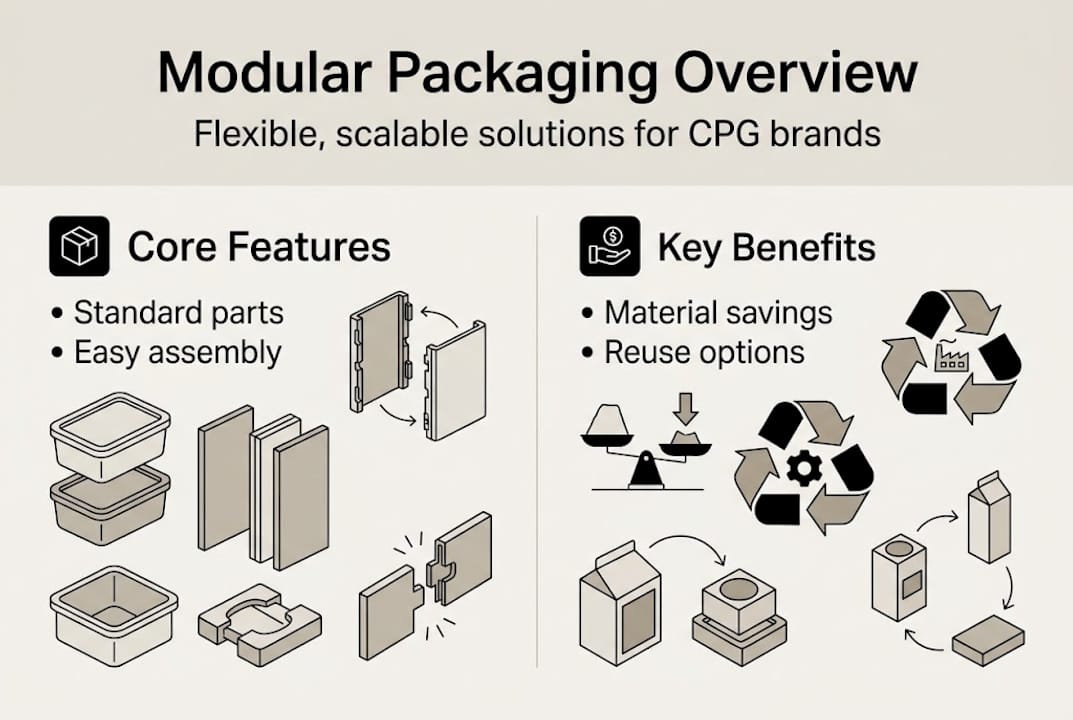
In practice, the modular packaging definition covers a wide range of formats. The mechanics involve separate components like outer shells, inner liners, pumps, or caps designed for easy non-destructive separation. Each component is engineered to connect with others using standardized interfaces, which means your 50ml pump can work across three different outer shells in your beauty line without requiring a new mold for each SKU.
Here's what makes modular packaging structurally different from traditional packaging:
- Outer shells serve as the visible brand canvas and can be swapped between product variants
- Inner liners hold the formula and are replaced while the outer container is kept and reused
- Pumps and closures are standardized so they work across multiple container sizes
- Interfaces are designed so consumers can disassemble without tools or instructions
Traditional packaging is typically designed as a single unit: one product, one container, one end-of-life outcome, usually landfill. Modular packaging, by contrast, allows each component to follow its own packaging lifecycle stages independently. An outer shell made from durable resin might go through dozens of refill cycles while the inner liner is recycled after each use.
"The real power of modular packaging is not just sustainability. It's optionality. You design once, deploy many times, and iterate without starting over."
For CPG brands managing 20 or 200 SKUs, that optionality is worth serious attention. It also opens the door to repurposing packaging designs across product lines without the cost of full creative restarts.
How modular packaging works: Standards, disassembly, and sustainability
With a working definition in hand, let's examine the technical and design principles that power modular packaging.
Building a modular packaging system is not as simple as picking recyclable materials and calling it green. It follows a deliberate sequence:
- Material selection: Choose mono-materials wherever possible. A package made from a single polymer type is far easier to recycle than one combining glass, plastic, and aluminum.
- Module standardization: Define your interface dimensions early. Every component in the system needs to connect using the same thread sizes, snap-fit tolerances, or attachment points.
- Interface design: The connection between components should be intuitive enough for a consumer to disengage in seconds without damaging either part.
- User testing: Run disassembly tests with real users before production. What feels obvious to your engineering team may not be obvious to someone opening your product at 7am.
- Closed-loop planning: Map where each component goes at end of life, whether that's a take-back program, curbside recycling, or an in-store refill station.
Following a structured step-by-step packaging design process is especially important here because decisions made in step one ripple through every component downstream.
Standardized packaging modules prioritize minimal mixed materials, standardized interfaces, and consumer-friendly disassembly to support closed-loop cycles. Facile disassembly enables efficient separation of materials for recycling or reuse, which directly improves your recyclability rate at scale.

Mono-materials are the secret weapon here. When your outer shell and your inner liner are both made from the same polymer, a recycler does not need to sort them. They go into the same stream together. That eliminates a major friction point in post-consumer recycling and makes your sustainability claims credible rather than aspirational.
Pro Tip: Before finalizing your module design, run a timed disassembly test with 10 people who have never seen the product. If any component takes more than 15 seconds to separate, redesign the interface. Consumer compliance drops sharply when disassembly feels like a chore.
For brands building out their CPG packaging workflow strategies, this testing phase often gets cut for speed. That shortcut regularly comes back as poor recycling compliance in the market.
Benefits and challenges: The reality of modular packaging in CPG
After understanding how modular packaging is constructed, it's vital to weigh both its upsides and practical hurdles.
Modular packaging is not a free lunch. Here's an honest comparison of what you gain and what you take on:
| Factor | Modular packaging | Traditional packaging |
|---|---|---|
| Upfront tooling cost | Higher | Lower |
| Long-term part costs | Lower (replace, not redesign) | Higher (full redesign per SKU) |
| Recycling performance | Strong with mono-materials | Varies widely |
| SKU flexibility | High | Low |
| Supply chain complexity | Higher | Lower |
| Consumer effort | Moderate (disassembly required) | None |
The core trade-off is time horizon. Modular packaging challenges include being bulkier and more expensive upfront, but the system lowers long-term repair and redesign costs while improving sustainability. Supply chain complexity and consumer disassembly compliance are the real friction points to manage.
The benefits worth noting:
- Design reuse: One outer shell can support 10 different product variants, slashing design and tooling spend per SKU
- Refill economics: Brands with refill programs report significant repeat purchase rates because the barrier to reorder drops when consumers already own the container
- Sustainability credibility: Modular systems give you documented, component-level claims rather than vague "eco-friendly" messaging
Pro Tip: Keep your module count as low as possible. Every additional component adds inventory SKUs, increases assembly complexity, and raises the chance of consumer confusion. Start with three components maximum and expand only when the data supports it.
Avoiding packaging design mistakes at this stage means resisting the urge to over-engineer. The brands that succeed with modular packaging are the ones that simplify ruthlessly before launch. Accessing design marketplace benefits can also help you pressure-test modular concepts before committing to tooling costs.
Actionable examples: Modular packaging in practice
To bring these concepts to life, let's explore modular packaging in action with the latest industry examples.
Two recent innovations show what modular packaging looks like when it's executed well.
Oroflex packaging example: Oroflex™ is a modular flexible packaging system that uses recyclable and post-consumer recycled (PCR) materials with customizable barrier layers and seal configurations. Hexpand™ takes a different approach, using stretchable mono-cardboard structures to replace plastic protective packaging entirely.
| Innovation | Material approach | Key sustainability feature | Best CPG application |
|---|---|---|---|
| Oroflex™ | Recyclable + PCR flexible films | Customizable barriers, mono-material seals | Food pouches, personal care sachets |
| Hexpand™ | Mono-cardboard | Plastic-free protective inserts | E-commerce, beauty gift sets |
Both examples demonstrate a critical principle: modular does not mean generic. Oroflex™ allows brands to dial in barrier performance for specific products (moisture, oxygen, light) while keeping the packaging format standardized across an entire product line. That's cost-effective packaging inspiration in action.
The SKUs that benefit most from modular packaging share a few traits:
- High variant count: Beauty brands with 30 shades of a serum benefit enormously from one outer shell in 30 colorways rather than 30 unique packages
- Refill potential: Products where the formula is the repeat purchase and the container can persist (facial oils, cleaning concentrates, supplements)
- Sustainability mandates: Categories under regulatory or retailer pressure to improve recyclability scores
The data backs this up. Sustainable packaging importance is no longer a niche concern. Retailers and regulatory bodies across North America and Europe are increasingly requiring documented recyclability, and modular systems make that documentation far more straightforward.
Key insight: Brands that standardize their module interfaces early lock in a design advantage. Every new product launch becomes faster and cheaper because the engineering groundwork is already done.
When modular packaging makes sense—and when it doesn't
Having seen modular packaging in practical use, it's crucial to understand where this approach truly adds value and when it may not.
Modular packaging balances performance versus sustainability and is best for high-SKU or variable product lines, but brands must manage the resulting inventory complexity carefully.
When modular packaging is the right call:
- Your brand manages 15 or more active SKUs with shared form factors
- You're building a refill or take-back program into your go-to-market strategy
- Retailer or regulatory requirements demand documented recyclability
- You're planning rapid product iteration and need packaging that keeps up
- Your consumers skew sustainability-conscious and respond to transparency
When integrated packaging is a better fit:
- You're launching a single hero product with one SKU and no near-term expansion plans
- Your product has highly specific packaging requirements that don't translate to other items in your lineup
- Your supply chain cannot absorb additional component complexity right now
- Your price point makes refill economics impractical for your consumer base
Modular automation insights from manufacturing show that modularity in packaging lines also aids sustainable material switches, though this is distinct from modular packaging design itself. Understanding that distinction matters when you're evaluating both your production setup and your packaging format simultaneously.
"The brands winning with modular packaging are not the ones that went all-in overnight. They're the ones that piloted on one product line, measured compliance and cost, and expanded strategically."
For CPG workflow tips, the practical move is to identify one product in your lineup where refill or component reuse is a natural fit, run a 6-month pilot, and let the data drive your next decision.
A fresh perspective: Reading between the lines of modular packaging adoption
Here's what most guides won't tell you: the brands that struggle most with modular packaging are not the ones with the wrong materials. They're the ones that treated modular as a binary choice, either fully modular or not at all.
That's the wrong frame entirely. The smartest CPG teams we see use modular packaging selectively. They apply it to their highest-volume, highest-variant SKUs where the economies of scale justify the upfront complexity. For simpler, lower-volume products, they keep integrated packaging and don't apologize for it.
The real opportunity is in creative reuse strategies applied across a portfolio, not a single product. When your outer shell design language is consistent across modular and non-modular products, you get brand cohesion without forcing every product into a system that doesn't serve it. Flexibility is the point. Dogma is the trap.
Ready to explore modular packaging solutions?
If you're inspired to put modular packaging to work for your brand, here are resources to help you take the next step.
Offcut connects CPG brands with print-ready packaging concepts that are already designed, tested visually, and ready for adaptation. Modular-ready concepts mean you're not starting from a blank page or paying for agency hours just to explore what's possible.

Whether you're a designer with innovative packaging ideas looking to get paid for concepts sitting on your hard drive, or a brand manager scouting for modular-ready packaging inspiration, Offcut's packaging hub gives you access to a curated library of concepts built for real-world CPG applications. Browse, adapt, and launch faster.
Frequently asked questions
What makes modular packaging different from traditional packaging?
Modular packaging uses interchangeable, standardized components that can be reused, refilled, or replaced independently, while traditional packaging is typically designed as a single-use, non-configurable unit.
Is modular packaging always more sustainable?
Not automatically. While minimal mixed materials and standardized disassembly support closed-loop cycles, poor material management or overly complex designs can actually increase material use and reduce real-world recycling rates.
What CPG categories benefit most from modular packaging?
Beauty, food, and personal care brands with many SKUs or sustainability mandates are the strongest candidates, especially those building refill or take-back programs into their business model.
What is the biggest challenge in adopting modular packaging?
Supply chain complexity and consumer disassembly compliance are consistently the two hardest hurdles, along with the higher initial tooling investment required to build a standardized component system.